
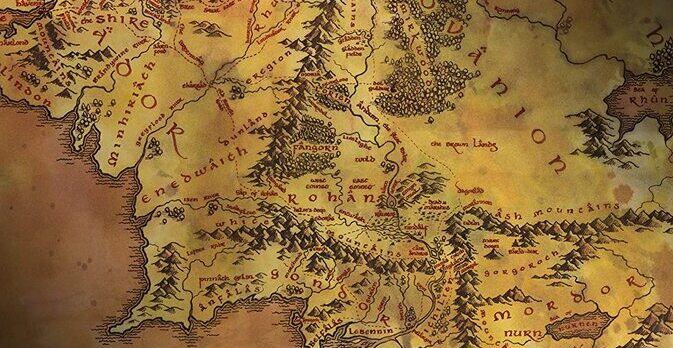
The pharaonic (and divisive) TV series “The Rings of Power” has in recent weeks rekindled the attention of the general public on the legendarium conceived by John Ronald Reuel Tolkien; attention has never completely subsided, at least since 2001, when the first title of the trilogy directed by Peter Jackson began to transpose the world of Arda and Middle Earth from the pages of books to the cinema screens. It has been much longer, however, than the universe Tolkienian exerts a recognizable influence in the musical field. In addition to the many indirect fascinations linked to fantasy imagery, which are difficult to enumerate, in various areas of pop music there have been, since the end of the 1960s, artists who explicitly drew on characters, places and events described in the works of the British writer. This article and the accompanying playlist will attempt to map out its geography.
 “The Lord of the Rings” was released in Anglo-Saxon countries between 1954 and 1955, divided into three volumes. Before then, the philologist JRR Tolkien had published another narrative work, set in the same world: “The Hobbit”, published in 1937. “The Silmarillion”, completed with the contribution of his son Christopher Tolkien and published in 1977, arrived in bookstores only after the author's death. In the meantime, the writer's works have been translated and marketed in a large number of countries: already in 1957 “The Lord of Rings” is available in Dutch, and in the following years versions were written for Swedish and Polish readers. The first Italian edition was published between 1967 and 1970, the German one between 1969 and 1970, the French one between 1972 and 1973, the Japanese one between 1972 and 1975. A long time interval, parallel to the spread of the flu Tolkienian in the musical field, which follows chronological stages clearly linked to the publication dates of the national editions of his best-known work: first of all Great Britain and the United States, then Bo Hansson's Sweden, and followed by the other European countries.
The network that connects pop music and Middle Earth unfolds across genres, but involves some strands in a more substantial way. In order not to disperse an already sufficiently complex flow into a thousand streams, here we will focus our attention on four sectors: folk, new age, progressive rock and metal. These are territories endowed with large overlaps, united not only by musical elements such as the propensity for expansion and the valorisation of instrumental interweavings, but also by two fundamental premises: the search for evocation and theescapism. The latter is intended as an escape from the daily dimension towards distant horizons, sometimes vague and mystical, but often endowed with their own complex structuring (see under worldbuilding) and surrounded by an epic/legendary dimension that combines well with historical, science fiction or fantasy narratives – such as that which characterizes “The Lord of the Rings” and the other works Tolkienian.
 The journey proposed by the playlist starts from well-known themes and names of a certain fame for fans of cinematic universe Tolkienian. The starting point is the splendid “This Wandering Day” which embellishes the fifth episode of the series broadcast on Amazon Prime: an effective exercise in Celtic style built around the famous passage “Not All Who Wander Are Lost” taken from the “Riddle of Granpasso” on “The Fellowship of the Ring”.
Following, again on acoustic sounds, are two extracts from tribute album of great value: the first is indeed a quadrilogy (“An Evening in Rivendell”/“A Night In Rivendell”/“At Dawn In Rivendell”/“Leaving Rivendell”) created between 1997 and 2003 by the Danish chamber group Tolkien Ensemble; The Fellowship project, also born in the nineties, instead moves along the lines of fantastic musicology. Incorporating ancient instruments and performer of the caliber of Jon Anderson, and making use of the collaboration of linguists and experts Tolkieniansthe collective led by Carvin Knowles attempts an experiment similar to Orff's “Carmina Burana”: reconstructing the sound of the cultures imagined by Tolkien, based on his descriptions, the many song lyrics scattered throughout his works and the possible historical developments of the music and languages of Arda. A proposal that would certainly have been appreciated by the writer, who famously gave shape to his narratives to have a credible “setting” for the artificial languages that he had been imagining for some time for elves, orcs, and dwarves.
Even before participating in the soundtrack of “The Fellowship of the Ring”, the Irish Enya, tutelary deity of the Celtic new age, had already explored Middle Earth in a song from “Shepherd Moons”, her fourth solo album. Howard Shore's theme for the first film of the 2000s trilogy is evoked by the selected song by the Italians Gian Castello, active since the 1980s in a borderland between neoprog, new age and Celtic music.
The transition to new age is accompanied by another intermediate episode, “Songs Of Quendi” by Sally Oldfield, taken from the splendid “Water Bearer” of 1978 and dedicated to elves (“quendi” actually means “elves” in quenyathe “Elvish Latin” created by Tolkien). The songs named Palantír (stage name of the German Christian Schimmöller), Gandalf (i.e. Heinz Strobl, Austrian), Joel Vandroogenbroeck, Arturo Stalteri, Shadowfax (English name of the Ombromanto steed ridden by the sorcerer Gandalf) and Marco Lo Muscio gradually lead through terrains progressive electronic, modern classical And fusion: both from the style and from the characters involved it is clear how the trail Tolkienian also highlights a broad contact with the progressive world in the new age field. Side note: although the concept album “Rings” by ex-Pierrot Lunaire Arturo Stalteri came out in 2003, the project was already in the works in the mid-1970s, and various materials from the time were collected in “Early Rings: Compositions 1974-1975”, published in 2005.
Sliding further towards prog-rock, we arrive at sound chamber music of the Swedish Isildur's Bane, a significant name of the progressive rebirth that debuted in 1981 with an album themed on “The Lord of the Rings”, “Sagan Om Ringen”. An excerpt from the follows Tolkien concept par excellence in the progressive field, also equipped with the exact same title: the 1970 debut of compatriot Bo Hansson, entirely instrumental and with graceful references easy listening. Camel, Argent and Barclay James Harvest are well-known bands on the British scene of the early Seventies, and the most prominent face of Ottonian neoprog, Marillion, take their name from a contraction of “Silmarillion” (Barclay James Harvest, moreover, released a single in 1972 under a decidedly Tolkienian: Bombadil).
Instead, they belong to the late American scene Sixties Gandalf and Smoke, whose disciplined psychedelic style can be imagined as a bridge between sunshine pop and that “stars and stripes prog” that perhaps could have been, but to tell the truth never was.
The lack of a real solution of continuity between electric folk, progressive rock and nascent hard-rock (not only in the musical sense, but also in literary inspirations) is evident in the pieces of Rush, Led Zeppelin and the now ex-Cream Jack Bruce, and ultimately also in the psychedelic reinterpretation of the Poetry of the Ring offered by the Americans Pearls Before Swine, darker and in territories similar to the Nurse With Wound List.
 Entering a fully metallic field, the dominant tones change. If in the previous songs the luminous atmospheres and references to woods, elves and positive characters prevailed, with the thickening of the sound even the quotes become darker: ogres and sorcerers corrupted by evil appear much more often in the song titles, together with terms linked to destruction, fall, end, loss, twilight. Even the names of the bands frequently refer to places associated with tragic events in the narrative Tolkienian.
The spectrum of subgenres touched upon is wide: stoners Sabbathian (Orange Goblin), death melodic (Amon Amarth), hard/Aor (Bob Catley, singer of the late-progressive Magnum), forward- (the Italians Ephel Duath)… Some threads, however, present themselves with greater consistency. In scope power, epic and above all blackthe references to Middle Earth go from tens to hundreds. It is therefore advisable to select based on the peculiarities and completeness of the product sound as for the “Tolkienian dedication” shown by the artists. In addition to the inevitable Nightwish and Blind Guardian – the latter certainly on the podium of the most devoted with theirs concept of 1998 “Nightfall In Middle-Earth” – here are the local Ainur with an emphatic prog-rock, with a metallic but never particularly heavy edge, and then the Fates Warning of the very first album, still linked to stylistic elements power/heavy more than prog-metal.
Through the Celtic references of the Irish Cruachan we enter black metal territory, and with the following piece, by the Norwegian Gorgoroth, we reach the peak of heaviness of the compilation. Gasping shrieks, blast beat and distortions lo-fi they give concreteness to the corrosive name of the band, which evokes the desolate plain to the North-East of the lands of the Dark Lord. Vark Vikernes is also Norwegian, famous for his sound environmental as well as for his unpleasant judicial events: his stage name, Burzum, is the lemma which in the dark language of the engraving on the One Ring indicates the word “darkness”.
The style of the Austrian Summoning is so steeped in the lore of Middle Earth to be sometimes described as “Tolkien metal”: as usual for their albums, their second album, “Minas Morgul”, is directly inspired by the Lord of the Rings and marks a suggestive mix between black metal and electronic dungeon synthwhich in the following decades would make dozens of proselytes. Among these, the Apulians and the same Tolkienians Emyn Muil explore its most symphonic developments in a decidedly evocative way.
The final part of the playlist marks a partial return to the folk and atmospheric tones of the first songs, but in a more restless than luminous key. The grim tribal ambient of the Swedes Za Frûmi is enriched by orcish proclamations in an obscure language, while the Spanish Narsilion and the French Ainulindalë move in a more variegated field, similar to the darkwave et al dark folk.
Forty songs are a lot, but not enough to map the hundreds if not thousands of formations that by their essence or only occasionally were inspired by JRR Tolkien's creations. Among the phenomena excluded from the discussion, the ambiguous relationship that has developed since the 1970s between culture is of interest Tolkienian and the youth circles of the Italian far right: the discussion would however have led far. Furthermore, Spotify offers almost zero coverage of formations such as the Fellowship of the Ring, Middle Lands, the Shire or the Seventh Seal.
A more structured compendium of the entire musical panorama inspired by Tolkien can be found in the “Music” section of the Tolkien Gateway portal, while a very up-to-date and comprehensive list forms the backbone of the commendable The Tolkien Music List.
Antonio Santini for SANREMO.FM
