
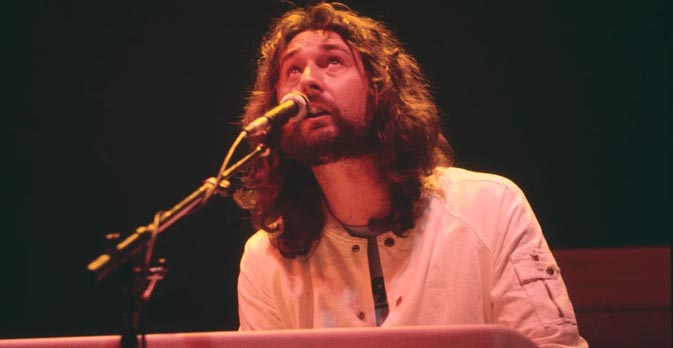
He left us like this, on tiptoe, with the usual sobriety and confidentiality. Rick Davies, founder, keyboardist, singer and creative soul of Supertramp together with Roger Hodgson, passed away on September 5th at his home on Long Island (New York), at the age of 81. He had been battling multiple myeloma for some time, which was diagnosed in 2015. Davies had been married since 1977 to Sue Davies, his life partner and, since 1984, the band's manager.
Born in Swindon, England, on 22 July 1944, a precocious musician – first as a drummer, then as a pianist, with a style influenced by jazz and blues – after some experiences with various groups, including Rick's Blues (with Gilbert O'Sullivan on drums) and The Joint, Davies decided in 1969 to found a new group thanks to the financial support of the Dutch patron Stanley August Miesegaes. It was precisely by responding to one of his adverts that Roger Hodgson introduced himself: Supertramp was born from the collaboration between the two. The contrast between Davies' baritone and harsh voice and Hodgson's ethereal and dreamy falsetto became the band's trademark, capable of fusing progressive rock and pop sensibilities with a unique and immediately recognizable sound. But beyond their vocal intertwining and the double signature on the songs, Davies and Hodgson highlighted two different musical approaches: the first, a fan of American rock and blues, preferred rusty atmospheres and more difficult scores, the second, with a folk-pop background, chiseled the brightest refrains and the most melodic ballads. All things considered, it was almost a re-edition of the Lennon-McCartney dualism.
After formidable records but still far from the limelight, such as “Crisis? What Crisis?” and “Crime Of The Century”, Supertramp exploded with “Breakfast In America” (1979), a pop-rock masterpiece that has sold 18 million copies to date. Then, however, something broke in the candid naïve harmony of the group. And when Hodgson left the company in 1983, after the release of “…Famous Last Words…”, the task of carrying forward the saga of the “tramps” fell on the shoulders of Davies alone, who retained the name and artistic leadership amidst legal disputes and conflicts that lasted until shortly before his death. Under his direction Supertramp released four more albums, the latest being “Slow Motion” (2002), and continued to perform until 2022.
But it was in the golden period of the 70s that Supertramp really left their mark. And Rick Davies' Wurlitzer electric piano became one of the sonic symbols of the decade, helping to create a bridge between cultured rock and popular music. In this playlist in his memory we have collected what, in our opinion, are the ten best songs that bear his signature. A small testimony to a great talent, too often underestimated also due to his shy and reserved approach, far from the excesses of rock. We propose it to you below, following the comments song by song.
10. Cannonball (from “Brother Where You Bound”, 1985)
The end of the Davies-Hodgson dualism sealed in this trailblazing single from the first album without the singer with the golden falsetto anymore. Despite having an 80s flavor, the piece flows on a bluesy grooves and jazzy which allows Davies to relax on the keyboards and also leave room for Helliwell's sax. There were also those who thought Davies was singing about Hodgson, with lines like “I'm washing my hands on you/ how could you be so untrue?”. However, he later claimed that the real target was a promoter who had betrayed him.
9. Bloody Well Right (from “Crime Of The Century”, 1974)
B-side of the single “Dreamer”, it carved out its space on FM radio thanks to the extended play intro of jazzy piano by Davies, which introduces Hodgson's poignant electric guitar licks and an arrangement poised between hard-rock and music hall, featuring a memorable sax solo by Helliwell. The text, in the wake of the legendary “School”, delves into how the inequalities of the British education system described in that song are reflected on the entire society.
8. Just Another Nervous Wreck (from “Breakfast In America”, 1979)
Although overshadowed by the successes of that greatest hits called “Breakfast In America”, it is a real melodic gem, which opens with the typical Supertramp-style piano licks while Davies presses on with lines like “give a damn” and “fight, while you can”, in a crescendo with an almost gospel fervor. The confirmation that the state of grace reached by Supertramp in their best seller it was also reflected in the so-called “minor” songs.
7. Another Man's Woman (from “Crisis? What Crisis?”, 1975)
Another blues-infused score, with a great shot, within one of Supertramp's most evocative and underrated works. Davies' smooth interpretation hides the mischief of the story told in the lyrics, which in the chorus refers to “your cannonball comin'”, a decade before “Cannonball” actually arrived.
6. Ain't Nobody But Me (from “Crisis? What Crisis?”, 1975)
Another tormented story between light and shadow, played by Davies, new to “Doctor Jekyll and Mister Hyde” with a theatrical and desperate tone in a sort of musical piece. With the famous line “Ain't no fish in the sea/ Gonna sigh for you”. More than a crisis…
5. Rudy (from “Crime of the Century” (1974)
One of the jewels of the album which is in all respects number 2 in Supertramp's discography. A touching meditation on loneliness warmed by Davies' luminous piano and dirty voice, but also by an almost hard-rock guitar playing (the experiment will be repeated in “Asylum”, again on “Crime Of The Century”). We propose it in the poignant live version of the historic “Paris” concert, characterized by a cinematic tension amplified by the live performance.
4. From Now On (from “Even In The Quietest Moments”, 1977)
Another feat from another underrated Supertramp album like “Even In The Quietest Moments”. A sumptuous ballad, set in smoky night-club atmospheres, which lasts for almost six and a half minutes, sealed by one of Davies' best vocal performances. A crooning throbbing and filled with desire that leads to a call-and-response enhanced by Helliwell's sinuous sax solo.
3. My Kind Of Lady (from “…Famous Last Words…”, 1982)
The most underrated, from the most underrated album. “…Famous Last Words…” pays for the fact that it arrives after a masterpiece like “Breakfast In America” and already from the cover it seems like a prophecy of misfortune: a hand is about to cut an acrobat's rope; almost an admission that the magical balance of the group is about to be broken. Already during the session of American Breakfast the first disagreements between Davies and Hodgson had emerged. And the new album fails to mask a now latent internal tension. However, a handful of classy songs remain, starting with this 1950s-style tile slow song, complete with choruses and a final sax solo. A poignant one love song in which Davies declares “You know I'll love you all the way/ When times get hard, we'll smile and sing” over a classic doo-wop arrangement that also showcases his falsetto. In the video clip Supertramp are already shown as a quartet, with Hodgson absent due to his imminent exit from the group.
2. Goodbye Stranger (from “Breakfast In America”, 1979)
One of Supetramp's most legendary songs, among the classics of the most loved LP. A sublime and enveloping passage, an indelible romantic peak of bass, falsetto voice, drums… Even better is how the wait is preordained for that absolute zenith: short and threatening riff hard guitar, diaphanous keyboard notes and then the lulling, heartbreaking piano-acoustic instrumental alcove. The way the piano sets up the chorus is something emotionally captivating. And when the keyboard renews its ardor and in that perfect fleeting celestial whistle, something exceptional happens, vainly pursued in thousands of other collections of songs. A place of captivating languor and cynicism together, after love, affliction and regret. Tenderness and visceral passion like never before, go beyond the text in the strict sense and glide away on the surface of the water. How much thrill of seduction even in the carnivalesque fantasy of the coda, to digress into a lucid madness, the excitement communicated in Hodgson's guitar solo, a magical fluid. (Fabio Russo)
1. Crime Of The Century” (from “Crime of the Century”, 1974)
The majestic title track of Supertramp's most experimental and daring album, with a nice riff piano to act as a prologue to the various sound panels, before the grand symphonic finale with a riot of keyboards and a lightning-fast sax solo. “Who are these men of lust, greed and glory?/ Rip off the masks and let's see,” sings Davies, in a song that retains a disturbing relevance even today. It is also Supertramp's possible link with British progressive rock, with its composite structure, its dramatic staging and its Broadway arrangements, culminating in a long instrumental finale. A masterpiece that best honors the memory of a great musician named Richard Davies.
Antonio Santini for SANREMO.FM
