
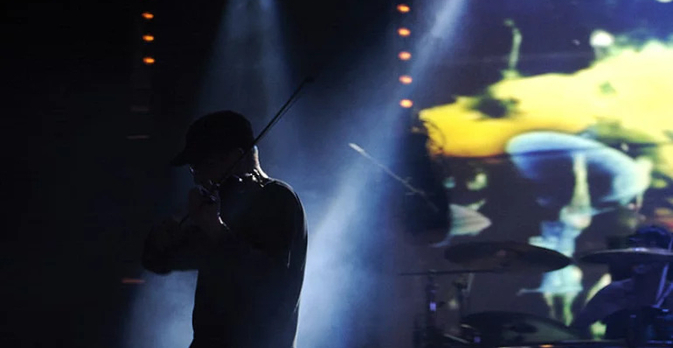
Instrumental storms. Rising tension, tormenting density, sudden clearings and moments of quiet. Shadow. Light. Pianissimo and fortissimo chasing and colliding. Many fans are used to associating sensations like this with the music of Godspeed You! Black Emperor, Mogwai, Explosions In The Sky, Mono, Sigur Rós. And to a term: “post-rock”. For some, this expression has even become synonymous with the musical style described above, a succession of highly emotional guitar surges and thinnings that others have mockingly named crescendo-core.
Another label, less widespread but even more descriptive, is soft/loud. In addition to indicating the bands mentioned above, the combination is well suited to a large group of disciples, much loved by a large fanbase but almost removed from the columns of the main newspapers dedicated to independent music. It is to the galaxy of these “other” adepts of the soft/loud that this playlist looks at: by choice, it leaves aside the tutelary deities who are well known even to the bulk of “generalist” enthusiasts and tries to delve a little deeper into a panorama that, in the past twenty years or so, has become very plural.
History of the genre (wrong)
Before starting the exploration, however, some explanations regarding the title, which tries to distance itself from the identification with post-rock, considering it misleading. The origins of the term “post-rock”, in fact, were linked to completely different musical horizons. When The Wire journalist Simon Reynolds coined the label in 1994, he meant to refer to bands far removed from sound film of the five artists mentioned at the beginning. His article (now available in the anthology “Hip-hop-rock 1995-2008”, published by Isbn) states: “Recently […] a handful of British artists, galvanized by the advances of electronic genres such as techno and hip-hop as well as by free improvisation and the avant-garde, have ventured into unexplored territories […]. The list of futurists includes Disco Inferno, Seefeel, Insides, Bark Psychosis, Main, Papa Sprain, Stereolab, Pram and Moonshake, as well as prophetic artists such as Kevin Martin (Ice/Techno Animal/God/EAR) and Mick Harris (Scorn/Lull), ex-drummer of Napalm Death”. And then he goes on to define “post-rock” as the use of rock instruments for non-rock purposes, combined with the widespread use of samplers, sequencer and interfaces midi.
It's clear that there's something out of tune. The points of contact between Reynolds' list and the one that opens our article are really scarce: of the latter, only one band is British and its music has very little to do with either “techno and hip-hop” or with assorted digital devilry. At the center of his formula, like that of most other bands, are the guitars, and their use, although extensive and strongly devoted to dynamics, certainly seems to fall within the rock canons.
Why, then, “post-rock”? To understand it, it is necessary to follow the traces of the expression in the years following Reynolds' article. Already in the nineties, a part of independent criticism appropriated the label and began to extend its field of use, including first of all American bands (especially from the post-hardcore from Louisville and Chicago: Slint, June of 44, Gastr Del Sol, Tortoise; but also Cul De Sac, Labradford) and then, retroactively, other British names: above all, the latest poignant Talk Talk albums by Mark Hollis.
At the end of the nineties, close to the release of Mogwai's first works, the term now encompasses a rather wide variety of styles, only partially linked to Reynolds' original definition. With the crystallization of a well-identified formula and the possibility for the trend to expand to a wider audience, the label is also ready for its “big leap”. As journalist Jack Chuter illustrates in his essay “Storm Static Sleep,” “what was previously an academic observation of a process in British and American music began to attract a new wave of bands, many of which took Slint's thunderous/quiet template and stretched it across landscapes of minimalist classical, drone, shoegaze.” The transition is inexorable: “Just as no post-rock listener would ever associate the word 'Mogwai' with the strange furry creatures of Spielberg's 'Gremlins', so post-rock began to make a clean sweep of its conceptual origins.” After a few years, “post-rock” is Mogwai, GY!BE, Explosions In The Sky, Sigur Rós, Mono (and, at least for us Italians, also Giardini di Mirò). The rest, just a memory or a curiosity.
“Death” and rebirth
And then? Well, that's it. For much of the independent criticism, the one that had given rise to the label and transformed it into an all-encompassing term capable of capturing the Zeitgeist of a phase in the nineties, after that handful of artists the trend loses interest. It's not that bands don't form anymore – on the contrary! dozens are born every year – but the tide has changed. “Fearless. – The Making Of Post-Rock”, an extensive 2017 text by Jeanette Leech, stops precisely at the names of those key formations. “Post rock and beyond”, by Eddy Cilia and Stefano Isidoro Bianchi, doesn't even get there (in its defense, it should be noted that the year of release is 1999).
The trend is increasingly followed and increasingly recognisable: long instrumental pieces with imaginative and interminable titles, highly evocative and even “landscape-like” music in its dynamism, covers oriented towards a common aesthetic of natural elegance and desolation. But to some of the music press these formulas already appear trite, “derivative”. This expression, particularly subtle because it is always presented as neutral, is among the favorite weapons of alternative criticism when it comes to declassifying entire scenes as mere historical accidents. In a “derivative” genre, adherence to a stereotype is more important than artistic personality and variety almost disappears, replaced by a flattening of the canon. At least that's the story.
An alternative vision is: variety and personality, completely evident to fans of the genre, leave the value radar of all-logic critics obsessed with “innovation” and make them believe that it is better to change the scene. The scheme, obviously, applies only to those areas that are aesthetically “peripheral” enough with respect to the indie/alternative ideology to not in themselves deserve irreducible attention: “derivatives” can be the “long tail” of post-rock or the current neoprog scenes; certainly not yet another post-punk revival or the very dignified but musically far from surprising return of some sacred monster.
Just as the soft/loud it leaves the field of vision of independent culture, however, it comes into contact with other communities of listeners. In addition to the fans of origin alternatives who, thanks to the possibilities offered by forums and other digital platforms, take the opportunity to distance themselves from the gatekeeping of industry critics, the new “son” of post-rock also intrigues young progressive rock lovers, post-hardcore enthusiasts and screamolovers of metal and its most expansive and extreme fringes. More and more second (or perhaps third?) generation bands are born from the explicit aim of playing “post-rock” in the manner of GY!BE and its associates, but the gaze of the new musicians is aimed above all – and not by chance – at the formula of the Texans Explosions In The Sky. While the filthy Mogwai referred to Slint, My Bloody Valentine and God Machine and the Japanese Mono proposed to “extend to infinity” the codas of U2 songs, Explosions In The Sky had in mind the sound enveloping of the Cure and the guitar twists of Metallica. And, needless to say, i growing up overwhelming than Mogwai themselves, pioneers of that emotional field.
While the progenitors of soft/loud proudly claimed the alleged “punk” affiliation of their music, the new generations are much more inclined to recognize the similarities with contemporary progressive and the decidedly adjacent trend of post-metal. Sites and magazines specializing in progressive rock now regularly cover the releases soft/loud and the English festival ArcTanGent, hosted in Somerset since 2013, was born as a stage dedicated specifically to the genre but soon expanded to also include math-rock, post-prog, post-metal, djent and (surprisingly, but not too much) synthwave.
Listening guide
The proposed selection of songs testifies to this reorientation of expressive references, which began around the early 2000s and is still ongoing today. The playlist opens with artists quite clearly attributable to the GY!BE orbit, gradually veers towards Explosions In The Sky and Mogwai, and gradually abandons its progenitors to pursue more heterogeneous stylistic directions. Already around the fifth piece, electronic and nu jazz elements make their way (the Australians Tangents, one of the most recent inclusions), while in the following tracks the melodic and muscular component is increasing (at its peak in the Dubliners God Is An Astronaut). After a passage through almost Celtic themes with the Northern Irish band And So I Watch You From Afar (among the most respected names on the scene at the moment), the energetic tones lead into decidedly electronic lands, well represented by the new trend of the beloved 65daysofstatic and by the progressive electronic romanticism of our local Port-Royal.
A sweet transition between indetronics And downtempo (Arms and Sleepers, Youth Pictures Of Florence Henderson) leads towards perhaps the most surprising breakthrough: songs with vocals! A wide range of formations, from the French Mermonte to the Japanese Jyocho passing through a range of American artists, combine climaxes, illuminations and changes of atmosphere typical of the genre with structures closer to pop, borrowing elements now from mathnow fromemoand sometimes by the new chorality that spread across the indie-pop scene around the 2000s.
The results are, more often than not, among the most blatantly progressive of the genre. The last, broad subgenre explored by the compilation is that of the hardest sounds, similar to the so-called post-metal and the more cinematic side of screamo. We chose to avoid key names such as Isis, Pelican, Cult of Luna, which may be good for future insights ad hocand instead keep the focus on projects borderline like Caspian, Russian Circles or Red Sparowes, to which some ideas are added sui generis like the Korean Jambinai or the Swedish Suffocate For Fuck Sake, who with their obvious references to Godspeed You! Black Emperor somehow close the circle of mixtapes.
United Kingdom, Japan, United States, France, Italy, Ireland, Korea, Sweden; progressive ed emofolk and electronic, math and pop, metal and minimalism – despite those who simplistically brand the genre as copy of copythe richness of the field soft/loud it is notable, both stylistically and geographically, and now includes fanbase diversified. Furthermore, the assortment could have been further expanded: complex scenes have developed in Poland, China and Thailand, and regarding the latter, a short film entitled “Post Rock A Documentary Film”, dating back to 2012, can also be found on YouTube. But the playlist was already long. Three hours and twenty, thirty-two songs. Torrential and also an exhausting thread. In full harmony with the topic covered.
Antonio Santini for SANREMO.FM
