The history of musical genres and categories is very rarely linear. The events of pop are full of bizarre terms born in reference to specific phenomena, then extended to entire strands, and often finally entered into the vocabulary of artists-public-critics with a meaning completely different from the original one. Typically, the first steps of this tortuous path take place “live” with respect to the musical events described. However, there are also retroactive labels, and the case of “Zolo” is certainly among the most peculiar. You could define it as the genre — sorry, the non-genre — weirder than pop.
 A first peculiarity is that the baptismal certificate is perfectly known. On June 25, 1995, on college radio KPSU 1450 AM in Portland, Oregon, at 5pm the show “The Zany Zolo Muzik Hour” debuted under the host of Terry Sharkie. For an hour every Thursday, it aired a mix of some of the most eccentric artists of the previous twenty-five years: Sparks and Xtc, Todd Rundgren and Gentle Giant, the Residents and Devo, Tuxedomoon, They Might Be Giants, Lene Lovich and a vast array of other names, lesser known or better known. Nothing particularly different from the eclectic selection of any music radio aimed at enthusiasts, one might say, but what was surprising about the event was not its breadth of spectrum: on the contrary, it was the bizarre coherence of its choices. Weaving between opposing styles and distinct musical eras, Terry Sharkie led the way in discovering an oblique but recognizable territory, a trend prolonged which, hidden in plain sight, crossed the peripheries of multiple scenes of the previous decades, and also some points placed on the map in a very central position.
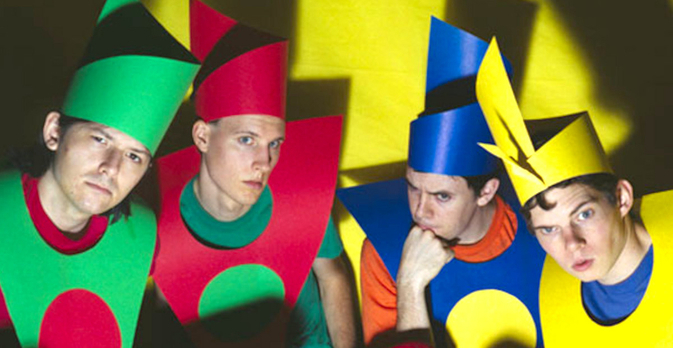
The definition of the grouping, which Sharkie wrote down in 1997 in the webpage “Zolo Synthesis”, identifies Zolo as “assimilation of bouncy guitars (boingy), bobbing keyboards (wobbly), percussion a polka dotssobbing falsettos, beat jolting (jerky) in staccato, and lopsided rhythms”. An “aural expression of the abstract, asymmetrical and colorful imagery that accompanies it, and which existed in scattered forms for many years before being codified through a name”. Speaking of the name, this would come from a series of colorful construction games put on the market in the 1980s (or so the webmaster of the Zolophile page, which is signed col nickname Tyrant Tula), whose appearance is easily associated in spirit with the bizarre aesthetics of “The Zany Zolo Muzik Hour”.
Sharkie's show, which in subsequent years changed its name to “Sforzando Cappricci Extravaganza” (yesor so it seems), conquers enough fans not to disappear into oblivion and also gives rise to further web and radio gems — including the “Newave Zolocoaster” show for the college radio KVRX of Austin, Texas, which aired between 1998 and 2002. No longer the prerogative of a single individual, the term Zolo is associated by followers with a hodgepodge of sounds seventies and eighties which contemplate many styles classic rock like songs freakdazed progressive, rock with movements campas well as post-punk oddities that are difficult to catalogue: zigzagging new wave, minimal synth dadaist and balenga, forward-prog, proto-industrial…
Sharkie will once again illuminate the common thread: “There are two prevalent methods in contemporary musical styles. At the center is the well-optimized approach that characterizes all music destined for mass acceptance […]. Alongside this there is a deconstructivist approach, which can encompass anything, from improvisation to brutism to ambient through industrialdarkness, pranks and all other forms of music outside the box. The missing link in the current musical world is an approach artywhich works on lifting, decoration, re-upholstering, as opposed to minimization and mutilation”.
To do from trait d'union between the galaxy of styles and its retrospective demiurge there is also a predilection for a looks eccentric and over the top, traceable both in the geometric tricks of the New Zealanders Split Enz and in the exuberant hair of the B-52's or in the clownish attitudes of the Cardiacs. Recalls Chad Allen, creator of “Newave Zolocoaster” and the Zoloscope blog: “One day I went to the KPSU studios to meet Terry in person. He was wrapping up the show and he was dressed in a suit. casual of Zolo clothing: pointed shoes, cuffed jeans and a loose t-shirt with a cut-out neckline and sleeves. His eyebrows were shaped into sharp quills and his haircut was sculpted, high and abstract.”
https://www.youtube.com/watch?v=NVjSycDJatc
Terry Sharkie, aka In his numerous projects on the web, Zaragon has for some time put his devotion to the Zolo genre into the background, dedicating himself to building the remarkable online archive JazzRockSoul.com, to a YouTube channel of musical comments and listening, and to maintaining an impressive RateYourMusic profile. However, the baton of the transmission of the Zolo verb has been taken up by new followers. Among these, the Oblong Boys of the aforementioned Chad Allen are probably the first artists to have defined themselves according to the bizarre non-genre, but today Bandcamp has hundreds of releases classified by the artists themselves according to this style. Furthermore, for a few years now, “Zolo” has been a tag on RateYourMusic and numerous themed lists have appeared on the platform (the most complete are those created by the user mkrasna). Indeed, a term from the rich and idiosyncratic vocabulary introduced by Terry Sharkie, “Zonk” (“Zolo + punk”), was the inspiration for a hamburger shop – which explains the origin and meaning of the expression on a specific page of its website.
Antics aside (assuming that, being the raison d'être of the trend, they can really be removed from the discussion), it can be said that today the niche of devotees is wider than ever, and the category has revealed its surprising usefulness in contextualising musical experiences that have always been seen as borderline between multiple territories, often not even very adjacent.
The playlist opposite attempts the impossible task of creating synthesis in such a centrifugal galaxy. Taking inspiration above all from Sharkie's 1997 selection, and integrating it with lineups added by internet fans in subsequent years, he tries to create a historical overview that goes from the depths of the Seventies to the present day. The lack of key albums by Cardiacs, Fred Frith, Stump and others on streaming services forced some significant sacrifices, and at the end we took the license to include a certain number of artists whose “Zolo-ity” is not yet ascertained by the community of fans – but who nevertheless seem emblematic of how the genre also connects to current trends.
The hope is that listening will lead to the discovery of new figures (maybe many are already there on Yellow Magic Orchestra and Curved Air, but does everyone know Family Fodder, Fibonaccis and Nimal?) or to a new possible perspective on names well known to pop fans. It is probable that few have dreamed, until now, of associating Stranglers and Godley & Creme, but among the many magics of the label, there is also that of behaving like one of those trick visuals that do not reveal themselves until the moment in which – bang! – you see them and suddenly you can't help but notice.
Antonio Santini for SANREMO.FM