
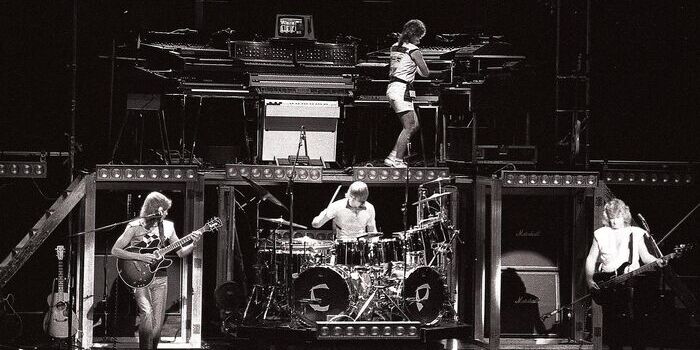
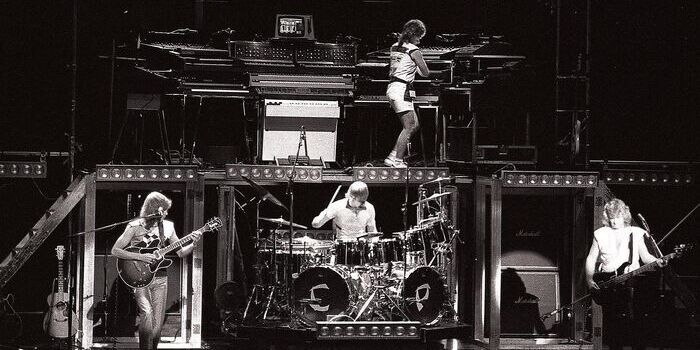
Okay, I might have lied. The “Miami Vice” theme never goes out of style. And the combo vaporwave+synthwave it may have made the wildest synthetic pomposities of the 1980s less repulsive than they were some time ago. But better this way. In the late careers of rock bigs seventies and between them one-hit wonder never transmitted across the ocean, there are dazzling pearls that tell of an era in which stadium rock he had no problem taking possession of the most futuristic cars on the market, a flirt with dance, new wave and power pop and to push the pedal to the max grandeur.
You're bound to know some of the protagonists. Yes, reborn on American soil under the protection of Trevor Horn and the South African Trevor Rabin, and then their lucky spin off Asia and Anderson, Bruford, Wakeman, Howe. Genesis, at the heart of their synthetic abstractionism, was Banks-Collins-Rutherford. Rush, Hall & Oates, Starship (it was Jefferson Starship, which would later mean Jefferson Airplane), Chicago – with a lot of water under the bridge separating them from the brass rock of “I'm A Man”.
There are other well-known names, but they are no longer human. Tools, technologies whose use/abuse would have exposed the sound of the AOR in the 1980s to criticisms whose echoes have not died down even today. Expressionless, tacky, “plastic”: this is how the wedding was labeled hi-tech of new synthesizers, drum machines and study expedients that ended up identifying in the collective imagination not only the music of the artists in question, but that of the entire decade. Among the many possible references, at least four are indispensable: the Yamaha DX-7 digital synthesizer, the first to open up the possibilities of frequency modulation (or Fm synthesis) and among the very first to present a Midi interface; the Simmons electronic drums; there drum machines LinnDrum — with sampled sounds that made it noticeably more dynamic than its rival Roland 808 and 909. And then the trick of the Eighties tricks, that gated reverb developed by Phil Collins in cahoots with Steve Lillywhite and Hugh Padgham, during the sessions for Peter Gabriel's “Intruder”.
But a genre doesn't live on just big numbers, and more than many others thehi tech Aor it is defined by the dozens (hundreds?) of less disruptively successful bands who, however, for the fans (yes, there are some!) have been able to represent the essence of the genre with their style. There are bands like the Canadians FM and Saga, born at the end of the prog/ epicpump and capable of masterfully adapting to the new synthetic verb, and others born a few years later, but happy to recover the pomp and kaleidoscopicity of the progressive that was (It Bites, Toy Matinee). A weight current combines the most progressive slope with the component heavywhile still keeping pop immediacy and sparkle at the center sound synthetic: Simon Chase, Aviator, Shooting Star are some examples, but the two most respected names are lo one-man-band Jeff Cannata and the British Magnum, a link between progressive rock and epic metal. All of which confirms that the legacy of progressive rock in the 1980s was not only taken up by Marillion and post-punk fugitives like the Chameleons.
The expression hi tech Aor is then associated with a myriad of lighter projects, sometimes with a decidedly synth-pop feel (see the famous “Sunglasses At Night”) and in other cases very close to the glories new romantic by Duran Duran and Spandau Ballet (Device, Nik Kershaw – the latter inclusion admittedly a bit borderline).
The proposed selection is unorthodox, and deliberately unbalanced on elements of continuity with the sound symphony of the seventies. The inclusion of some less paradigmatic artists is intended as a way to enhance the variety of the genre, as well as to suggest hypothetical connections with other areas. The curious reader has the task of launching into the explorations of greatest interest to him!
The post Aor Hi-tech appeared first on Onda Rock.
Antonio Santini for SANREMO.FM
