
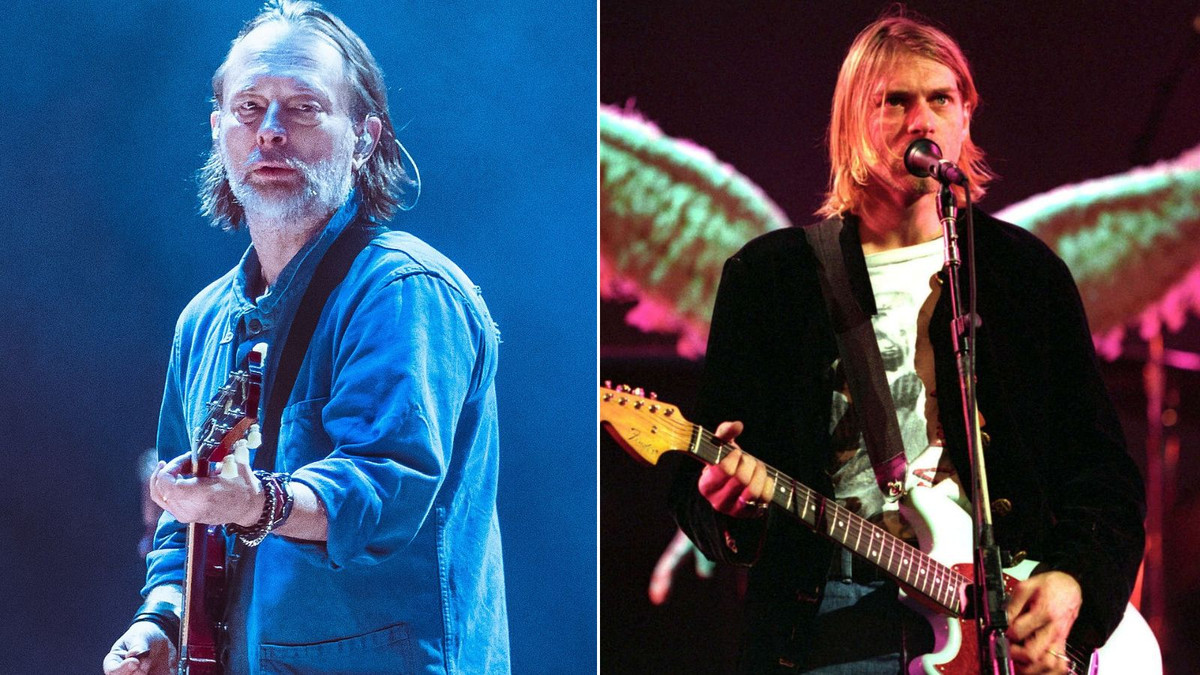
Thom Yorke said he immediately knew something was changing when he heard Nirvana's “Nevermind” for the first time. The frontman of Radiohead, speaking on BBC 6 Music after receiving the Academy Fellowship Award at the Ivor Novello Awards, recalled the almost dazzling impact that the album released in 1991 by Kurt Cobain and his companions had on him.
“I remember hearing 'Nevermind' for the first time and thinking, 'Okay, here we go,'” Yorke explained, describing that moment as one of those rare jolts that could redefine the musical landscape. For the British singer, the arrival of Nirvana represented a generational watershed, an event capable of suddenly changing the way of perceiving rock music and what it could become.
Yorke underlined how such experiences are increasingly rare in an industry that tends to look above all to the past instead of investing in new artists. According to him, the public should still be able to experience that sensation of surprise and disruption that accompanied Nirvana's explosion in the early nineties. “In the real world, people need to feel that every couple of years an artist comes along that makes you say, 'Damn!'” he added. “It still happens every now and then. That's what I'm talking about.”
During the interview, the Radiohead leader also criticized the way in which large investors and billionaires in the technology sector are purchasing historical music catalogs and turning them into collectibles, without however concretely supporting new generations of musicians. For Yorke, relatively modest investments would be enough to allow emerging artists to grow, experiment and even make mistakes: “The truth is that you only learn through mistakes. Today, however, all it takes is one mistake and you're done for.”
Speaking of the relationship between Radiohead and Nirvana, some time ago, in an interview with Daniel Sarkissian, Paul Kolderie, the producer of “OK Computer”, hypothesized that Yorke and his companions' aversion to “Creep” had been greatly exaggerated, comparing Thom's attitude with that of Cobain towards his own works. “Maybe they don't like it when people scream at concerts, but they don't hate that song,” he explained, “That song, thirty years after its release, is still an important part of their catalog and it's one of the reasons they got a big publishing deal… They don't hate that song. They don't disown it. And they don't disown the money that came with it.”
Sarkissian and Kolderie then compared Cobain and Yorke's alleged aversion to their own songs, both cases debunked by the testimonies of their collaborators. The producer calls it “exactly the same thing” and claims that Yorke took pride in his songwriting. “You have to be proud to have an impact like that,” he says, “It's not easy to do. 'Creep' has more plays on Spotify than 'Stairway To Heaven'. Two hundred million more.” More than the music itself, therefore, it was probably the weight of the success that was indigestible. Yet, it was that very element that allowed them to continue making the music they loved.
Daniel D`Amico for SANREMO.FM