
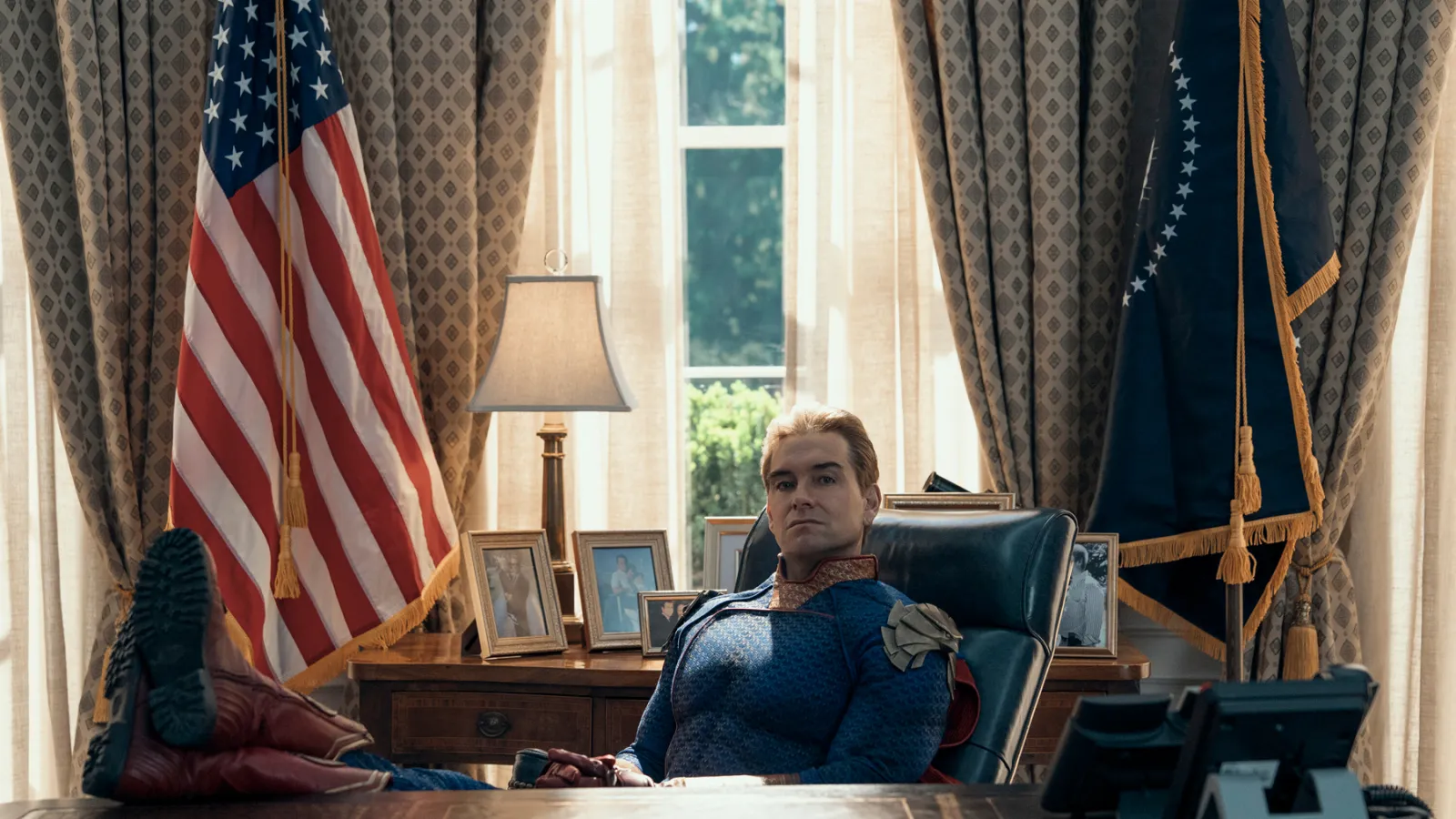
The Boys showrunner Eric Kripke told Rolling Stone in 2024 that he had “an ending in mind” for the series, and he didn’t mind hinting that for all of the show’s grotesqueries, it wouldn’t be a particularly dark conclusion. “I want to live in a moral universe,” he said, “where when you choose love, family, and mercy, good things happen to you.”
That series finale is streaming now on Amazon Prime Video, and as promised, at least some of the show’s heroes were able to scrub off five seasons’ worth of accumulated blood spatter and head towards a happy ending. As a whole, the show’s final season continued its unnerving knack for capturing the surreal nature of life in the 21st-century United States: Its most preposterous-seeming plot line, in which Antony Starr‘s Homelander literally declares himself God, ended up echoing our real president’s I-am-Jesus Truth Social post.
Kripke jumped on a Zoom with Rolling Stone to talk about the creative process, the final battle, online grumbling from fans, his future with The Boys, and more. (Many spoilers follow.)
You haven’t made it a secret that writing a final season and a final episode is stressful. How long have you had a sense of this specific ending? How much did it evolve?
About the middle of Season Three, we had enough ideas lined up that we were like, OK, I think I understand not necessarily the ending, but where we want every character to end up. Meaning, who lives, who dies. The ones who live, where do they end up? We had that to a certain extent. And the way it evolved was just figuring out, how do we get to those points? The Boys, we’ve always said it’s character first, and we’ve always begun by mapping out where the characters need to go emotionally. Our feeling was, it’s our final season. We have 15 characters that we have to land emotionally. That’s gonna be our focus.
On a practical story level, did you essentially introduce the concept of Soldier Boy’s ability to remove superpowers with an energy blast as your ace in the hole? Because you also had a Supe-killing virus that you never used.
We knew very early on that was gonna be a really useful tool. In our minds the virus was more representing, “Can you really go scorched Earth and destroy everything on the planet in exchange for accomplishing your goal?” ’Cause I think Sage was right. There would be a very messy slaughter of a lot of people if that virus were to be released. So you can’t actually release it. The de-powering blast was something that was in our pocket heading into the season.
We spent about six weeks in the writers room figuring out what the season’s gonna be. And [we thought] it would be delightful to de-power him even for a little bit and see what an absolute pussy Homelander really is without his powers. Once we knew we were going there, we knew [it was] with Kimiko, who makes sense because she’s regenerative — especially coming off of Frenchie’s death. But if you go back, in Episode Four, Butcher is watching Soldier Boy’s Russian video. In Episode Five, he’s wheeling all this machinery into the room, saying he and Frenchie are working on something. We were dropping the breadcrumbs all along to build up to that moment.
It’s Kimiko’s blast that takes away Homelander’s powers. Was there ever a point where you thought the blast could have come from Soldier Boy himself?
No. I think we owe the audience to have the Boys bring down Homelander and not overthink it. Not say, “I know you’re expecting the Boys to beat Homelander after tuning in faithfully for seven years, but we’re not gonna give it to you. We’re gonna give it to the Gen V kids or Soldier Boy or anything.” To me it was always, no, the Boys have to do it. And it has to be Butcher at the very end. It has to be.
What were the emotions in the room shooting both the de-powered scene and the death scene? What was Antony Starr like in those moments?
Emotional and melancholy and bittersweet. I was there, and I’m not always there for that kind of moment. I think it was just really realizing that it’s over. The death-of-Homelander scene really drives home that this is over. And I give Ant a lot of credit, because after being this sociopathic bully for so long, I’m like, “All right, now in this scene, you’re the world’s biggest pussy.” Because that’s what happens with all autocrats who have their power taken away. So goes Saddam Hussein when you pull him out of the spider hole. It’s time for you to beg for your life. And he just attacked it with relish.
I know Antony takes this character very seriously. He had no hesitation about going as far as having him offer oral sex to save himself and all that?
I reached out to him before the script came out, and I said, “Heads up, ’cause I know you have a lot of strong feelings about how powerful the character is. He is not powerful in his death. He goes out in the most pathetic way possible.” And he was like, “Of course. He has to. This is the end. He has to get a comeuppance that befits the horror that he’s been inflicting for the last seven years.” So he totally understood it. And as a matter of fact, he added the line “I’ll eat your shit on live TV.” [Laughs.] ’Cause I think he wanted to really dig into what a mess Homelander was. He was a great partner for all of it.
What was he Ant like when that scene was over and he was walking off set?
Honestly, it was just hugs. The emotion of the family overtakes whatever is happening in that particular scene. As we were shooting it, they were starting to tear down the boardroom in the next stage. It’s all going away. And this summer camp we’ve been able to keep going for so long — it’s like everyone is splitting up to the wind. It was a lot of the cast just hugging each other and realizing that this very finite experience is over.
Was there a practical effect with his head split open? Was he walking around with that?
The open wound is a practical effect by our brilliant special-effects makeup artist, Zane [Knisely]. He’s wearing basically a green cap with a wound on the side. And then Stephan Fleet and our VFX geniuses made it into negative space and brain and all the stuff that you couldn’t do without [actually] murdering him, which I wasn’t down to do.
So you’re hugging Ant with his gross, weird head.
Yeah. With his gross, weird head and his brain. But that’s life on The Boys, man. We’re all very used to the actors looking as horrific as possible as we’re all sitting by craft service sipping coffee and chatting.
A writer on Breaking Bad told you that a secret to their final season was keeping a list of dangling plot threads. Did you follow that advice?
Don’t get me wrong. I don’t claim to hold Breaking Bad‘s water. But the technique of writing every loose end up on a board and using it as an idea source was really useful. You can see what characters are out there, what storylines do we still need to talk about, and just making sure that we land as many things as we can.
Do you feel like you tied up as many of the loose ends as you wanted to? That’s one goal, and the other goal is to make a satisfying finale. It can’t be the only goal.
I wanted to land the characters. That was my thing. We always started and ended with the characters. And I wanted them all to have satisfying journeys and satisfying endpoints and payoffs. That was my main goal, and I think by and large we did that. Obviously, the online discourse has been a bit of a hurricane and a bummer to read. And I’ll admit that I had my spin-out moments. But Season Five is the biggest season yet, and 39 days in we have 57 million viewers. And you relearn the same lesson you’ve learned a million times, which is the online world is not the actual world. It’s so easy to feel like, “Oh, my God, that’s everything.” But it’s not. It’s a fraction of a single percentage point. And God love them, they can have their opinions, but it’s been a calming process to know that it is not, in fact, the majority opinion.
Some of the most vocal online fans seem to have really misunderstood the “It’s what Clara would have wanted” line — Soldier Boy’s reference to a character who was a full-on Nazi. They seem to think the viewer was supposed to sympathize with Soldier Boy and Clara in that moment, which wasn’t at all what you were trying to do.
No, of course not. Clara’s goal was to create an Aryan super-soldier. And Soldier Boy is misguided in his love for her. He’s imperfect in his love for her. He’s bad at picking partners. And she’s a Nazi. [It’s as if] Captain America was in bed with a Nazi, and that’s the point.
So this woman that he still holds a candle for would have wanted this Aryan super-soldier of infinite power, and she used to think it was gonna be Soldier Boy. But he couldn’t be that thing for her, but maybe he can still give her the thing that she wants.
For whatever reason, there are definitely people that the show is not working for this season. Whether it be pacing, whether it be lack of giant fight scenes — I read all the comments obsessively, one might say. To an almost unhealthy degree, one might say. But all I can say is I set out to tell a particular angle on this story. I did what we do every season, which is try to focus on the Boys and try to make it a world that’s recognizable to the one we live in. I really wasn’t interested in a post-apocalyptic world. That just wasn’t ever gonna be in the cards. It was always gonna be a fun-house-mirror reflection of the world we’re in right now, and its slide towards fascism. And I don’t regret it. I’m happy with how it turned out. And luckily the majority of the audience agrees, and that was a very comforting piece of information.
The lines that [former TV-writer character] the Worm said in the first episode turned out to be way more prophetic than I had ever expected. I thought, honestly, it was just an in-joke and a self-aware joke: “Try making everyone happy. You can’t do it. Finales are the worst.” Those lines turned out to be, at least in the online world, very true.
You could never have predicted the sort of religious turn that has taken place in and around the actual White House, except you did.
Some of that stuff has been existing for a while. The Democratic Church of America [on the show] was something that has been in the atmosphere. There’s this movement, the New Apostolic Reformation, and there’s been books about it, and we were looking at it two years ago. It was very much about how America is a Christian nation, and Trump is going to lead us into a new golden age of Christianity. So that’s been floating around for a while. Now, did I expect that Trump was gonna release an image of himself as Jesus and have a bunch of evangelicals pray in front of a golden statue? I did not. But the target this season was a target that was out there, and the timing ends up being uncanny. That’s been the unsettling bummer, frankly. The timing is always so on point.
It does seem like one of the hopeful messages is that these figures have an inherent hubris, and when they take it to a certain point, it will take them down. It’s strongly suggested that the Homelander-is-God thing wasn’t gonna go over with the public.
Every strongman eventually goes too far. And the methodology is generally the same, in that they start saying really crazy shit. The people around them start to be really aware that it’s crazy but are too scared to do anything about it. So they let him believe — they stop telling him the truth, and they only start telling him what he wants to hear, so he’s even more and more insulated. And then he presents it out to the world, and the world’s like, “That’s fucking crazy. You’re crazy.” And then the fever breaks. That has happened again and again. Maybe it’s wishful thinking that it happens again out in the world, but at least we wanted it to happen to Homelander.
You foreshadowed Frenchie’s death and the parting of Kimiko and Frenchie by basically making it clear that even if they survived, they weren’t really meant to be together anyway.
I think had he survived, they probably would have at least tried to make it work. And who knows whether they’d have succeeded or not. But for us, that was just interesting — we’ve been playing four seasons of will-they-or-won’t-they, and all they’ve ever done is talk about their past and overcoming their past. So now that they were both in a position where they had finally overcome it and were actually turning toward the future, just realizing they weren’t on the same page about their future was interesting to us. They’ve never had a single conversation about kids or how they want their future to look.
The past seasons have had different thematic concerns. Last season was a lot about mortality and death. This season, at least for our characters, it was, how do you view the future? Once this thing is over, where do you see yourself? And do you think you’re gonna survive? If you do survive, what world do you think you are gonna inhabit? Do you think a happy ending is possible? Especially when things are as dark as they are. So every character reckons with what they think the future is gonna be rather than looking backwards, which they’ve done in previous seasons.
We know that the upcoming show The Boys: Mexico, which is planned, takes place after these events. So the universe will continue forward, not just backward with the prequel Vought Rising. What are your thoughts about other shows set in the present tense of this universe, and to what extent will you be involved? Are are you ready to move on to other stories and other universes?
I am excited to stretch my muscles on a couple other universes. But I’m also gonna remain to oversee stuff that’s coming out through this VCU [Vought Cinematic Universe]. Quality control, be an advisor. My whole thing is I don’t wanna be the day-to-day showrunner, because I made my passion project; I made The Boys. But Vought Rising is Paul Grellong’s passion project. And I never want these things to feel like they’re widgets. Each one needs to be idiosyncratic and weird and unique to itself and to be somebody’s passion. Just the way that Gen V is completely different from The Boys, which is gonna be completely different from Vought Rising — though they share a certain DNA and tone, they have very different thematic concerns and very different types of characters.
It’s still a super-fun world, and I think the point we were trying to make at the end is nothing is just perfect and happily ever after. Now you have all these loose Supes running around that Vought isn’t taking responsibility for anymore. And there’s problems to solve. There’s always gonna be problems to solve. If you pull your loved ones tight and take care of each other, you can have a happy ending.
There’s a moment in the finale with a tech-billionaire character who certainly doesn’t resemble any particular tech billionaire in the real world. Any murmurings from higher-ups about that moment?
Not at all. Nothing but laughter and enjoyment. And I don’t know what conversations happen up at the higher levels. All I can tell you is they let me do it. Even if I’m just a court jester, they haven’t chopped off my head, and I’m grateful for that.
Hughie and Starlight — these potentially corrupting, really dark events have happened to them, and yet you ended on a moment where they’re all right. They’re gonna have a kid. They start an electronics store. Did you have any doubt that you wanted them to have their happy ending?
No, I had no doubt. They were always going to. And having a child is just such an inherently hopeful act. In Season Four, Annie had an abortion for many complicated reasons, but one of them being she just didn’t have a positive, optimistic view of where the world was going. And so now this is meant to be a payoff to that — she wasn’t ready then, and now she’s ready, and she has hope for the future. But no, they were always gonna have an imperfect ending. She’s throwing up and peeing in her pants and fighting with her mom. But they’re gonna pull together and make it work as a family.
You never made it sound like this was gonna be a series that ends with “nihilism is correct and there’s no hope and the bad guys win.”
No. I think the message that comes across, I’m hoping, is that there is hope if you keep trying every time you’re knocked down, and it’s not gonna come without terrible sacrifice, and it’s never gonna be perfect. We didn’t wanna leave the world in this perfect place. There’s problems, and you’re gonna have to deal with them. But you can find your own salvation by focusing on the people you love and taking care of each other. And hopefully that’s the message at the very end of things.
Daniel D`Amico for SANREMO.FM