
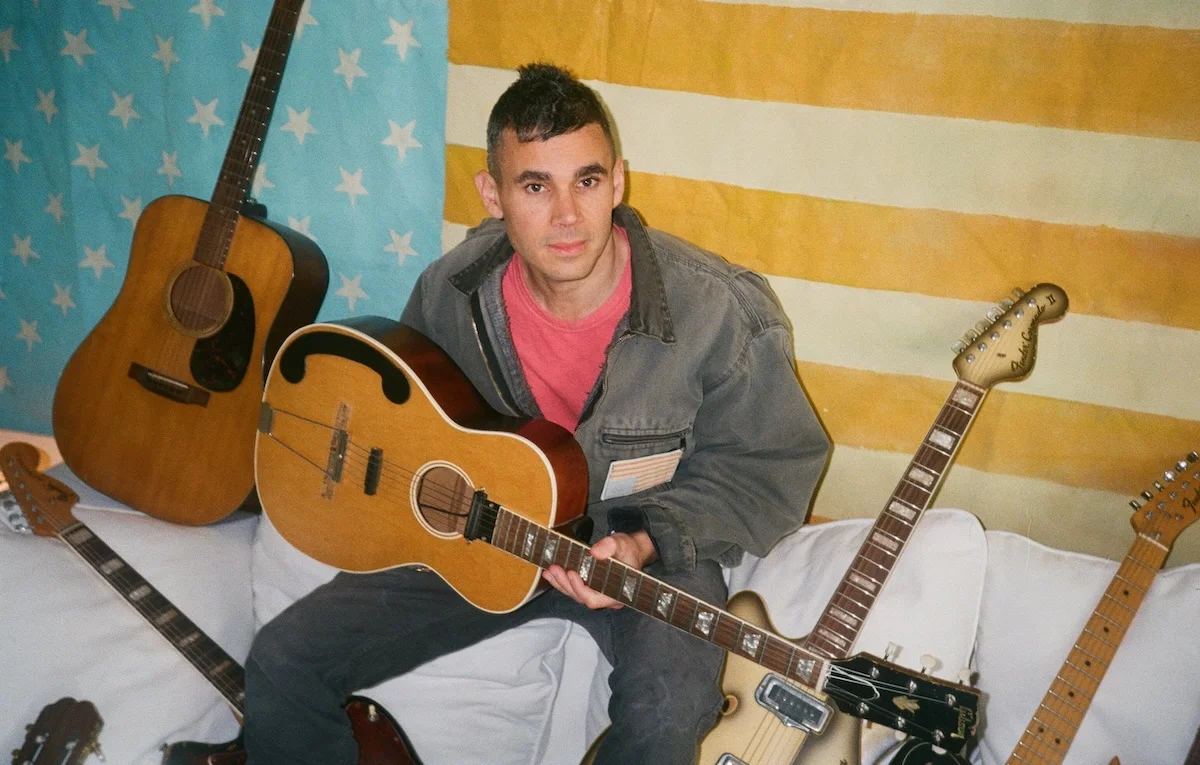
Since he founded Vampire Weekend about twenty years ago and produced their first three albums, Rostam Batmanglij has carved out a unique role for himself in pop: refined author, visionary producer, figure capable of moving between different worlds without ever completely losing the cultured and sophisticated imprint of the band of origin. Then, in the 1910s, pop and R&B became more popular arty and indie has progressively approached the mainstream, one of the architects of this change was him, contributing to records now considered contemporary classics such as Blonde by Frank Ocean, A Seat at the Table by Solange, Women in Music Pt. III of Haim.
In a piece by Rostam you can hear contemporary hip hop, but also chamber music and even sounds linked to his Iranian origins, all perfectly in step with what is happening at that given moment on the most advanced frontier of American music. In another era such a trajectory would have seemed absurd, like REM's Peter Buck later Fables of the Reconstruction had decided to produce Whitney Houston instead of the Feelies. In this era in which the boundaries between genres have now dissolved, Rostam's path appears natural, and always impressive.
In his solo albums, Rostam has developed a form of bedroom pop that is ambitious and difficult to categorise; it is dreamy music, in some ways baroque and at the same time airy, with lyrics in which he seems to touch on intuitions and revelations without ever fully grasping them. The third album American Stories he is both ambitious and humane, warm and approachable. To understand Rostam's level of musical knowledge, just listen to the piece that opens it and is titled Like a Spark: it's as if Astral Weeks had been produced in a parallel dimension where Van Morrison is influenced by Middle Eastern music in the same way that George Harrison was influenced by Indian music. Rostam plays piano, mandolin, celesta, Minimoog, Mellotron and other instruments before giving the finale to a solo on saz, a traditional Turkish stringed instrument.
Back of a Truck instead it is in the area of brighter Californian folk-rock, with beautiful snare hits that seem to come from an 80s Cameo record, while sitar and steel guitar enter the breakdown pushing the melody towards a kind of psychedelic line dance. There's also some country in the beautiful one Different Lightwhile in Hardy the strings light up like disco synths over a turbulent beat, with Clairo guest on vocals.
All nine tracks of American Stories they are full of sonic details, melodic insights, little embellishments that capture attention. But we're not talking about the typical case of the talented producer who uses the record to show how good he is in the studio. In the second half the songs become less flashy and more reflective and thoughts on middle age and more universal considerations are intertwined in the lyrics. “The road to death / is the one we have all taken,” Rostam sings in The Road to Deatha ballad whose resigned look at mortality recalls Bob Dylan and Leonard Cohen. To Feel No Waywith its soft and melancholy pace like a cool jazz ballad, follows the musician as he wanders alone through New York and then finds himself sitting at a table on Orchard Street, savoring the strange freedom that solitude gives. Forgive Is to Know instead it starts from a car trip through New England full of emotions and, along the way, slowly opens up, accumulating beauty and awareness.
There is obviously also a political subtext in the songs of an album that is titled American Stories and which in this historical moment is signed by an artist of Iranian origins. It's unlikely that Rostam was thinking about war when he wrote it, yet the most intense song on the record, that is Like Aparta delicate folk song cloaked in a sense of mourning, is a small light of hope in devastating times. Rostam sings of burnt olive trees that have roots too deep to be eradicated and of kids smart enough not to believe their parents' lies. “I know the world will fall / I hope the pain ends,” he repeats in a blend of fatalism and resistance. The final ballad, The Weightis half a progressive protest anthem and the other half a coming-of-age story. They are songs so strong that they could easily have ended up in the repertoire of one of the superstars with whom Rostam collaborates. But that's okay, they work better as chapters in his personal story.
From Rolling Stone US.
Daniel D`Amico for SANREMO.FM