
There is a fairly precise image that measures the weight of 13 years of absence: a room packed with motionless people in front of a bright red hexagon. Not a normal record preview, rather a collective liturgy with the audience arranged around the signal in a religious manner, waiting for their own (and new) epiphany to arrive from the speakers. From Hexagon Sun onwards, the hexagon belongs to the visual lexicon of Michael Sandison and Marcus Eoin, the two entities behind the Boards of Canada, but in Inferno Sessions (which were presented to the public for the first time) ceases to be a brand, a graphic, an appeal for initiates to become a physical centre, an altar, an alarm receiving device. Only this time a memory isn't emerging, this time the present is taking shape.
Before revealing their fifth and highly anticipated album, Boards of Canada have returned to manifest themselves in their usual way, with even more clues and side appearances creepy than usual. VHS tapes with cryptic messages delivered to a very limited number of fans, posters with dystopian images appeared in various cities between America and the United Kingdom, collective listening organized in Tokyo, Berlin, London, New York. A transmission reactivated little by little from the distance, the antenna starting to send a signal again.
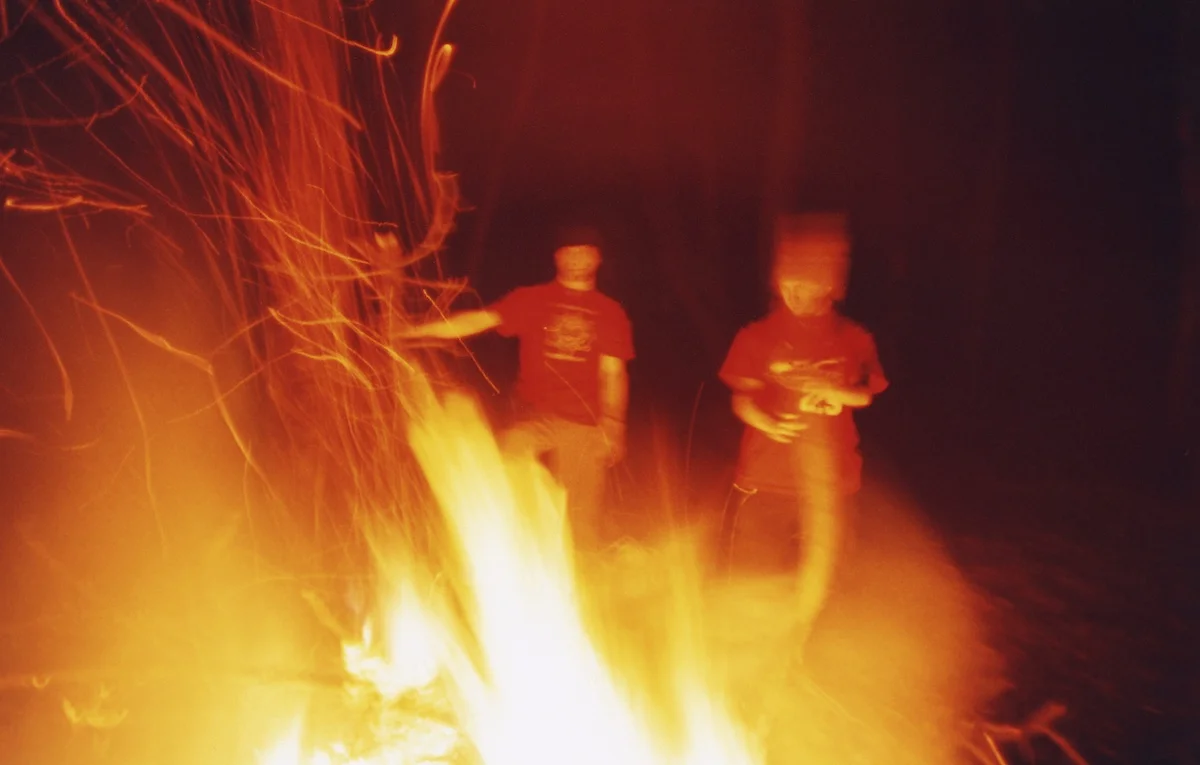
The album cover also works on the same frequency. No demons or postcard flames from the afterlife. There's a blurry scene, engulfed in sick reds and yellows, with a clear echo to their artwork by Music Has the Right to Children, but here re-soaked. The past is no longer a refuge. It is flammable material. Sandison and Eoin don't fall into the old BoC habitat to make us feel safe in the analogue haze again. They take that language and subject it to a worse climate among more exposed voices, faith, radio astronomy, bodies, distressing bass, spoken samples (different, along the journey). Less smooth shapes, same signal, unbreathable air.
The title makes a statement, but not in the most obvious way. Hell in fact it doesn't always sound dark and distressing. It seems more like the resignation of having ended up in a room where someone prays in arcane languages while the world outside gropes adrift. Dante remains a wandering ghost, more like an idea of descent into disorder than a model of his famous circles. And, above all, there is no Virgil here: that role falls to ourselves. To get out of the darkness, we must first understand what we continue to venerate in there.
The first break with the past, however, is a resounding one. The Scottish brothers have never needed to raise their voices to be scary: an off-axis progression, a hidden sample that whispers, a worn texture are enough. Here the threat is more frontal. The drums clash, the basses keep the floor low, certain structures draw from industrial, jungle, corroded post-punk. There are bucolic mono pads and more industrial sheets. We are not faced with a faded memory to be looked at from afar, rather an escape room to be crossed together with spirited strangers.
The first part of the album gets progressively dirty. Introit gentle, sunny part, a colorful jingle that smells like a trademark. It lasts very little. Prophecy at 1420 MHz immediately turns off the room. Nothing, conscience, truth, divine intellect, cause and effect, a laconic “I am God, the ultimate resonance” to greet the onlookers: not a mystical sample thrown there, but a kind of sermon picked up by an occult radio. The hydrogen line at 1420 MHz to which the title refers is a radio astronomy coordinate used to study the universe, origins of the cosmos and even imagine extraterrestrial communications. In the hands of the Boards of Canada, science becomes dark prophecy, and in an instant you understand that you will not be safe on the record.
The album proceeds in zones: deformed liturgies, spoken echoes, lopsided rhythmic engines and crooked ballads, intermittent returns to quiet and danger. Somewhere Right Now in the Future allows an oblique grace to emerge, between Cocteau Twins and My Bloody Valentine. Naraka it collapses after half the song, with a problematic devotional song: ecstasy and bewilderment in a religious dirge that torments the rhythm. Memory Deathperhaps the most classically BoC moment, takes a breather between ethereal melodies, stereo games, a soft but never entirely friendly peace. For a moment Brian Eno seems to be coming towards us, but the door to the abyss remains open. Against the light, a similar progression was already there Societas x Tapethe mix broadcast by the duo on NTS in 2019 for the thirtieth anniversary of Warp. Shortwave, post-punk, kosmische, advertising samples, analogue oddities, fragments brought together more by magnetism than by genre. Not a playlist, more an oblique atlas of their adult imagination. Hell it takes that logic and brings it into a real record, in a heavier way: the mystery does not remain in the case of the cult Boards of Canada, but decides to take shape.
In this short circuit between science, spirituality and broken modernity, we almost arrive at the Battiato of Pollution: not really in sound, of course, but in the idea of a mystical laboratory where matter, frequencies, body and transcendence try to communicate through faulty equipment. And the strongest theme is undoubtedly the spiritual one. The Word Becomes Flesh it recalls the Gospel of John and compares it to a biological imaginary, with the incarnation becoming matter, development, flesh. The passage is one of the least resolved passages, more interesting as an allusion than as an access portal.
In Hell there is a difference in the way we treat ambiguity compared to the past. In Geogaddi evil often remained a shadow in the game, an occult geometry under still childish colors. Here it is more explicit, adult, unpleasant. Tomorrow's Harvest announced an already faded future while the new chapter discovers that the future is no longer the home of a threat, that moment is the present.
The Process it is a return to the darkness, amidst the shouts of a restless crowd, pads in minor and a female voice announcing the out-of-control breakdown of the world, recalling that of One Very Important Thought from the debut album. Also Into the Magic Landwith a western motif filtered through their vocabulary, sounds familiar, while remaining a little fragile. Yet the album doesn't live only in codes. The ending with I Saw Through Platonia it is the point at which you stop rising and look down, inside your body. Plato, in the thought of the British physicist and philosopher Julian Barbour, is described as a timeless universe, a space in which every possible moment already exists. Here it becomes pure image: distant winds, sinister air, BoC style that returns like a polite ghost, and under the scorching layer a barely perceptible heartbeat. First it is a detail, then it becomes a presence, then a threat. Until it stops pulsating, and with it the disc. After theology, cosmology, prayers, numbers, the most basic thing remains to ask ourselves, at the end of the journey: are we still alive?
Hell However, it doesn't seem like an album about the end. It remains more interesting when trying to understand what remains after: it does not erase the darkness of Tomorrow's Harvestpasses through it with a challenging urgency. He doesn't just imagine collapse: he searches for a voice, a ritual, a body, a community, perhaps even a twisted form of hope, as in American Arena. It's possible that those who were expecting a more hypnotic, seductive return, closer to the idea of the duo as the perfect mystery machine, won't like it. Some parts are stiff, heavier than necessary, disoriented. But this very irregularity prevents it from becoming an elegant exercise in style, to just return. It's not a perfect record and maybe it doesn't want to be. And he risks seeming less mysterious precisely because he speaks to you clearly when he wants to.
For years we have said that Boards of Canada made us feel nostalgic for things that never happened. Hell it breaks that reflex: it no longer asks us what we remember, but where we ended up. It's not their most welcoming album, but it could become one of the most necessary to understand their planet, because it takes away the predictable part of the miracle. The past fades. The signal remains. This time it comes from reality. What is he telling us?
Daniel D`Amico for SANREMO.FM
