
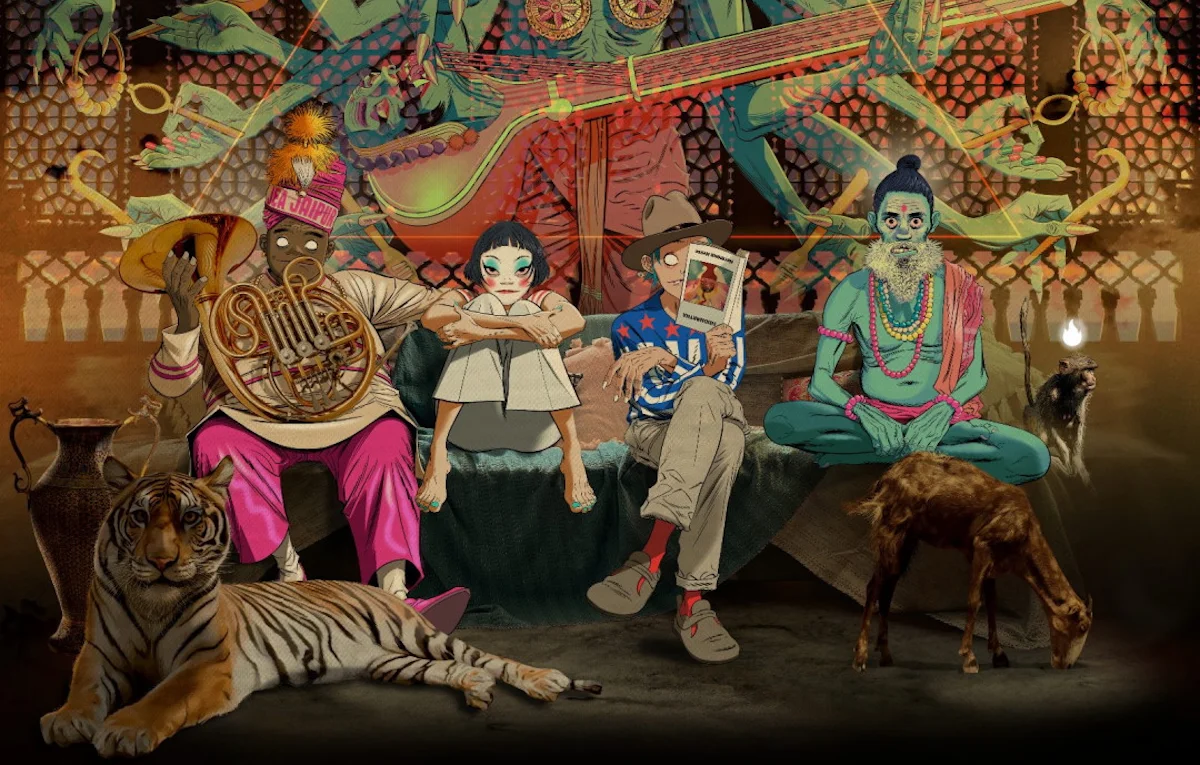
In the 1960s, India was one of the symbolic poles of the European counterculture: an alternative spiritual and political horizon to the West. In the midst of the psychedelic season, young artists and intellectuals looked to the East as a new anti-system model. The Beatles' trip to Rishikesh in 1968, George Harrison's introduction of the sitar into pop music, interest in Hinduism, Buddhism, transcendental meditation. India becomes a concrete presence in the European cultural imagination, a promise of authenticity and transcendence, a place where spirituality and everyday life seem to coexist without the fracture perceived in Europe.
Today, a historical moment in which transcendence is told by Plastic Guru (cit. Damon Albarn), India is in our feeds every day in the form of diluted symbolism and social philosophy. Now that it is so close, it has lost part of that distant sacredness in the eyes of us Westerners. If his soul has remained the same, the lens with which we look at it has gradually clouded over. But, with a good cleaning, it is easy to understand why India can be, yesterday as today, a place of unique spiritual power. Just ask Damon Albarn and Jamie Hewlett of Gorillaz.
In Varanasi, Albarn immersed the deceased body of his father – an artist who had found profound inspiration in Hindu culture precisely in those years of countercultural push – in the Ganges, and then cremated it in the sacred funeral pyres of the place. He followed the traditional funeral rite, which ends with scattering the ashes of the deceased into the river. Some time before, however, his friend in Gorillaz Jamie Hewlett had been forced to stay for months in India, in Jaipur, with his mother-in-law in intensive care. Given the various private vicissitudes, TheMountainthe new Gorillaz album could only be born there.
The theme of death is central in TheMountain also because the dead, here, really come back. And they do it clearly, not by moving objects around the room with the intention of being noticed, but by putting their voice into it, speaking to us. From Tony Allen to Dave Kolicoeur of De La Soul, from Proof of D12 (remember Eminem's collective?) to Mark E. Smith of the Fall, from Dennis Hopper to Bobby Womack, the album is a continuous conversation with the otherworldly. It's not just Albarn dealing with his father's death (“the hardest thing is saying goodbye to someone you love” he sings as a bridge between The Hardest Thing And Orange County), but a series of missing friends and supporters who guide the couple Albarn and Hewlett towards a new awareness of life. “To talk about death we needed dead people who know more than me,” Albarn explained.
India is not only the context of Gorillaz's rebirth after a humanly and musically sobbing period (“the trip to India represented the pinnacle of Jamie and Damon, Part Two. Reconciliation and renewal of marital vows”), but it is also the sound scenario on which Albarn builds the 15 tracks of the album. Recorded between Mumbai, New Delhi, Rahasthan and Varanasi (as well as Ashgabat, Damascus, Los Angeles, Miami, New York and London), it boasts the collaboration of several Indian artists such as Ajay Prasanna on bansuri, the Indian flute, Anoushka Shankar on sitar, Amaan Ali Bangash and Ayaan Ali Bangash on sarod, The Mountain Choir, the traditional ensemble Jea Band and the voices of Asha Puthli in The Moon Cave and that by Asha Bhosle – cult figure of Bollywood – on vocals in The Shadowy Light. A corpus that, together with Albarn's usual distorted voice, and the usual minimal drum machines knocking on time, creates a coherence that leads the entire mountain of sound on the right path.
But don't think of a heavy, tough, dark record. The general climate of TheMountainon a musical level, is light and danceable as Gorillaz have accustomed us to. A coherent and compact album, the likes of which Gorillaz haven't made in a long time, according to Albarn and Hewlett's own admission who (rightly) had to bother Plastic Beach of 2010 – another extraordinarily choral album – as the pair's last moment of real creative alignment.
TheMountain However, it is not a hit record, as we had already understood with the first singles released. Don't imagine finding one there Stylo or one On Melancholy Hill. But not even songs cheesy like those who fattened some of the previous albums. Albarn, in fact, manages to measure his ambitions this time, keeping together the theme of death, a certain musical joy that flows between the songs (The Happy Dictator, Orange County, The Manifesto, Damascus) and a line-up of artists which, in addition to those already mentioned, ranges across genres and geographies: from Idles to Omar Souleyman, from Johnny Marr and Paul Simonon (the former Clash already on tour with Gorillaz for Plastic Beach) to the South Americans Trueno and Bizarrap, from Sparks to the American rapper Black Thought. There's so much life in this afterlife pop.
We immediately loved Gorillaz for their ambition. In the last 15 years, however, this same ambition had become a curse and a delight for the duo who had often curled up on themselves, losing plot and narrative. TheMountain finds all this again and you can understand it from the particular inspiration of Hewlett (watch this trailer to understand), who finally comes back to life after a period in which his hand, fundamental in building the band's identity, seemed to have been limited by his teammate.
Perhaps the great impulses of the beginning will no longer return, that unpredictability capable of conquering even the charts Plastic Beachbut Gorillaz have finally found their maturity. To do so they had to climb a mountain, bathe in the Ganges and stare death in the face. To be reborn. Luckily, life sometimes leads you to do all this. Welcome back Gorillaz.
Daniel D`Amico for SANREMO.FM