
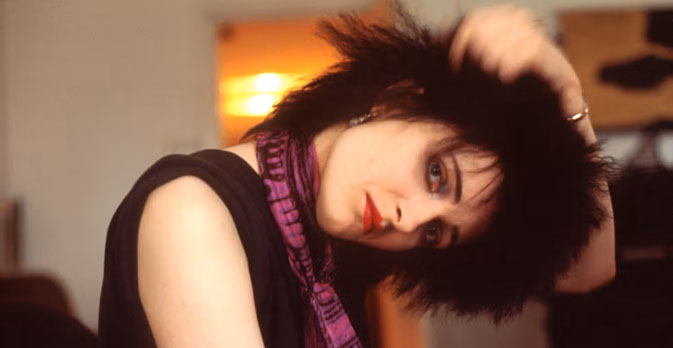
In 1992, on the pages of the British magazine Melody Maker, Siouxsie Sioux retraced her artistic journey through twelve fundamental records. A varied background emerged that drew on different worlds: the glam-rock of Marc Bolan and David Bowie, the urban nihilism of Lou Reed and the Stooges, American punk, the contemporary music of Philip Glass and even the soundtracks of Bernard Herrmann and the classical compositions of Prokofiev.
The first great point of reference for Susan Janet Ballion was Marc Bolan and the song “Jeepster”. Even more than the music, what struck her was its ambiguous and elusive image. “Bolan's image and his ambiguous sexuality had a huge impact on me,” he recalled. “She dressed almost like a drag queen, wore makeup and had an overtly feminine side. I didn't need female role models. My sister, who was ten years older than me, went to Art College and was surrounded by gay friends, so this all seemed perfectly natural to me. I was a tomboy and hated the idea of a boyfriend. Ironically, though, I was really fascinated by Bolan and his feather scarves.”
Shortly after, David Bowie arrived. Her appearance on “Top Of The Pops” was a culture shock for a girl who couldn't stand bands like Mud and Rubettes. “I would aggressively defend Bowie and Bolan when people made fun of them for their effeminate looks,” he said. He also remembered a curious episode related to Bolan: when the Banshees performed a version of “20th Century Boy,” the T. Rex leader went to see them live and apparently didn't even recognize his own song. Shortly afterwards he invited them to participate in his television program, but the project fell through due to the tragic car accident that cost him his life.
The meeting with Lou Reed and “Transformer” represented another decisive stage. “I'll never forget the first time I saw that cover, with the heavy makeup on my eyes, the black nail polish and the lipstick,” she explained. She was also struck by the dry irony of songs like “Vicious”. Growing up in the suburbs of London, she found her surroundings suffocating: boys always ready to fight and girls who constantly judged others. For this reason he preferred to frequent the capital's gay clubs, which he described as a safe haven. “I had a lot of female friends there, who happened to be men.”
Roxy Music was also among the glam passions. Bryan Ferry won her over with his “contemptuous smile”, Brian Eno with his synthesizers and eccentric clothing, while Phil Manzanera appeared to her like a sort of science fiction character straight out of “Doctor Who”. “Roxy Music and Bowie were not the targets we wanted to eliminate in 1976,” he explained. “The real enemies were the supergroups and those rock dinosaurs devoid of glamour, glitter, sex or any other form of vitality.”
John Cale's darkness occupied an equally important place. His version of “Heartbreak Hotel”, contained in “Slow Dazzle”, accompanied a difficult period of adolescence. “It gave me chills,” he said. “I was becoming more and more introverted, I spent my time locked in my room, angry at the world.” At that time she often followed her sister, who worked as a go-go dancer, until she got a job in one of the pubs she frequented. That sinister song, in short, seemed to give voice to his state of mind.
If John Cale represented the more restless side of his personality, the Stooges embodied pure anger. “Iggy Pop was perhaps the most fascinating of all,” he stated. “His narcissism and the way he took everything to the extreme suited my aggression and restlessness perfectly. I felt I was ready to explode.” And the homage would be consummated with the famous cover of “The Passenger”, included in the 1987 album “Through The Looking Glass” by Siouxsie And The Banshees.
In 1976, however, Siouxsie remembers having literally consumed the first Ramones album. He remembered spending his days at bus stops ominously humming the chorus of “Beat On The Brat.” Living in Bromley and Chislehurst, she felt isolated and broke, but made up for it with an intimidating attitude that even allowed her to get reduced fares on buses without any conductor daring to challenge her.
An even more traumatic experience came with the “Psycho” soundtrack composed by Bernard Herrmann. “It completely shocked me,” he confessed. Years later she played that music to John McGeoch, who told her: “This is exactly how I want to make my guitar sound.” The impact of Alfred Hitchcock's film was such that for years the English singer retained an almost infantile fear of showers, even going so far as to scare her mother by brandishing a bread knife and imitating the famous scene from the film.
Among the female figures he admired was Patti Smith. “After Nico, she was the first true rock author,” he claimed. He wasn't just referring to the songs, but also to attitude, image and stage presence. “It was the Nirvana of its era,” he claimed. Unlike many of her heroes of the seventies, often characterized by a strong female component, Patti possessed decidedly masculine traits. At that time, she said, she worked in a bar but was fired after the owner saw in the tabloids a photograph of her taken during a Sex Pistols concert, of which she was a well-known member. groupiewithin the famous Bromley Contingent.
In the 1980s, however, Siouxsie discovered Philip Glass, despite an initial distrust, aroused by an interview in which the composer spoke about his work in scientific and rational terms, an approach that she found distant from her own sensitivity. Over time, however, Susan began to appreciate the obsessive repetition of her compositions, comparing it to apparently distant experiences such as “Sister Ray” by the Velvet Underground, the music of Herrmann and the works of John Cage. All elements that would also become important for the evolution of the Banshees.
Another epiphany came in 1980 during a trip to the United States. Watching the full version of “Caligula”, she was struck by the closing credits accompanied by Prokofiev's music from “Romeo and Juliet”. Not knowing who the author was, he spent weeks humming it to everyone he met. “Its power fascinated me,” he explained. At the time he appreciated bands like Public Image Ltd., Wire, Joy Division and Gang Of Four, but hated the labels that critics kept inventing. “Punk, new wave, post-modern: they were all boxes they tried to put you in.” Among the definitions received, his favorite remained one: “A spider on stilts”.
The last album on the list was “Der Mussolini” by DAF. “Right Said Fred were ridiculous. DAFs were the real ones,” he declared bluntly. For Siouxsie the German group represented the embryo of what would later become industrial and Electronic Body Music. Those sounds brought to mind the nights spent in the clubs Heaven and Cha Cha's, the first experiences with LSD and a life lived in a house nicknamed “Crocodile Road”. “It was a happy, demonic and decadent period,” he concluded. “God only knows what the neighbors thought.”
On the sidelines of the interview with Melody Maker, Siouxsie had also created a compilation based on her main musical references: here it is below.
- Marc Bolan: “Jeepster” (from “Electric Warrior”)
- David Bowie: “John, I'm Only Dancing” (from “Changesonebowie”)
- Lou Reed: “Vicious” (from “Transformer”)
- Roxy Music: “Virginia Plain” (from “Greatest Hits”)
- John Cale: “Heartbreak Hotel” (from “Slow Dazzle”)
- The Stooges: “I Wanna Be Your Dog” (from “The Stooges”)
- Ramones: “Blitzkrieg Bop” (from “Ramones”)
- Bernard Herrmann: “Psycho” (original film score)
- Patti Smith: “Land” (from “Horses”)
- Philip Glass: “Einstein On A Beach” (four-LP box set)
- Prokofiev: “The Second Suite: The Montagues And The Capulets” (from “Romeo And Juliet”)
- DAF: “Der Mussolini” (from “Alles Ist Gut”)
Daniel D`Amico for SANREMO.FM