
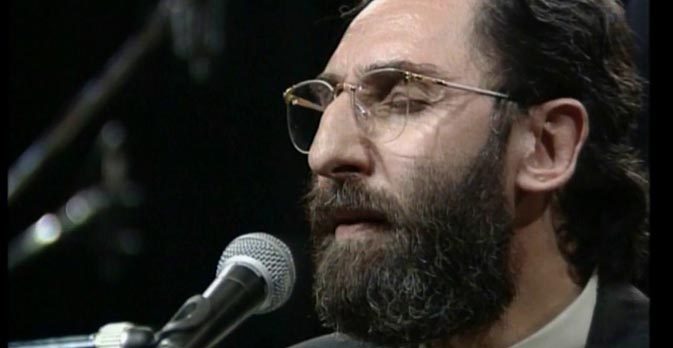
In December 1992, Iraq was a defeated, isolated and exhausted country. The first Gulf War, which began in August 1990 with the invasion of Kuwait by Saddam Hussein's regime and ended in February 1991 with the intervention of the international coalition, had left behind it devastated cities and a deeply troubled population. What made the situation even more dramatic were the very harsh economic sanctions imposed by the United Nations: the embargo completely isolated the country, causing a very serious humanitarian crisis. What was missing were not only basic necessities and medicines, but also books, musical instruments and everything that fuels the cultural life of a nation. While politics continued to reason according to the logic of opposition, Franco Battiato decided to make an opposite gesture: to use music to build a bridge towards a people who were paying for faults that were not theirs.
A bridge to Baghdad
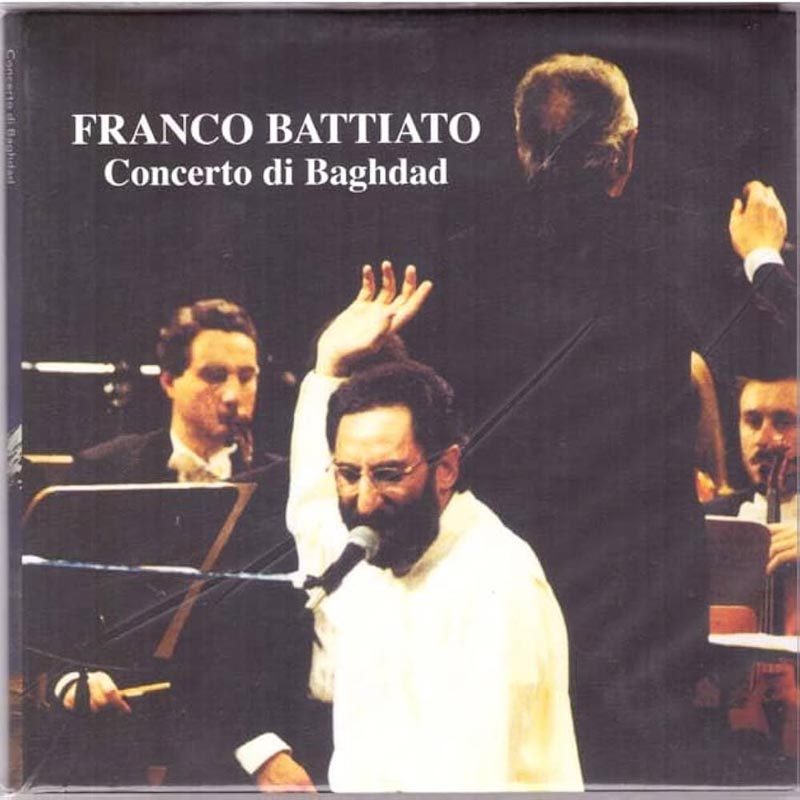
Thus, on 4 December 1992, the Sicilian musician took to the stage of the National Theater in Baghdad for what would go down in history as the “Baghdad Concert”, an event that attracted much criticism at the time and which today, however, is rightly remembered for what it was: a courageous gesture of peace. The initiative was born within the humanitarian project “A bridge for Baghdad”, promoted in favor of Iraqi children, with the collaboration of Unicef, the Iraqi Red Cross, the Iraqi embassy and numerous entities that worked so that that meeting could take place despite the embargo and the enormous logistical difficulties.
The concert was broadcast almost live in the Arab world and subsequently in Europe, until the Italian broadcast on Christmas night, with the aim of raising funds for Iraqi children.
The invitation had come directly from the Iraqi embassy. Battiato knew well that accepting it would arouse controversy: performing in a country led by Saddam Hussein meant exposing himself to the accusation of legitimizing the regime. But the singer-songwriter was very clear in distinguishing the political level from the human one: “The purpose of my visit to Iraq was humanitarian – he explained – because I don't think it's right that a people should suffer for faults that aren't theirs; but it's also true that I believe it's right to give everyone a chance for redemption, for murderers to become saints”. And he reiterated a principle that perfectly summarized the meaning of his choice: there was “nothing that prevents a person from helping those who think in a different way”. However, Battiato later had the opportunity to point out that if Saddam Hussein had appeared in the room, he would have been seriously embarrassed, but the dictator did not participate in the event.
The challenge to the embargo
Even the journey to Baghdad itself was a testimony of solidarity. Enrico Maghenzani, Battiato's producer from 1985 to 1995, remembered those days thus: “85 of us left Italy, not caring about the embargo, we loaded the medicines as flight baggage, disembarked in Amman in Jordan and crossed the desert by bus and were forced to divide ourselves into two hotels, with consequent difficulties in connecting. The rehearsals with the orchestra made up of Iraqi musicians and Italian virtuosos were truly exciting.”
Once he arrived in the Iraqi capital, Battiato found musicians without the instruments necessary for the concert and realized that even books had become a rare commodity. He immediately understood how profoundly the embargo was suffocating not only the economy, but also the culture and the possibility of looking to the future in that country. Thus the concert also became a way to draw the world's attention to the emergency experienced by the civilian population and the need to ease the restrictions that especially affected the weakest groups.
The initiative also produced concrete results. In fact, Maghenzani recalls that “eight young people with serious pathologies, thanks to this concert, managed to reach Italy to be treated, but they were like drops in an ocean because shortly after the second Gulf War broke out”. And he adds: “The concert in Europe was broadcast almost live in the Arab world and then in Europe, first in London and then in Italy on Christmas night. We also made a video whose proceeds went to Unicef and the Iraqi Red Cross for projects to protect children”.
The concert at the National Theatre
On the stage of the National Theatre, Battiato, sitting on a traditional carpet, was accompanied by the National Symphony Orchestra of Iraq and I Virtuosi Italiani. Maestro Giusto Pio conducted most of the program, Antonio Ballista took the podium for “Gilgamesh” and “Schmerzen”, while Mohammad Othman conducted “Fogh in Nakhal”, a traditional Iraqi folk song that the Sicilian artist would later record in 1993 on the album “Caffè de la Paix”.
The lineup was also built as a symbolic journey between different cultures. The opening with “The Shadow of Light,” sung entirely in Arabic, was the most eloquent gesture of the entire evening. Battiato transformed that composition into a prayer addressed directly to the Iraqi public, choosing his language to express closeness and hope: “Remind me how unhappy I am / Far from your laws / How not to waste the time I have left / And never abandon me / Never abandon me”. A way to ask that God not abandon a people left without bread, without homes and without a future.
After “The King of the World” and “Fisiognomica”, the concert took on increasingly intense tones with “Nevski Prospect”, where the cold, desolation and nostalgia seemed to perfectly reflect the human landscape left by the war. “The trains of Tozeur” and “Mesopotamia” instead recalled the geographies and civilizations of the Mediterranean and the Near East, almost as if to recall a common cultural heritage that no conflict could have erased. “And I come to look for you” brought the spiritual dimension back to the centre, while the trio taken from “Gilgamesh” evoked the ancient Mesopotamian epic, one of the founding texts of the civilization born precisely in those lands.
The second part of the concert alternated Wagner, Brahms, Beethoven and “Plaisir d'amour”, demonstrating how European music could naturally dialogue with Middle Eastern music without borders or contrasts. “Like a camel in a gutter” therefore prepared the most intense moment of the evening: “The ocean of silence”. In that song Battiato seemed to offer an answer to the pain he had experienced in the days spent in Baghdad. It was a vision of hope, the possibility that a light continued to exist even in the heart of darkness: “What would I have seen of the world / Without this light that illuminates / My black thoughts / How much peace does the soul find inside”.
The concert ended with “Fogh in Nakhal”, an ancient song of the Iraqi popular tradition whose title literally means “Above the palms”. It is a song that tells of a distant and unattainable love, deeply rooted in the culture of the country. Battiato interpreted it in Arabic, closing the circle opened at the beginning of the evening with “L'ombra della luce”. It was the most natural way to reiterate that music can become a common language even when politics divides.
In the last minutes of the show, a little girl, Aida, also took the stage and Battiato wanted her next to her. His presence transformed the finale into an image of extraordinary symbolic strength: the face of Iraqi childhood, the same one that the concert sought to help, became the true center of the scene.
The historic show will remain a testimony on a DVD which reveals all the emotion and difficulty of that undertaking.
A few years later the world would witness a new war in Iraq. For this reason, looking back at those images today, the “Baghdad Concert” appears even more extraordinary. It did not change the course of history, but it demonstrated that it was possible to challenge the logic of war and opposition by choosing that of solidarity and peace. For one evening, in the heart of a wounded city, Franco Battiato actually managed to build a bridge to Baghdad.
The concert lineup
- The Shadow of Light (in Arabic)
- The king of the world
- Physiognomy
- Nevski Prospect
- Tozeur's trains
- Mesopotamia
- And I'm coming to look for you
- Gilgamesh (trio from act 2)
- Schmerzen (Richard Wagner)
- Plaisir d'amour (Johann Paul Aegidius Martin)
- Gestillte Sehnsucht (Johannes Brahms)
- Oh Sweet Were the Hours (Ludwig van Beethoven)
- Like a camel in a gutter
- The ocean of silence
- Fogh in Nakhal (traditional Iraqi)
Daniel D`Amico for SANREMO.FM
