
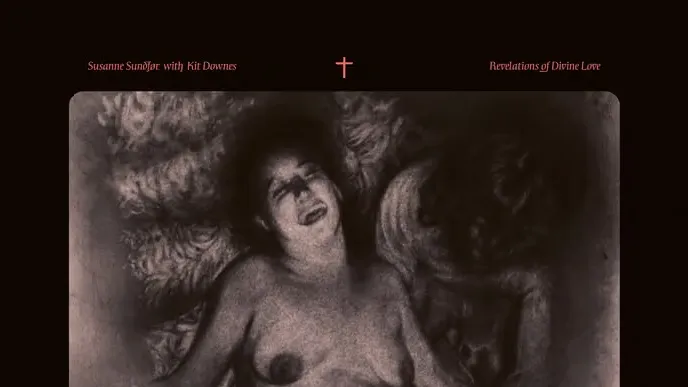
Six hundred and forty five years before Ariana Grande declared that “God is a woman,” the English mystic Julian of Norwich fell gravely ill, experienced a series of divine revelations, and encountered Jesus Christ. He came to Julian with wounds oozing nourishing blood, suffering in the service of new life. Jesus, she realized, was a mother.
Susanne Sundfør’s Revelations of Divine Love, her eighth album, takes as its subject Julian’s 14th-century devotional text of the same name, the earliest known book written in English by a woman. Sundfør was also drawn to Julian’s ideas through a close friend who converted to Catholicism while battling cancer, and with whom Sundfør read religious texts, including Julian’s Revelations.
No score yet, be the first to add.
This is predictable fodder for the Norwegian singer. Her music has grown increasingly austere over the years—she turned from relatively straight-ahead electropop to sobersided folk for 2017’s Music for People in Trouble, then to ambient folk, jazz, and classical influences on the stiflingly erudite Blómi. In the meantime, her public persona has, frankly, grown weirder. (There are only so many Instagram posts advocating for eating meat one can take.) Depending on your tolerance for grand aims and liturgical self-seriousness, her latest album may strike you as extraordinary or unbearable. Consider this a litmus test: If concepts like “neopaganism,” “mystical devotion,” “the organ as minimalist instrument,” and “God” intrigue you, you likely fall into the former camp.
On Sundfør’s 2015 album 10 Love Songs, one of my favorite albums to recommend, she couched divinity in the handy language of pop. The genre has long trafficked in the sacred through stylized metaphor, whether in Ariana Grande’s “God Is a Woman,” Madonna’s “Like a Prayer,” or 10 Love Songs standout “Accelerate,” in which Sundfør casts bearing the cross and being crucified as a kind of ritual sacrifice to her lover. But here, she addresses God directly. Perhaps this is in fashion—Cameron Winter’s most quoted lyrics invoke Him, and like Winter, Sundfør isn’t kidding around. She goes several steps further, though. Like Jesus Christ, who doesn’t laugh in the Bible, she is unwaveringly serious. She dispenses with the secular framework altogether, making music that takes the divine as its subject, form, and purpose.
Daniel D`Amico for SANREMO.FM