

vote
7.0
- Bands:
PRINCE OF FAILURE - Duration: 00:45:00
- Available from: 06/19/2026
- Label:
-
Kscope Music
Streaming not yet available.
When we talk about Daniel Tompkins, our thoughts inevitably turn to TesseracT, one of the groups that most contributed to defining the modern evolution of contemporary progressive metal. However, over the years, the British singer has repeatedly demonstrated that he possesses an artistic sensitivity that transcends the boundaries of djent and the technicalities that have made him famous.
The Prince of Failure project, born from the collaboration with Paul Ortiz of Chimp Spanner, probably represents the most personal and introspective manifestation of this path.
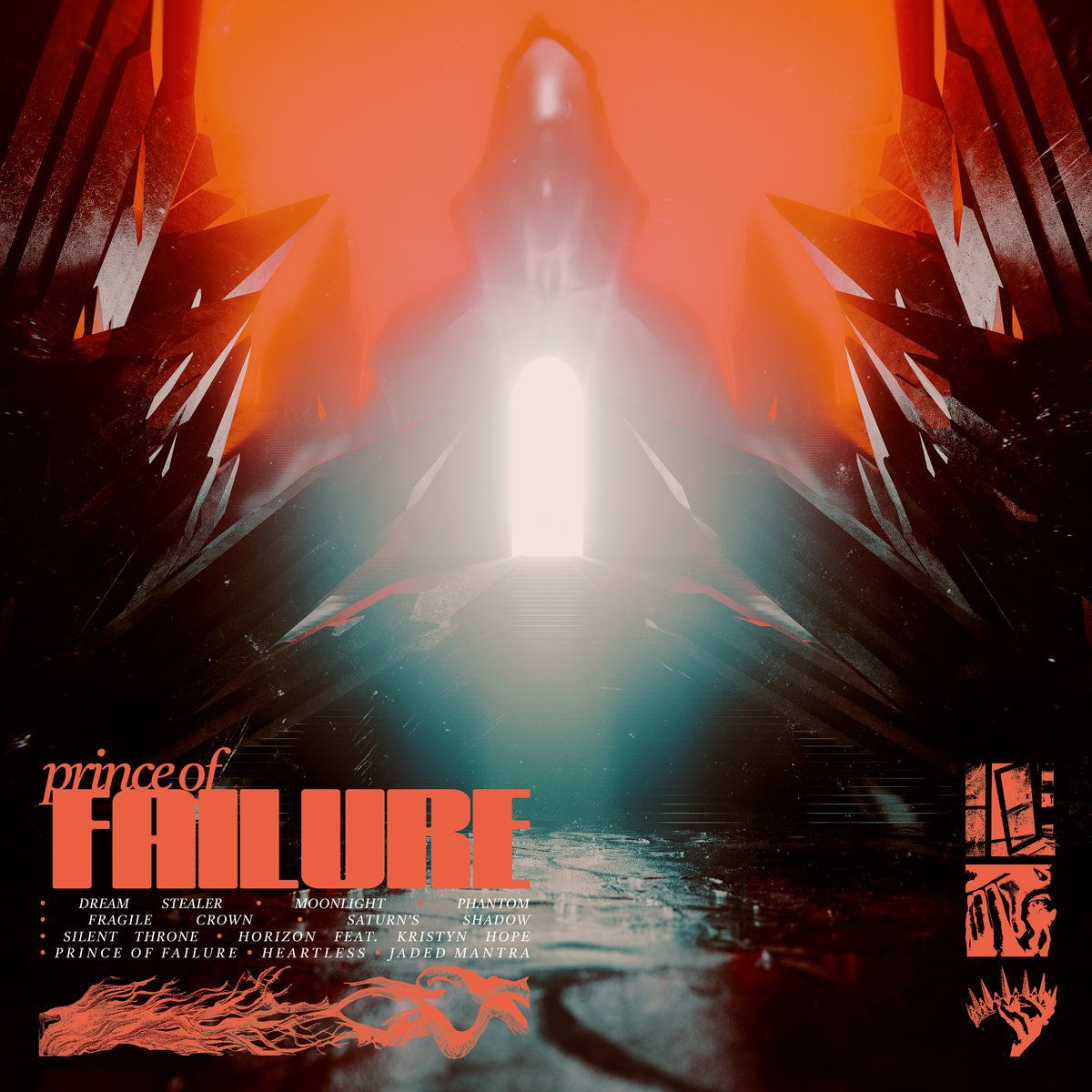
The self-titled debut album “Prince of Failure” is not simply a collection of songs, but a conceptual work built around extremely delicate themes such as neurodivergence, self-perception, social alienation and the difficult process of accepting one's identity.
It is a work that requires attention and emotional involvement, far from the logic of immediate listening: precisely this highly introspective nature represents at the same time one of its greatest strengths and one of its most evident limitations.
From the first notes of “The Glass Veil”, the duo's intention clearly emerges: to create a sound environment suspended between reality and the subconscious. Ortiz's electronic textures do not play a simple ornamental role, but become the narrative fabric on which the entire sound experience develops. The listener is immersed in an almost cinematic dimension, where every sound seems to have a precise function within the story.
With “Dream Stealer” and “Moonlight” the album gets to the heart of its narrative: here one of the most fascinating aspects of the work emerges, namely the ability to blend elements from modern progressive rock, atmospheric electronics, contemporary alternative and certain ambient sensibilities without ever losing coherence.
There are no moments in which the influences seem to blend together artificially; everything appears part of a single artistic vision. However, precisely this constant search for atmosphere sometimes leads the compositions to sacrifice incisiveness and memorability: some songs are in fact more effective as part of the overall flow of the album than as truly autonomous episodes.
Episodes like “Phantom”, “Fragile Crown” and “Saturn's Shadow” further delve into the psychological side of the album: the melodies seem to continuously oscillate between hope and despondency, while the arrangements build constantly transforming soundscapes. In some moments there are echoes of Chimp Spanner's more atmospheric productions, but filtered through a more song-oriented compositional sensibility.
Tompkins' vocal performance deserves a separate discussion. Those who know the singer from his performances in TesseracT might be surprised by the approach adopted here: the range and technique remain intact, but are put at the service of expressiveness rather than spectacularity. The vocal lines often give up the search for power to favor fragility, intimacy and emotional nuances.
It is probably one of the most sincere performances of his career, but in some passages the choice to maintain such a controlled register limits the emotional impact that certain sections could have achieved.
One of the most successful aspects of the album is the management of dynamics. In a historical period in which many modern productions tend towards constant saturation, Prince of Failure instead choose to let the compositions breathe. Silences, pauses and spaces take on fundamental importance, amplifying the emotional impact of the most intense moments. On the other hand, this same choice makes the album less engaging for those looking for greater rhythmic variety or a more marked presence of traditional instruments.
From a production point of view, however, Paul Ortiz's work is of the highest level. Each element occupies its own space with surgical precision, without ever compromising the naturalness of the whole, the electronics coexist harmoniously with traditional instruments, while the mix constantly maintains a balance between technical detail and emotional involvement.
However, precisely this almost obsessive care sometimes ends up making the record excessively smooth, depriving it of that roughness that could have increased its personality.
The second half of the album probably reaches its creative peak with “Horizon”, enriched by the participation of Kristyn Hope of Daedric. The track represents a sort of emotional turning point within the narrative, introducing a brightness that until then seemed almost unattainable, while the interaction between the voices creates one of the most successful moments of the entire work.
The interlude “Palace of Echoes” prepares the ground for the title track, the authentic conceptual heart of the album: “Prince of Failure” perfectly summarizes the philosophy that permeates the entire work: failure not as a definitive condemnation, but as an inevitable and even necessary component in the path of every human being. It is a reflection that acquires particular strength precisely thanks to the absence of rhetoric. The song does not offer simple solutions or easy consolations, but proposes an authentic and profoundly human form of acceptance.
In the conclusion entrusted to “Heartless” and above all to “Jaded Mantra”, the album reaches its point of maximum narrative maturity. The tensions accumulated during the journey find a resolution that does not coincide with a triumphal victory, but with a new awareness. It's a coherent and well-constructed closer, although not particularly surprising from a musical point of view.
Perhaps the most interesting aspect of “Prince of Failure” is its ability to stand out within a progressive scene often dominated by the search for technical complexity: here complexity exists, but it is emotional even before musical. The album doesn't want to impress through odd tempos or demonstrations of virtuosity; he prefers to delve into human frailties, transforming them into art.
What is missing, however, is a greater number of truly memorable episodes. While maintaining notable artistic cohesion, the album rarely reaches those compositional peaks capable of leaving a lasting mark on the listener. Some ideas are developed with elegance but without the necessary strength to transform into truly unforgettable moments.
In this sense, the album sits ideally alongside the more introspective works of Steven Wilson, Devin Townsend and solo Daniel Tompkins himself, while remaining slightly below the best works of these artists in terms of impact and capacity for innovation.
“Prince of Failure” as a whole is a rather mature, sincere and artistically coherent debut, but not without limitations: the thematic depth, the quality of the production and Tompkins' vocal interpretation undoubtedly represent the strong points of the work; on the other hand, a certain atmospheric uniformity, the scarcity of truly memorable moments and a writing that is sometimes more contemplative than incisive prevent the album from making the definitive leap towards excellence.
An interesting work worthy of attention, especially for fans of more introspective progressive music, but which leaves the feeling of being able to offer something more.
Daniel D`Amico for SANREMO.FM