
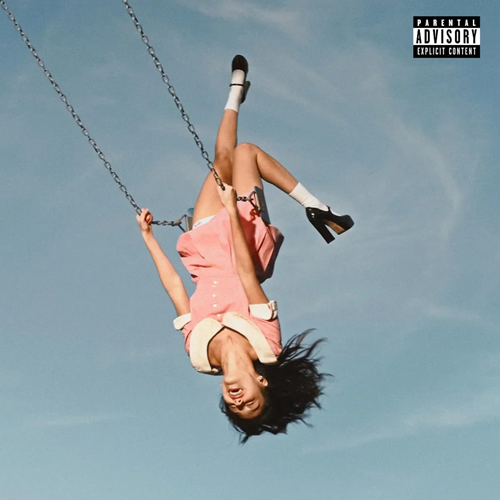
As she enters the music scene of these turbulent 20s, Olivia Rodrigo's star seems increasingly difficult to ignore. From ex-Disney star to modern pop rock icon – new Avril Lavigne, more than someone says – the American singer has transformed her adolescent love troubles and her existential crises into songs which, in the span of two acclaimed albums – “Sour” (2021) and “Guts” (2023) – have made her the symbolic artist of Gen Z, placing her in a narrow musical corridor that has allowed her to earn everyone's respect despite remaining relatively an artist dedicated to making music “for teenagers”.
Rebellious and provocative, but not as much as her almost contemporary Billie Eilish; casual and at ease in exposing herself on stage, but not at the level of her famous colleague Sabrina Carpenter; advocate, like many of her generation, of a “return to guitars” but not with the commitment and conviction of the English rocker Beabadoobee. Olivia's remains a particular case, the case of a girl who wants to be alternative but also especially talk about her heart problems, who wants to guitar at full blast but never do it too far from the charts.
In his third album, whose title is already a whole program, the direction is confirmed more or less the same but with a strong inclination towards a romantic melancholy that seems to feed on itself and does not want to seek solutions to these infinite dilemmas of love, but only more suffering. “You Seem Pretty Sad For A Girl So In Love” (“you seem pretty sad for a girl so in love”) is Olivia immersing herself in her worries with pure sincerity; but also, impossible not to notice, with very little to say about it compared to what other much more “expert” colleagues such as Taylor Swift have already done and how, above all, one would expect from a girl (and artist) who is no more than 17 years old as at her professional debut, but is now 23.
Musically, the album embraces an instrumental approach that often includes classical arrangements as in the celebrated first single “Drop Dead”, a Laufey-like song that opens the album and marks its mood. There tracklist it is in fact punctuated by ballad which should perhaps communicate sincere romantic anxieties but often border on banality – “Stupid Song”, “Begged”, “Less” belong to this group. There is no shortage of nice surprises, such as the atmospheric crescendo in “Purple” and the slightly anachronistic indie rock of “My Way”, the rockiest piece of the album and perhaps the best, at least when compared with the rest of the songs. Even “Expectations”, more lively and lively set to light-hearted rock with strong bass, could play well at many parties: in the song Olivia lists everything she no longer looks for in a man, describing her “evolution” in this sense but, it seems, she herself is uncertain whether to take these changes with irony or not.
“Maggots For Brains” is the only song on the album to reveal the clear influence of the Cure – there has been a lot of talk about this inspiration, which in theory should have affected the album to a much larger extent – whose style is obviously taken up with all the necessary updates (to 2026); it is also one of the few songs to betray a rather explicit existential malaise (“I'm a zombie in my body/ I'm a sad shell of a woman”) beyond simple romantic suffering. “U + Me = <3” tries to trace a similar experience in the guitar work, but stops at a less than sensational pop/rock that refers more to the beginning of the millennium than to the 80s new wave territories of Robert Smith's band. Who, however, appears in person in a duet with Olivia in the song "What's Wrong With Me", a pairing that however disappoints and beyond the sensational bridge generational features little else of note, because the song is decidedly not very incisive. After all, the influence of the English myth of alternative music and gothic rock on this third work by Olivia Rodrigo has proven to be rather superficial, if not non-existent.
As for the rest of the album, there is little else to say: although solid in her role as a generational icon, Olivia Rodrigo does not seem to show musical or lyrical (or personal) growth, apparently preferring to continue building soundtracks for her thousand romantic worlds in which she loves to lose herself in tears, bitter irony and pure ecstasy of love – when love is there. If, however, this is all that an artist considered today among the most important and famous in the world can communicate, even if we keep in mind that she moves in the pop field, we perhaps have to ask ourselves: will this really, really remain one of the most talked about albums of 2026? And, if so, does it deserve it?
06/19/2026
Daniel D`Amico for SANREMO.FM
