

How much does an indie band earn from a virtually sold out tour in the United States? Does filling the premises 99% ensure good revenue? Judging by the detailed accounts made public by the Welsh Los Campesinos! (don't you know them? Listen here and here, and if you want here too) the answer is: very little. Indeed, in their specific case there is a risk of making a loss. Apparently it is true that what saves the budgets of many small groups who continue to tour despite the increase in costs is merch. Selling t-shirts makes almost as much money as playing for two hours on stage.
«It is now widely believed that for 99% of people, whether they are artists struggling to cope with rising costs or fans with less and less money available to buy tickets for shows in sports halls and stadiums with ever-increasing prices, the world of concerts is screwed. And all this within a music industry based on speculation.”
The report published on Substack begins with these words, with which the group illustrates the economic balance of the 2024 tour in North America. It's an interesting case, but unique in its own way. It cannot be considered the norm, but it can help start, as they themselves hope, a more transparent debate on the live market for small-medium bands that have a name and want to tour. Los Campesinos! in fact they have some particularities: they save on management costs because they manage themselves, but there are many of them on stage, seven of them, and for various reasons they often travel with some family members in tow. And even if they have achieved a certain fame, like many other small-medium sized bands they do other jobs for a living.
I repeat: their case, like all of the text, is unique. They are not unknown – they had their moment years ago and have almost half a million monthly listeners on Spotify – but they move outside the logic of the live industry in arenas and stadiums. To give you an idea: what they earn by doing ten concerts before costs (and which they will therefore never collect) is equivalent to what Taylor Swift gave as a production bonus to every single truck driver on the Eras Tour. And yet music is not only made up of sold out stadiums and huge tours, but also of concerts with 1000 spectators, which in any case are not few. Obviously the move from the United Kingdom to the United States weighs on the accounts, but it can give even a rough idea of the costs that bands of their stature have to face by making the move in reverse, from the United States to Europe.
The purpose of the report, they explain, «is not to explain the situation of all the bands that go on tour, although it is likely that many of the figures involved are similar for others. And we certainly don't want to arouse sympathy. It only serves to offer an honest and precise picture of the specific situation of Los Campesinos!. We're posting this in our ongoing effort to be transparent and honest about the music industry, and perhaps also to make our fans understand why we can't tour more often and longer. We also hope that our frankness will help encourage other bands to speak more transparently.”
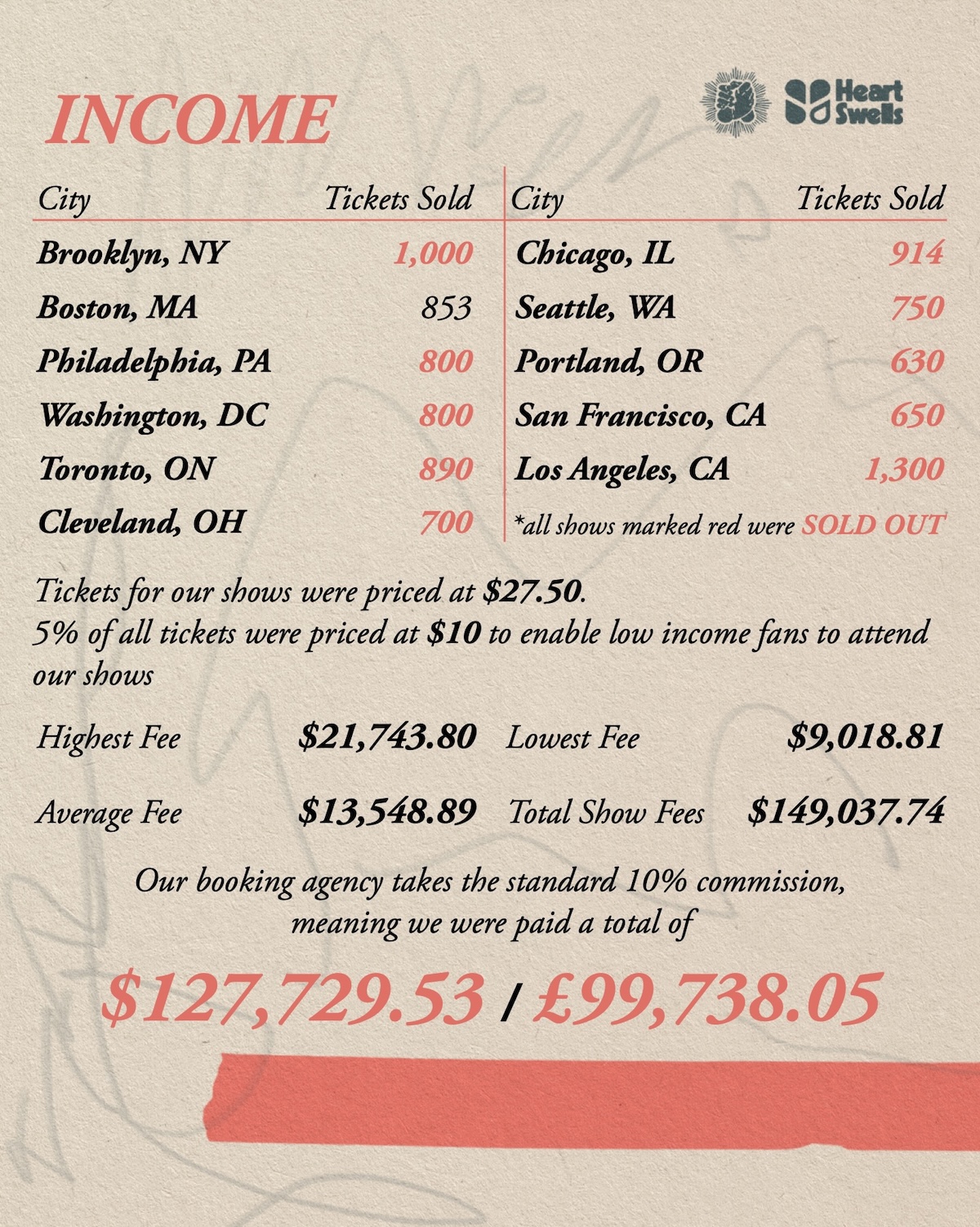
Photo: @LosCampesinos
The band arrived in the United States on June 14, 2024 and left on the 29th. They played 11 concerts interspersed with three days off and/or traveling from one stop to another. Of the 11 concerts held in venues ranging from approximately 700 to 1300 seats, 10 sold out. The eleventh wasn't for a long time. In practice, they sold more than 99% of the available tickets. From this point of view, the tour was a success.
«Usually» they explain «the compensation that a band receives for a concert is based on an agreement called Guarantee vs 80%. It means that there is a minimum “guaranteed” amount that the band collects (even if the audience doesn't show up and the promoter screws us over). If the ticket proceeds (net of costs) exceed the guaranteed amount, then the band is awarded 80% of the total profit of the concert. In such a situation, the difference between the guarantee and the highest compensation actually received is called overage».
By keeping the tickets at the popular price of 27.50 dollars (about 23.50 euros) to allow everyone to participate, which is what the fans are asking for, and even putting some tickets at 10 dollars for spectators in serious economic difficulty, in the 11 dates the band earned 149,037.74 dollars, which after taxes and booking commissions becomes 127,729.53. But then there are the costs, from over 5000 pounds for work visas to flights (another 9000 pounds) to transport to the States, which they traveled around using a tour bus and which are an important item (over 57 thousand pounds). Remunerations for those who work for the group, for equipment, accommodation and so on must also be deducted from the earnings.
Total costs amounted to £101,827.95, compared to earnings of £99,738.05. Basically, with a practically sold out tour under those conditions (popular priced tickets, lots of musicians, a tour bus) the band ended up in the red by 2000 pounds. The cliché according to which merchandising saves the day is apparently true. The group, which in the past has refused to play in venues that ask for a percentage of the merch, during the North American tour sold 2266 t-shirts out of 12,687 appearances, a huge success, practically one in five or six spectators bought one. Retail price of a t-shirt: 35 dollars against 16 dollars in production costs. Added to the rest of the merch, they brought in $111,978, basically 89% of what Los Campesinos! they earned by performing on stages.
Net of the costs of the merch, the group was therefore left with 40,336.54 pounds in their pocket. «We were at –2089.90 pounds, but adding the profit of 40,336.54 pounds from the sale of the merch, we arrive at a total profit of the tour of 38,246.64 pounds».
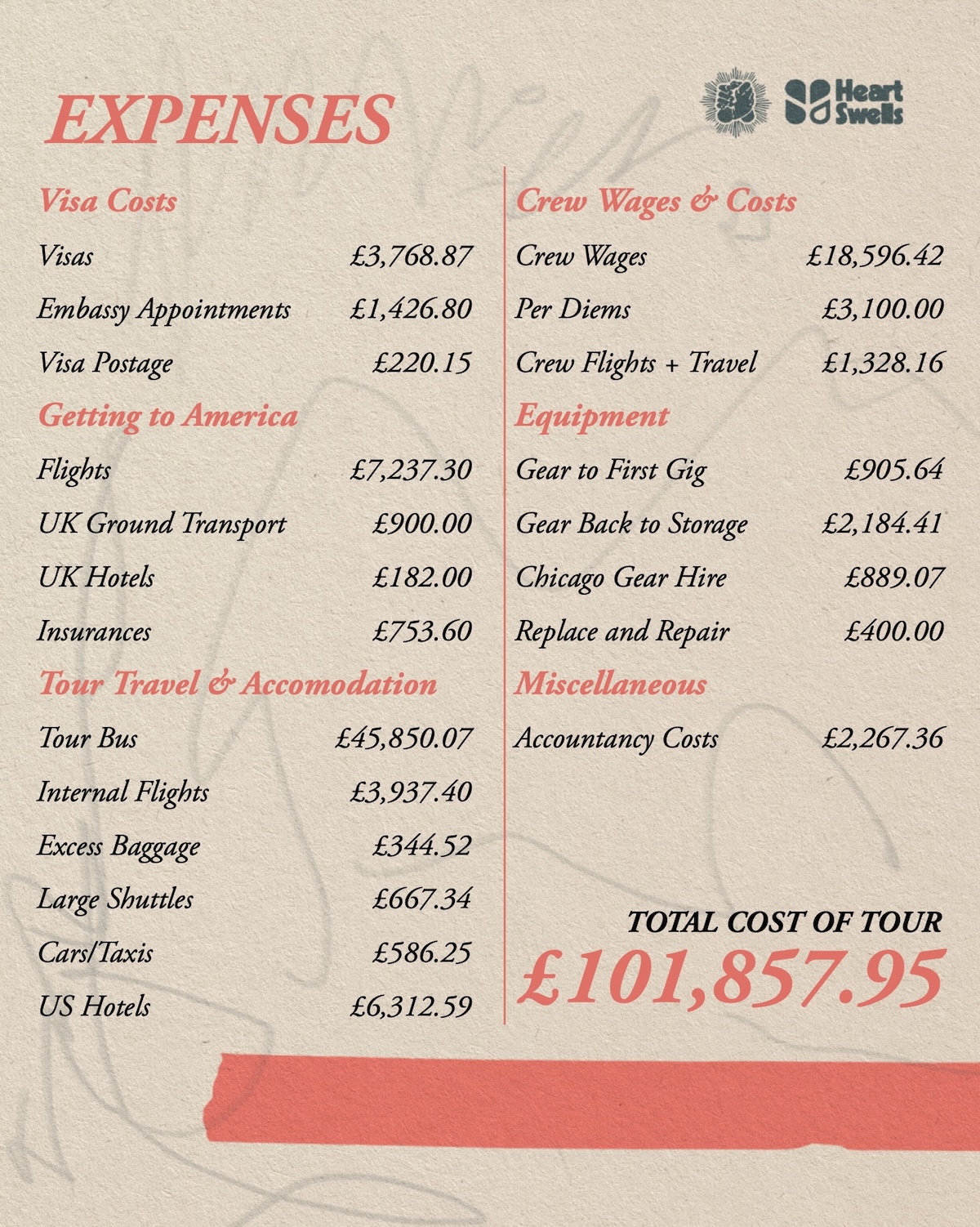
Photo: @LosCampesinos
Divided by seven it is just over 6000 euros each. Is it little? Is it a lot? And what do they do with that money? I leave the answer to them: «Many of you will be thinking: “Well, 40,000 divided by seven is 5500 pounds each”, but it doesn't work like that. That money is used to finance the next tour or the next project. There is something that perhaps you have never thought about: the vast majority of the expenses listed are made before even collecting a penny and this is the case for a good part of the projects. It means that for a band to be able to afford it, they need to have access to capital long before touring (or recording an album, or whatever) begins. And who has access to capital? The artists who are signed to a major label and who continue to fleece fans with exorbitant ticket prices and the musicians who come from wealthy families and can always return home to their parents.”
«So for Los Campesinos! Touring is expensive and financially risky, but barely sustainable. It's not the modest sum earned by the band that makes a tour worthwhile: it's the love and passion for live music, it's the fact that we all go on the road together. It's the same motivation we had when we started touring twenty years ago.”
Los Campesinos! they published their accounts to encourage other artists to talk about them more openly. Is there any Italian band willing to do it?