

vote
7.5
- Bands:
HEAVENWOOD - Duration: 00:51:30
- Available from: 12/06/2026
- Label:
-
Mighty Music
Streaming not yet available.
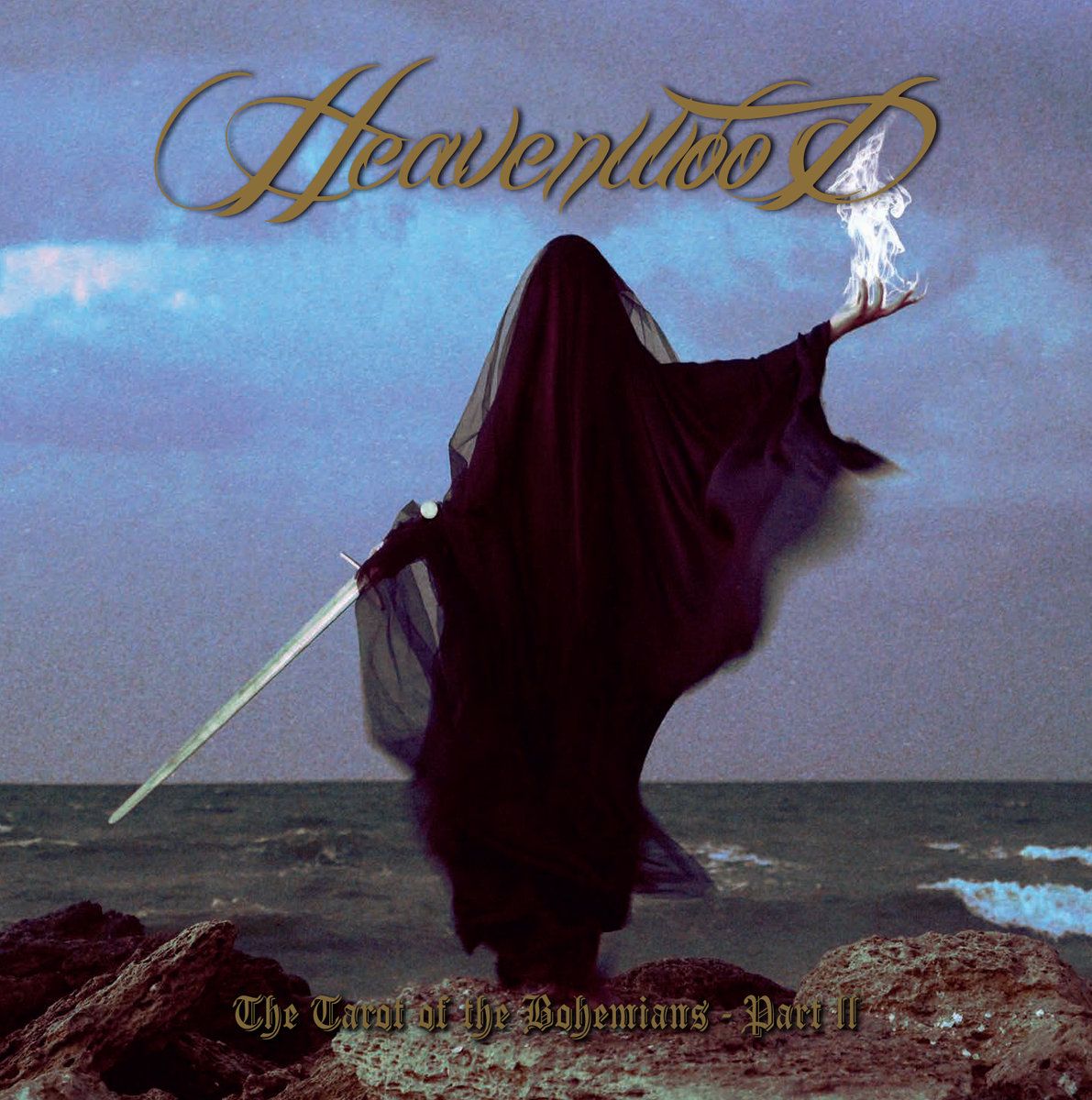
As had already happened with “Redemption” in 2008, Heavenwood return with this new “The Tarot Of The Bohemians – Part II” after ten years of recording silence. And just like on this occasion, this time too there are obvious changes, the first of which concerns the lineup: after the departure of the guitarist Vitor Carvalho and the historic singer Ernesto Guerra, the guitarist, founder and main composer Ricardo Dias dos Santos remains the last remaining member, and therefore the entire weight of the long and honored career of the Portuguese group now rests on his shoulders, as well as the burden of carrying it forward.
The abandonment of the original singer is certainly not a trivial matter, but Ricardo Dias doesn't seem to worry too much about it: from the second voices already within his competence he moves to the forefront, extricating himself between a convincing growl and a warm, almost confidential baritone singing, which fits well into the gothic metal tradition, which the Portuguese have been practicing since the beginning of their career in the mid-nineties and which essentially coincides with the birth of the subgenre.
It can be said, in fact, that Heavenwood's music takes impetus from the experiments of those years of the sacred triad of British death-doom Paradise Lost, Anathema and My Dying Bride, who, together with a large group of young bands, from Tiamat to Moonspell, from Sentenced to Theater Of Tragedy, went on to define the coordinates of what would be defined as gothic metal.
The Lusitanians should therefore also be considered in the pack, who with their debut “Diva” in 1996 managed to place one of those works that symbolize those years of contamination and experiments.
Since that moment, a lot of water has passed under the bridge, and it is not possible here to retrace all the various phases of the Porto ensemble, but suffice it to say that between tightenings and mitigations, pushes forward and returns to the classic, their sound has gradually been enriched with new accents, and Ricardo Dias tries to keep almost all of them together even in this new release, which is not and cannot be a simple continuation of the previous album, as one might assume from the start from the title.
Naturally, some elements of “The Tarot Of The Bohemians – Part I” recur on this sequel, in particular the guitar riffs that wink at a certain melodic death, in the wake of other gothic metal groups such as The Man-Eating Tree and Trail Of Tears, but, in addition to Ernesto Guerra, the keyboards that characterized that work are also missing, and in general the sound is drier and more controlled.
The concept on tarot inspired by the treatise “Clef Absolue De La Science Occulte. Le Tarot Des Bohémièns” by the French doctor and esotericist Gérard Encausse, also known by the pseudonym of Papus, remains interesting and is approached with care: all ten songs are associated with a card of the major arcana, those of greatest esoteric significance, and each has the right atmosphere required by the corresponding major arcana.
In this way the first song “Death” excellently presents the revived Heavenwood with a slow, heavy and evocative flow, dominated by the growl and the refined but roaring guitars; even more extreme, and on balance bordering on death metal, is the third track “The Devil” – and it couldn't be otherwise, considering the theme.
“Temperance” is inexorably rhythmic, while “The Stars” and “The Moon” are sweet and captivating, almost like pieces of gothic rock, which help to vary the dish and keep the attention alive; the ending with the airy “The World” is beautiful and very appropriate.
Overall we are in the presence of a very pleasant gothic metal with various death-doom accents: a solid stylistic feature, always exciting and capable of satisfying more than one palate.
Where the lack of Ernesto Guerra could be perceived, well-placed female vocals and even a children's choir intervene on the refrains of “The Judgment”; Dias himself is however good at not making his predecessor on lead vocals regret too much: he doesn't have the same flair, experience and versatility, but he fits well into the context and offers a flawless performance.
Eduardo Sinatra, who had already played on the first part, ensures a precise, energetic and varied contribution behind the skins; the bass, again by Dias, is very measured and functional to the final result.
Nothing revolutionary obviously, but this long-delayed return reaffirms Heavenwood's coat of arms; of course, no one would have imagined it with very small ranks and after an entire decade, however what matters is the result and it cannot be denied that Ricardo Dias brought it home this time too.
Probably what Heavenwood has always lacked and has significantly affected their career is a personality that isn't too strong, especially when compared to bands like fellow countrymen Moonspell; this does not mean that their productions are almost always of great taste and above average.
Daniel D`Amico for SANREMO.FM