
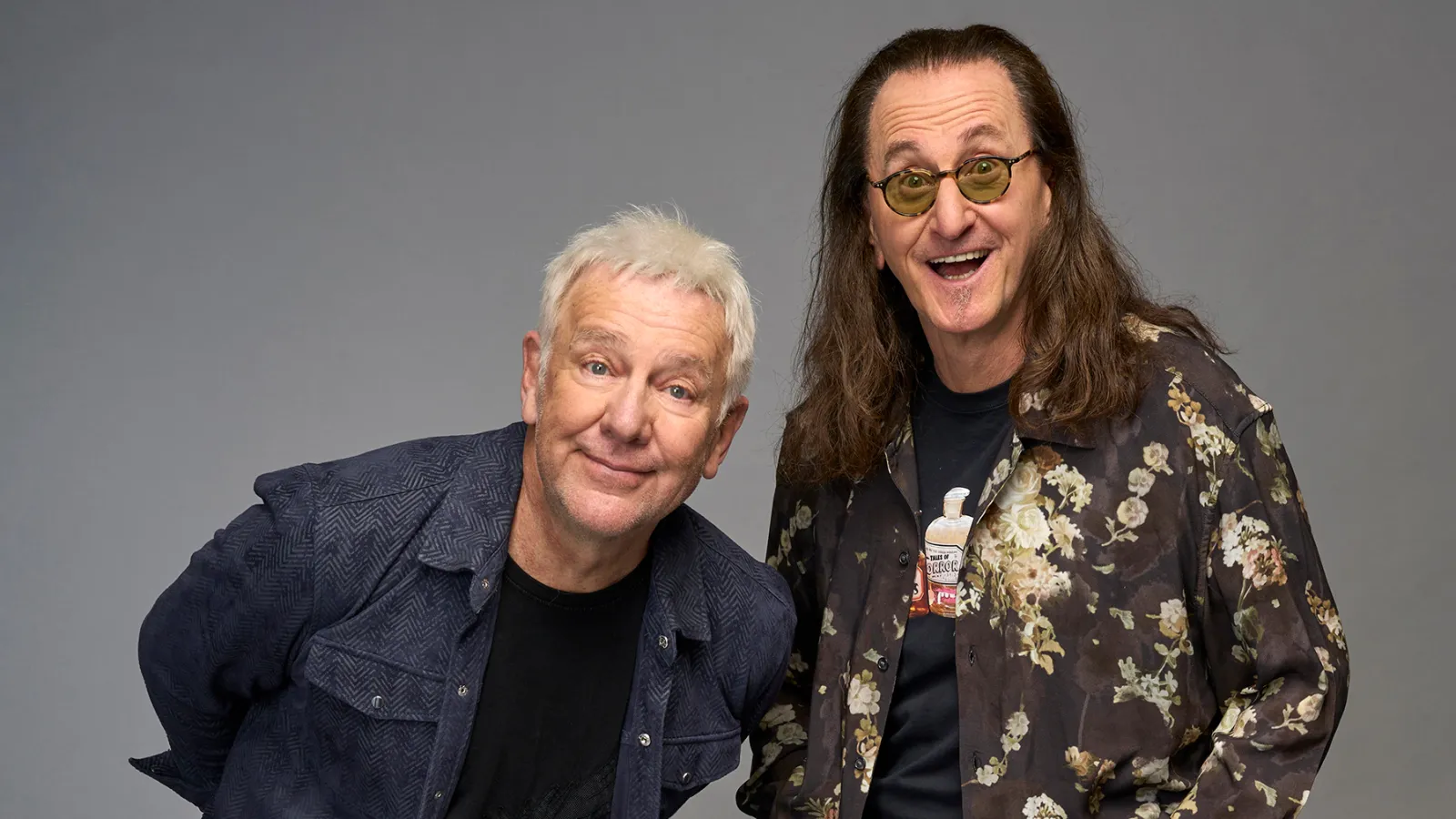
This cover story was produced in partnership with Rolling Stone Canada
O
n their long journey towards becoming Rush again, Geddy Lee and Alex Lifeson pushed past death, illness, age, self-doubt, and for one guy, a weed habit that dated back to 1966. They just didn’t count on the fog.
In early June, the resuscitated band was about to begin its first concert in 11 years, the kick-off of its Fifty Something tour. Backstage at Los Angeles’ Kia Forum that Sunday evening, Lee was feeling tense, Lifeson less so. “I was, surprisingly, not really that nervous,” the guitarist says. At showtime, video screens surrounding the stage began to glide upwards, revealing two familiar silhouettes, complete with dual doublenecks, shrouded by thick clouds of smoke. Lifeson put his foot on his volume pedal, ready to unleash the swelling notes that begin 1977’s “Xanadu.”

The August cover of Rolling Stone Canada
Photograph by Richard Sibbald
As more smoke billowed, he could feel his guitar’s twelve-pound weight on his spine, but couldn’t see a single fret. For a second, at least, “not really that nervous” melted into near-panic. A few feet away, Lee glanced down at a small mirror that was supposed to let him watch drummer Anika Nilles. In the haze, his rearview was gone. “We were drowning in fog,” Lee says, laughing at the Spinal Tap absurdity of it all.
Half-blinded but undaunted, they launched the song. In the opening moments of her very first Rush concert, Nilles whirled through the “Xanadu” intro’s lengthy procession of exclamatory drum fills. A minute in, she was pounding out the tom-tom-heavy accompaniment to a winding riff. Don’t fuck up this fill, she recalls telling herself, just as her left hand lost its grip: “I saw this stick flying over the toms.” She missed a single drum hit, enough to trigger a concerned glance from Lee, before plunging on one-handed. In the same millisecond, she somehow snatched the errant stick out of the air, flipped it over, and kept going. “It happens,” she says, still unfazed. “You drop the stick. As a drummer, you’re used to it.” (“She’s a pro,” Lee adds. “She rose to the occasion on opening night.”)
At age 43, Nilles, a native of Aschaffenburg, Germany, is three decades younger than her new bandmates. When she was born, Rush were about to record their tenth album, Grace Under Pressure. She’s had stage fright in the past, but on the highest-stakes night of her career, was relaxed enough to break into a smile right after that stick recovery. It helped that she meditated for a full 45 minutes before the show, part of a “calming routine.” “In each song part,” she says, “I had to coach myself a little bit through it, especially in the first show, not to fly away.” She tried not to consider the bigger picture. “That all helped not to think too much about how big that seat is and what role I’m filling in it, at the point where I’m sitting on stage. Be in the moment, be present, be focused.”
The seat she’s filling will, of course, always belong to Neil Peart, who died of brain cancer in 2020. That night in L.A. was Rush’s first concert without him since his debut on Aug. 14, 1974. Peart was a one-of-a-kind virtuoso, one of the greatest drummers rock ever knew, his monstrously complex parts so intrinsic to Rush’s sound that the idea of replacing him long seemed unfathomable. He was also their lyricist, lending Canada’s greatest power trio their cerebral ambition and poetic soul, after some loveable sci-fi/fantasy excursions in their earliest days. “We’re only immortal,” Lee sings in 1991’s “Dreamline,” “for a limited time.”
Watch the video interview below
For this tour, though, he was determined to prove otherwise. Not only was Rush’s frontman, bassist, and designated taskmaster reviving a vanished band, but he had over-the-top, nearly masochistic ambitions for its new incarnation. “It’s how I’m built,” Lee says. “I’m crazy.” The musicians, now also including keyboardist Loren Gold, would have to learn over 40 songs, many of them stuffed with more musical twists than some bands’ entire albums. There are four alternating setlists, each stacked with the trickiest material of their notoriously tricky-to-play catalog – the full first side of 2112 was just the start. Gold’s presence at least rescued Lee from playing bass pedals with his feet during every keyboard part, but he’s still grabbing some signature synth riffs for himself.
“Why do you do it? It’s a test,” says Lee, who turned 73 in July. “It’s howling at the moon! It’s saying, ‘I’m this age now. Can I still do it?’ Those moments of self-doubt, of course we all have those. Anika has those, and she’s much younger than us, apparently. That’s just being a human. You always doubt that you can stretch and play at your apogee.”
For Lifeson, that struggle was real and visceral. “In the last month of rehearsals,” he says, “there were times I was sitting on the edge of my bed at two o’clock in the morning thinking, ‘Did I make the right decision? Can I do this? Can I play? Am I good enough?’ It wasn’t really until Sunday, when we played that gig, that it all kind of came down this funnel and spilled out. It was at that moment that I thought, ‘Yeah, this has all been worth it. This is where I really am happy to be.’ I’m tired this week. But I’m really, seriously happy.”

RICHARD SIBBALD
Lee wanted to get back on stage from the moment the band said goodbye in August of 2015, but confirming the tour meant many months of grim-faced work. His daughter, Kyla, said she hardly saw a real smile from him for a year and a half. “In my history as a musician, I don’t think I’ve ever rehearsed quite as much as an individual, and also as a band,” Lee says. “Of course, we needed to, because it was a monumental task… In the last month and a half, I think at one point we did the show 24 times in 27 days. It’s been a long time since we were on a stage, and we put so much of our heart and soul into shaping the show and perfecting our parts. And when the curtain goes up, you just never know which version of you is gonna show up.”
Opening jitters aside, the first show turned out to be a triumph, with the crowd instantly, even gratefully, embracing Nilles. By nights three and four, any remaining nerves had burned off. Lifeson was roaming the stage, trying to make the new drummer laugh. “We’re much looser than we’ve been before,” Lee says. “Goofier.”
More than once, Lee couldn’t help leaping in the air as he thumped out, say, the riffs of “Red Barchetta” or the climax to “La Villa Strangiato.” Did anyone suggest that, for a septuagenarian with many months of shows ahead around the world, including two homecoming runs through Canada, leaving the ground might not be the best idea? “Yes,” Lee says, smirking. “My trainer. My wife. My daughter.”
JUST TWO YEARS AGO, Lifeson told me his mind was made up. “There’s no chance that we’re going to get a drummer and go back on the road as the rebirth of Rush or something like that,” he said in May of 2024. He and Lee had just started to play Rush songs in private again, but Lifeson insisted it was just for fun. He was recording with a band called Envy of None, but otherwise seemed like a man at peace with semi-retirement. “I really would feel like we were doing an injustice to our fans and that would be just a money grab.” A few months later, in another interview, he went even further, calling the R40 tour a high point: “I guess I’d rather be remembered for that legacy than returning as the top Rush tribute band.”

RICHARD SIBBALD
In September of 2022, at two tribute concerts for late Foo Fighters drummer Taylor Hawkins, Lee and Lifeson performed together for the first time since Peart’s death, with a revolving crew of drummers. Earlier, they had made it clear that Rush was gone: “That’s finished, right? That’s over,” Lee told me in late 2020. After feeling their songs under their fingers again, they weren’t so sure, and it didn’t hurt that Paul McCartney urged them to get back on the road backstage after the first show, at Wembley Stadium. In the aftermath, Lifeson got briefly excited about the idea, then seemed to change his mind. Lee kept at him, and along the way, began to find Lifeson’s interview comments increasingly baffling. “Al is great at saying one thing to your face and then saying something else in public,” Lee says now. “You’re like, ‘Oh, that’s interesting.’”
Lifeson shrugs. “Yeah, I kind of do do that.” They’re sitting side by side in the dark basement studio of the Sunset Marquis in West Hollywood, their go-to hotel in the Seventies.
Lee has boundless affection for his best friend, but he found one part of Lifeson’s public comments intolerable. “I know how he feels and how he’s felt for a long time,” Lee says. “We’re friends first. But… when I heard this thing about the tribute? It’s like, ‘They’re your songs, motherfucker!’ It’s not a tribute band! We own those songs as much as we did with Neil. And they’re part of us. They’re part of your soul. They’re part of your heart. And when we started playing them together again, that kind of woke up in him.”
Lifeson thinks he was trying to send messages through the press that he didn’t have the heart to say to Lee’s face. “Maybe I was trying to send a bit of a signal,” he says. “I wanted to create this wall that I didn’t have to climb over, by saying, ‘Oh no, I don’t wanna be in a Rush tribute band,’ blah, blah, blah.”
As Lifeson told me in 2024, his reluctance was as much physical as it was emotional. After two failed surgeries, he suffered from stomach paralysis, gastroparesis, which left him constantly nauseous. He had a continuing issue with arthritis in his hands, though medicine keeps that largely under control. He also found himself dreading the road. “You could feel like a hotel room is prison,” he says. “That can be a lonely place. I didn’t know if I really wanted to do that.”
“THEY’RE YOUR SONGS, MOTHERF—ER! IT’S NOT A TRIBUTE BAND!”
Geddy Lee
He started to budge last year, during a sojourn at VivaMayr, a well-regarded wellness clinic on a lake in the Austrian countryside, where staff design custom low-calorie nutrition programs, massage your stomach daily, and teach you to chew bread 40 times. Lee decided to tag along, “for moral support,” and ended up enjoying it, despite a ban on both alcohol and caffeine. Lifeson dropped 30 pounds over two visits, and learned how to address his digestive issues. “They really set me straight,” he says.
While they were there, the duo set up a studio in Lifeson’s room, with gear shipped from home and instruments rounded up from a local music shop. Every day, after their treatments, they began making music. “We started really getting into it,” says Lee. “And when you combine that feeling with the fact that he was feeling good, I think that’s what convinced him that maybe we should think about this.”
Lee had just finished his third book, and restlessness was setting in. “I don’t like not having a project. I am not happy if I don’t have something to engage me,” he says. “I thought, ‘Right. Time to write some lyrics. Time to get your fingers in shape.’” For a while, he assumed he might be working towards his first solo album since 2000, maybe his first-ever solo tour. Some of the lyrics he was writing felt too personal for Rush, not to mention that he hadn’t sung his own words with the band since their first album, before Peart joined. “But before I got to that point,” he says, “we sparked.”

RICHARD SIBBALD
Lifeson had to admit it. “When we sat down, this was not about being in a Rush tribute band,” he says. “This is about being Rush. In one of its best forms. And that was a whole different kind of thing.”
Lifeson had one more life change to make. He first smoked weed at age 13, and while he’s had periods of abstinence, it’s been a fairly constant companion for the last 20 years. “ In the studio, I enjoyed it,” he says. “I found it did spark some creativity that was different from the straight world.” Four months before tour launch, at age 72, he quit.
When he’d get high at night and pick up his guitar, as was his ritual, he “wasn’t playing that well. And I started having these negative feelings about my confidence and about what was ahead of us. We were halfway through the process. It’s too late to jump off this ship that’s screaming across the sea. And I thought, this is interfering with the way my brain should be working, and the kind of focus and discipline that all of a sudden I really wanted to have in my life.”
He went on a THC-removal rampage. “I got up, and I went in the bathroom, and I took all my little jars of pot and the pipes and threw them in a garbage bag,” he says. “Then I went in the kitchen, I took all my pipes and threw it all in the garbage. Then I went in the studio and looked at one container of pre-rolls and I thought, ‘Oh, I really like these. Maybe I’ll just hang onto these.’ And I was like, ‘Al, this is not the idea.’ So I tossed that in. I went to every little place I had stashes. It was a garbage bag full of pipes and bongs and pot, pot, pot, pot. All my friends said, ‘Why did you throw it out? You should’ve called me. I would’ve been happy to take it.’”
“THIS IS ABOUT BEING RUSH. IN ONE OF ITS BEST FORMS.”
Alex Lifeson
He initially planned to abstain for a week, then a month. “THC stays in your system for typically 30 days,” he says. “I got to the month and I thought, ‘Oh my God, maybe I’ll just try it for two years then, for the whole tour.’” He has no regrets. “The other day I was standing on stage thinking, thank God I’m not smoking pot anymore, ’cause I’m so much clearer. I don’t procrastinate like I used to. My memory is so much better. It’s all the stuff that they tell you about cannabis. I never believed it.” He’s mostly stopped drinking, too. “It’s really been a positive experience. I didn’t expect it, and I was hoping it wouldn’t be.”
Lifeson’s attention to detail can easily rival his bandmate’s. For this tour, he decided to ditch physical guitar amps in favor of digital emulation, with sounds set up to match each song’s precise studio amps and effects. “He’s got this fucking incredibly complicated setup of pedals and sounds,” says Lee, “just because he wants each moment of the song to be true to the original moment of that song.”

RICHARD SIBBALD
Lifeson was tweaking those sounds all through the rehearsals, and Lee didn’t always love the 30-minute delays that could result. Even with the tour well underway, he’s still massaging those presets. “There’s always something I want to just get a little bit better,” Lifeson says. “And I like it. That keeps me going. And that’s the way my brain works.”
Lee laughs. “He’s such a fucking guitar player. There’s an old studio joke about a guitar player getting a sound. The producer goes, ‘That’s it. That’s perfect!’ And the guitar player says, ‘Okay, I’ll change it.’”
“HOW DO YOU REPLACE SOMEONE who you can’t replace?” That, in Lee’s words, was the question in the air.
In the autumn of 2022, Lee’s longtime bass tech, John “Scully” McIntosh, went on tour with Jeff Beck. Beck had recruited a new drummer with a substantial online following, one Anika Nilles, and Scully immediately took note. He reached out to Lee, who had just performed at the Hawkins tribute shows, suggesting her as a potential collaborator.
Lee duly looked her up on YouTube. In videos from the Beck tour, a shades-wearing Nilles grooves like John Bonham, breezing through Beck’s most complex material and the skittering hi-hats of Billy Cobham’s “Stratus,” blasting out a succession of beastly fills. In clips of solo songs like “Alter Ego,” her playing is more overtly technical, with ever-shifting parts and a notable sense of percussive melody, even as she toys with polyrhythms and unusual time signatures. There’s even an instructional video where she shows drummers how to think in quintuplets.
“HOW DO YOU REPLACE SOMEONE WHO YOU CAN’T REPLACE?”
Geddy Lee
Lee, who knows a bit about drumming greatness and weird meters, was impressed. “I was like, ‘Oh my God, she’s so good,’” says Lee. “She’s so interesting. She’s got such charisma, personal charisma, and flair.” He filed the name away, but for three years, he says, “I just kept it to myself.”
Once Lifeson was fully on board, the guitarist suggested “some other guys that maybe he was thinking of that might work for the gig,” Lee recalls. But he asked Lifeson to go check out Nilles, and he came away converted. “I see what you like about her,” Lifeson said. “She’s really good.” Scully made the call, a Zoom introduction went well, and Lee extended the invitation: “Would you like to come to Toronto and just jam and bang it out?”
For all Nilles’ mastery, Lee and Lifeson weren’t fully convinced until the fifth day of that informal audition. She was so well-known in her world that she made the cover of Modern Drummer in 2017, but the Beck tour was her only high-profile, mainstream gig. Beck never told Nilles what to play or how to play it, which left her with preconceptions ill-suited to Rush. ”I wasn’t sure if I should prep every little detail,” she says, “or to have the main parts down, but have some freedom here and there.”

RICHARD SIBBALD
In those first days, the feel of “Tom Sawyer” initially eluded her, if not the fills, and in “Subdivisions,” she kept adding additional complexity to Peart’s already well-embroidered parts. “A lot of extra grace notes,” says Lee. “I don’t think she fully understood what her mandate was.” Once she realized the extent to which Peart was a self-described “compositional drummer,” his parts welded into the music, “she approached listening to the songs in a very different way,” Lee adds.
Getting there meant the rapid dismantling of some of her hard-won skills. Her elegant method of playing “those sneaky sixteenth notes” on the hi-hat, one of the defining bits of “Tom Sawyer,” simply sounded wrong. To get Peart’s dauntingly robotic sound, she had to pound the thing harder, with the same impact on each note, using her forearm instead of her wrist. In old interviews, she spoke of using technique to compensate for what she believed was male drummers’ greater physical strength. For Rush, she decided to simply get stronger, and you can hear it in every snare hit. ”I have to play more out of muscle power,” says Nilles, who’s been lifting weights for months in between rehearsals.
“I NEVER THOUGHT SOMETHING BIG LIKE THIS WOULD EVER HAPPEN.”
Anika Nilles
Her drum kit kept growing, too, and she fell in love with Peart’s brutal sound on the earliest Rush records. “I like being a rock drummer!” she told the band early on. The process required an almost eerie level of absorption. “Now, I have a little bit of Neil in me,” she says. “ What I learned for myself the most is the compositional part. He was brilliant in that, really. He constantly builds, and builds, and builds the drum part to a point where you think, ‘What the hell is going on?’”
“There are moments where I’m just so proud of her,” says Lee. “Because in order to do this gig, let’s be frank, you know, you have to compromise a bit of yourself. Because you’re trying to be true to another drummer’s part… And that’s a sacrifice.”
For Nilles, it’s simple. ”I have no ego, so I play what is required,” she says. Still, she’s not going for clone-like micro-replication of Peart’s parts, and is still sneaking in some extra twists. “At the same time, I am a musician myself, with my own character and own style, and that sneaks in even if I don’t want to.”
As they tried to acclimate Nilles, Lee and Lifeson gained new insight into how quirky and insular their musical approach could be. ”Sometimes Anika would write to me and say, ‘What time is this part in?’ I would go, ‘Fuck, I don’t know,’” Lee says. “And I realized we would do a weird musical passage in an odd time signature, but we wouldn’t need to count, ’cause we would just glue a bunch of phrases together… We knew the nuances of each other’s parts so intimately that we had cues in each other’s playing. But she hadn’t had enough familiarity yet. She couldn’t possibly have played off of those cues yet. And now I think she can.”

RICHARD SIBBALD
Nilles grew up surrounded by drummers, playing by age six. Her parents recognized her talent, but feared the instability of a musician’s life. So she spent five years studying social work, and got a job working with kids at a preschool. She kept playing on nights and weekends, and another life kept calling to her. She started over at age 26, enrolling at the Popakademie Baden-Württemberg in Mannheim, where she was convinced she’d fallen behind her younger classmates. “I felt like I was old and sucked,” she once said. She soon surpassed them, thanks to the same work ethic and humility that would later win her the most fraught gig in rock. Clips of her playing eventually went viral, and her YouTube success ultimately led Beck in her direction. “I never thought that something big like this would really ever happen,” she says. “I would have been happy with a regular touring gig in Germany.”
After Peart’s death, more than one drummer actively pitched themselves to Rush, which Lee found offensive. Nilles never coveted the gig, or even imagined having it; she didn’t even know the band’s music all that well before her audition. For fans, those all seem to be points in her favor. It’s hard to imagine persnickety Rush obsessives cheering quite so ecstatically for a session pro or superstar drummer borrowed from some other band. ”It’s so great to see the audience really accept her,” says Lifeson. “And root for her. They really want her to be a success.”
“I HAVE NO EGO, SO I PLAY WHAT IS REQUIRED.”
Anika Nilles
Before the first show, she heard from Peart’s widow, Carrie Nuttall. ”I got a nice message from her, a really lovely message,” Nilles says. “It was really nice to hear that she is on board and looking forward to this whole journey.”
With the initial concerts behind her, Nilles is allowing herself to finally feel some of the impact of it all. “I feel really energized,” she says. “And relieved.” But that was already evident in the broad smile she’d flash after nailing the “Tom Sawyer” drum fills. Pushed to recall her thoughts in those moments, she laughs hard: “I made it through!”
BEFORE REBUILDING THE BAND, Lee had to do the same for himself. ”I didn’t play bass on a regular industrial level for 10 years,” he says. “I thought I was in shape, ’cause I would go down to the studio, and I would play one of my zillion basses, and I would go, ‘Ah, this is great bassing!’ You’d think you’re in shape. You’re not. That’s not playing shape. That’s not touring shape. Not until you get calluses on calluses on calluses and your fingers are sitting there at night sizzling.That’s getting in shape. So I had already made the decision before Al agreed to do any tour to get my fingers back in shape.”
His other task was scarier and more personal. How did the voice of Geddy Lee get so high? He had no idea, but he was finally going to have to find out. In the Seventies, Lee sang in a speaker-melting shriek that he unleashed without coaching or conscious technique, somehow doing everything right (or wrong, if you believed certain churlish critics) from pure instinct. From the Eighties onwards, he pared down the high notes, though he did push into glass-shattering territory on the final verse of “Freewill.” As the years passed, he found his old banshee wail harder and harder to access, particularly in this century. He took it as a natural part of aging, and simply did his best, occasionally lowering keys to give himself some help.
This time, after over five decades of singing professionally, Lee decided to take his first lessons. He began Zoom meetings with a veteran vocal coach, Mitch Seekins, who works remotely from the small town of Ilderton, Ontario. Seekins, a longtime Rush fan, knew right away that Lee was a long way from being ready. “ It was shocking,” says Seekins. “I mean, it was horribly out of shape. The muscles weren’t responding in the top end anymore.”

RICHARD SIBBALD
But the coach still had very good news for his client: “I could hear that it was there, he just couldn’t do it yet. He wasn’t sure if he was ever gonna be able to do what he did when he was much younger… But there was no degradation at all, even due to age.” The high notes would inevitably lack some of the reckless power of the old days, but they were all accessible. The real trick was convincing Lee that he could do it. “ The hardest part of the repair part is the psychological end of the thing,” says Seekins, whose techniques can seem Yoda-like. “Because it is subconscious, and if you’ve convinced yourself that you can’t do something, well, guess what? You can’t.”
Lee, who already works out four times a week, began to get it. “ It’s no different than going to the gym and getting strong,” he says. ”You have to get this muscle strong, and that’s what I’ve worked on — and to take a more forensic look at how a voice makes a sound, and apply it.” Even so, he adds, “I was nervous to try some of those songs.”
“I HAVE TO SING IN THIS F—ING STRATOSPHERE.”
Geddy Lee
It quickly became evident that he was pulling it off. “ We were just looking at each other like, ‘Holy crap,’” says longtime Rush collaborator Dale Heslip, who directed the tour’s opening film and designed the stage. “Like, he has turned back time.”
As Lee gained confidence, new possibilities opened up, including adding the long-unplayed title track of 1977’s A Farewell to Kings back to the show. It’s still the single hardest song of the tour for both Lee and Lifeson. Youthful ambition bequeathed them unpredictably shifting time signatures, a daunting nylon-string intro, some odd musical shifts during the guitar-solo section, and a long list of other complexities. ”You kick off the verse, and I have to sing in this fucking stratosphere,” says Lee. “There’s a lot of insecurity that comes with bringing back a song from that long ago… When you’re at this age, people expect you to be a lesser version of yourself, and that’s just not acceptable to me.”
They did have the option of dropping keys down, which is how they handle 2112 and “Anthem,” on the grounds that they both sound heavier that way. “It’s partly an excuse and partly the truth,” Lee says. But they took a close look at “Freewill,” and decided to keep it as is. ”There’s no way I would do that song unless I could hit that third verse,” says Lee. “Which is really the highest verse that I sing all night.”
Somehow, night after night, he’s making it all the way up there. “The cats,” says Lee, “are meowing.”
THERE ARE STILL SOME MOMENTS ONSTAGE when Lee glances behind him and is surprised to see a cheerful blond woman on drums. “I keep expecting to see Neil’s intense mug back there,” he says. In truth, Peart is still very much part of the show. The most intense moments each night are “Time Stand Still” and “Bravado,” both presented as overt tributes, with his face on the video screens and his voice heard beforehand, musing on his uncompromising approach to life and art. “If the dream is won,” Lee sings on the latter song, “though everything is lost/ We will pay the price, but we will not count the cost.” The Lifeson solo that follows is a tribute in itself. “ It has to be delicate in a way,” says the guitarist. “And emotive. And it has to have this crescendo. It has to go to a positive place.”
Even without the overt nods, Peart’s presence would have been inescapable. As he emphasized to me in 2015, Rush’s long run owed everything to the trio’s deep level of collaboration, with each member essential to the triangle they formed. “You know how the dynamics of bands go when one guy writes all the songs and gets all the attention,” Peart said, sipping whiskey in the garage hideaway where he did all of his writing. “For me, of course, the singer does, but I’m sitting there, playing along, watching everybody sing along with Geddy to my lyrics, you know? The shared involvement in what we do and the shared reward and appreciation for what we do is huge because no bands survive. The Police. Talking Heads. Where someone is the band in every quantifiable way, it can’t really endure.”

RICHARD SIBBALD
If Rush had toured closer to Peart’s passing, it might have been trickier to include some of the lighter moments built into the show, from the comedic opening film to the tradition of South Park’s Cartman counting off “Tom Sawyer” while fronting “Lil’ Rush.” “You have to acknowledge the absence,” says Allan Weinrib, the tour’s creative director, who happens to be Lee’s brother. “Still, at the end of the day, this is Ged and Al going back on the road, you know? Once you decide you’re going on the road, you decide you’re gonna have fun again.”
“We didn’t want it to be funereal,” says Lee, who still acknowledges getting choked up during a song or two. “Because we wanted everyone to remember him happily and celebrate the fucking amazing person that he was… But I’m still processing. If I have to sing his lyrics, I feel very close to him. It’s impossible not to, unless you’re kind of dead inside. Even just talking about it sometimes, I can’t help myself. It’s hard. There’s a part of him that will never… That grief will never completely disappear.”
Nuttall and Peart’s daughter, Olivia, attended the first two shows in Los Angeles. “It’s very hard for them,” Lee says. “They’re still grieving a lot. For them to sit through a show where we’re doing it again, that’s hard. I appreciate the difficulty.”
Even the tour poster, created by Hugh Syme, who’s long designed Rush’s album covers, nods to the situation. It shows two small birds on a wire, and a third flying away. As it happens, says Lee, “I had an incident with a bird recently.”
The morning after the first show, Lee walked into the living room of the house where he was staying and found a bird on the floor, staring at him. He swears it looked exactly like the bird on the poster. It circled his bed, landed, turned to look at him again, and went out the window. “It was super-weird,” says Lee, who couldn’t help thinking of it as a visitation from Peart. “I’m not a big believer in mumbo-jumbo weirdness, but it was special.” He grabbed his phone to text Lifeson, and as he hit send, there was the bird again, sticking its head through an open door. It gazed at him one more time before flying away for good.
Given the volume of Peart’s writing, it seems safe to assume there could be enough unused lyrics somewhere to form the basis of new Rush songs. But Lee is cautious, and maybe slightly uncomfortable, when I bring up the prospect. “I haven’t thought about it at all,” he says. “It’s a good question.” As for new music in general, “ there’s always a spark,” Lee says. “But I can’t afford to get ahead of myself here. And when we put this band together, it was for the purpose of this tour. And after this tour, we can, I guess, reassess and see what we have and what we want to do. Can’t really give you a better answer than that.”
“WE’RE A QUIRKY ROCK BAND, BUT WE ARE TRYING TO ROCK.”
Geddy Lee
There’s an awful lot of weeping going on in the stands at the Fifty Something tour. Even as fans mourn Peart, they’re just as moved by his band’s improbable, all-too-temporary reversal of entropy. The 20th century and its musicians keep fading away — but Rush came back. “It is a miracle tour,” says Weinrib.
The band members don’t want to get too grandiose, but they understand. “I feel it on stage,” says Lifeson. “And I feel it from the crowd. It’s beautiful to see everybody so joyful, ’cause these are not joyful times that we live in right now, and it’s a bit of an escape. And I look at our audience, and the whole family’s together for this big picnic, and there’s lots of high-fiving and laughing and crying, and it’s a beautiful moment in time.”
Lee nods. “People are responding to this tour because they need something that’s going on here,” he says. “And maybe there’s not enough of it right now in the world.” Or maybe it’s simpler than that. “We are a rock band. There are not a lot of us that are still going.” He smiles. “We’re a quirky rock band, but we are still out there. Trying to rock.”