
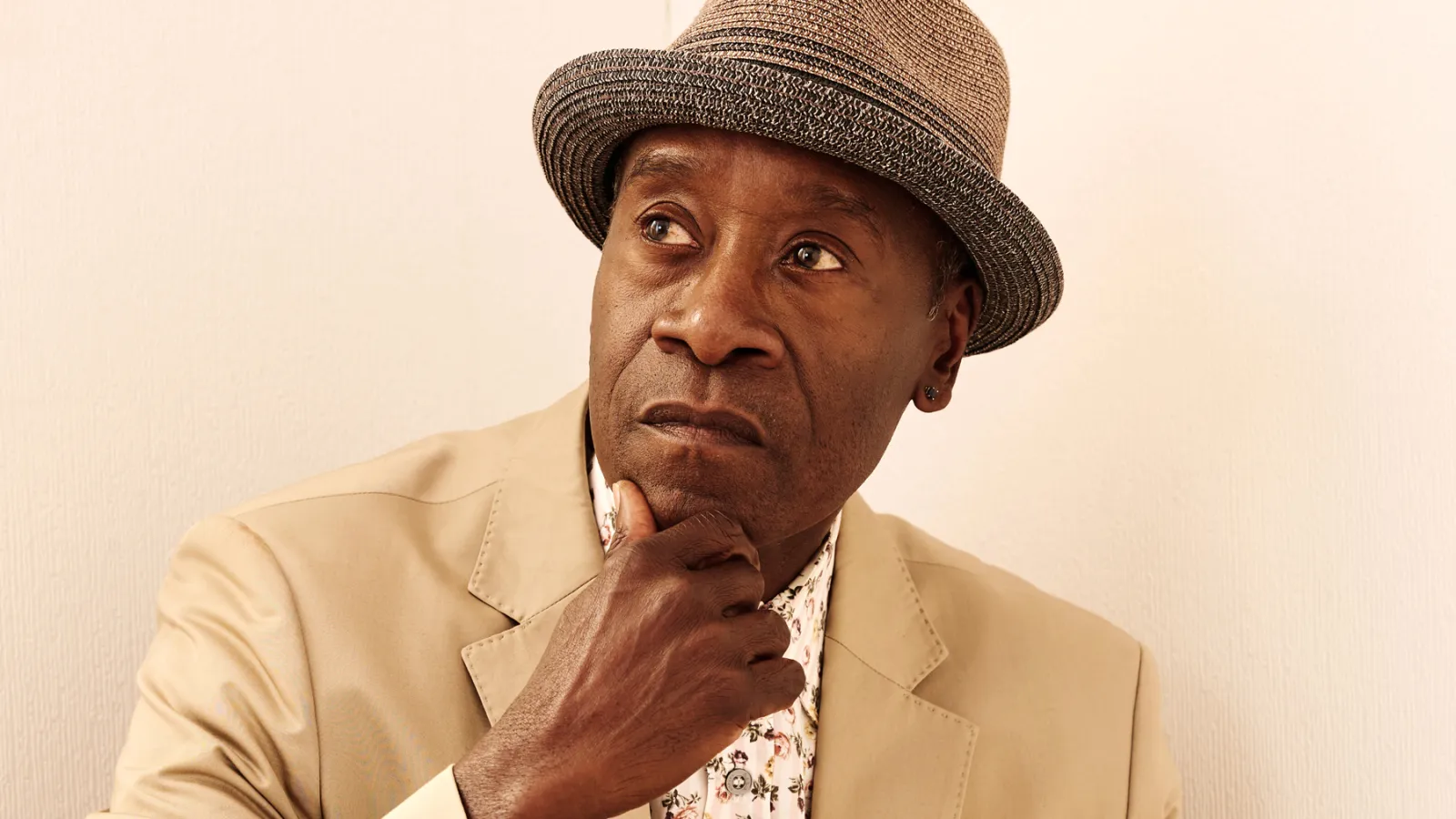
The Friday before the New York Knicks win the NBA Finals, their first in 53 years, I’m talking with Don Cheadle over Zoom. Between seas of Knicks fans on the streets, global visitors in World Cup soccer jerseys, and rumors of the Taylor Swift and Travis Kelce wedding happening at Madison Square Garden, the city has been electrified. But Cheadle, despite being at the center of it all with a starring role in a revival of Proof on Broadway, has been removed from the noise. Turns out the Broadway schedule doesn’t allow much time to participate in all the festivities. “I don’t know how many performances we’ve done, but those eight shows a week build up,” Cheadle, 61, says. “You have to take care of yourself.”
Co-starring The Bear’s Ayo Edebiri, the current production of David Auburn’s Pulitzer- and Tony-winning Proof has been open since mid-April at the Booth Theater. It is the first time the play, which closes on July 19, has been revamped since its debut in May 2000. It also marks Cheadle’s Broadway debut. Set in Chicago, Proof centers on Catherine (Edebiri), a mathematical genius who struggles with mental illness, just as her father, Robert (Cheadle), also a brilliant mathematician, did before his death. Catherine’s sister Claire (Kara Young and, later, Adrienne Warren) flies in from New York City following their father’s passing, shaking up Catherine’s universe. Robert, meanwhile, has left a final problem to be solved: Who is the author of an incredible math equation found in one of his old notebooks — him, or the dutiful daughter who’d been caring for him? Though he’s playing a ghost, Cheadle’s stage presence pulls audiences into Robert’s world of both despair and promise.
Cheadle’s wide-ranging catalog of work dates back to 1985, when he made his film debut in Moving Violations. Ten years later, he broke out in the neo-noir Devil in a Blue Dress, alongside Denzel Washington. He’s worked with Steven Soderbergh, Paul Thomas Anderson, and Warren Beatty. He’s starred in Oscar winners (Crash) and joined the MCU (as War Machine). He’s been nominated for an Academy Award (for his role in Hotel Rwanda) and numerous Emmys, and has won two Grammys (for the soundtrack to his Miles Davis biopic Miles Ahead, and for a spoken-word album). This May, he starred in Boots Riley’s social satire I Love Boosters, playing a pyramid-scheming con man, in a costume that makes him nearly unrecognizable.
Despite this proof of his own genius, Cheadle doesn’t have a strict methodology when it comes to choosing or preparing for any one role. “As you get older, you start understanding the power of this form and the power of storytelling,” he says. “To take on different characters and try to really embody them, you can potentially move culture, you have an opportunity to impact things.”
How does it feel to be in New York City during this moment of the NBA Finals?
A little nuts. [Between] the NBA Finals and the World Cup, it’s a crazy time in New York right now.
Between the New York Knicks and the San Antonio Spurs, who are you rooting for? Have you been able to get to a game?
You can’t ask me that! You trying to get me stabbed up? But, No. We are working at the time that the games are.
In Proof, how has playing Robert, who’s brilliant but also struggles with mental health, stretched or transformed your range?
I guess that’s something that is for an audience to determine, if it’s working for them or not. I know that being inside of the experience, whenever you do theater, and I’ve done a lot of it, you’re flexing that muscle every day, every night, you know, except for Mondays. [You perform] twice on Wednesday, twice on Saturday, and you’re trying to maintain what you’ve established as far as what the play is and how it’s set, but at the same time trying to find something new and different every night. It’s little accents you put on things, and ways that you emphasize different parts of it just to keep it alive and to keep it fresh, so that the audience doesn’t feel like they’re watching something that’s being done by rote. It’s the first time every time.
How do you manage self-care? Do you have a particular morning routine or are you very intentional about those Mondays you have off?
I don’t have a strict routine, no. I try to stay fit and eat pretty well. I don’t drink too much. I haven’t been smoking a lot — you know, it’s not no weed, but not tons. Just being thoughtful about your instrument, and knowing that it’s a marathon. I want to be present, I don’t want to be on stage and be a wreck and exhausted, although some interesting stuff would happen then, too!
Has that level of rigor been your favorite part of the process or do you find that challenging?
Honestly, my favorite part of the process is rehearsal. The most interesting part of it all is the discovery and digging in and finding all of the different ways you can play with it and seeing how elastic it is. But I mean, it’s all challenging. [Proof is] not an easy play. It feels sometimes like hard-hat time. When you’re not getting fed until 11:30 or 12:00 [at night] because it was a late show and you had two that day, it’s the creature aspect of it.
The acting challenge is being fully committed every night to a childlike state of play. We were talking last night, when you’re seven, eight, six years old and you’re playing, you are super committed. That’s where you want to be — you want to believe in it just as much as you did when you were a kid.
Proof was originally written with a white family at the core, but in this new adaption, the majority of the characters are Black. When I saw the play in April, Black men and their mental health was a prominent topic in the news. Following a divorce proceeding, former Virginia Lieutenant Governor Justin Fairfax had killed his wife before committing suicide at their home. Days later, a Louisiana man named Shamar Elkins killed eight children, seven of whom were his own, and wounded two women, including his wife. While physical violence is not a part of Proof, how does putting a Black family at the center of a story about genius and mental health troubles impact the telling, especially onstage?
I think there’s definitely some different ways that the audience is responding to it. For one, there’s a lot more people of color, a lot more Black people in the audience. It’s a super diverse crowd, and [that’s] not the norm. We have our own challenges with the price point — it’s not cheap to go to Broadway to see these plays. So that’s heartening and encouraging, when it’s something that people want to spend their hard-earned money to see.
This play wasn’t changed, really, to accommodate a Black family, it’s just that these themes of, like you say, mental health and legacy and genius and responsibility and property, all of these things come into play and hit differently for us in the same ways that socioeconomically, philosophically, spiritually, mentally, things hit for us differently in the world writ large. And sometimes that doesn’t work — you can’t just put a Black family in a play that was written for a white family and be like, “There you go.” But in this one, oddly, it really worked, because of these universal things. It brings into question, what does it mean for a Black family, for all intents and purposes, [to be] “assimilated.” What does it mean that Claire married Mitch [a character the audience never sees], who I don’t think is Black. What is she bringing and representing as somewhat an adversary to Catherine? It’s not physical violence that Robert necessarily is inflicting on Catherine, but there is an emotional task and weight that he has on her, and there’s a toll and a price that she has to pay dealing with this person who isn’t taking care of himself, and all of his demons coming to the fore, and she’s not really equipped to deal with it.
As far as affordability, I saw that the production has partnered with New York City Public Schools, so that students and teachers can easily attend. How does having access to the arts help people to develop as humans? Personally, how did it help you to develop to where you are?
I absolutely think bringing people into the theater who would not otherwise have had the opportunity to see plays, and this particular iteration of this play, gives so much energy and so much wind under the wings of imagination and creativity. Seeing yourself represented in a way that you’re not used to seeing and thinking, “That could be me.” There’s something that art does that is both intangible and tangible — it can open up different channels for you in ways that you think and in ways that you experience the world, that give you a leg up in tons of different things outside of being an actor or being a musician. Science would indicate that it’s turning on different parts of your brain that allow you to apply that kind of approach to things that might seem mundane.
Your earliest role as a child was playing Templeton, the rat in E.B. White’s Charlotte’s Web. Was that your first interaction with theater or did you come up with parents raising you in the arts?
Yeah, it was my first time. My parents weren’t artists. My mom was a teacher and my father was a psychologist. My sister and I, and then my brother, later, were always into, you know, singing, and performing and that kind of thing.
Where did that knack for the arts come from?
We were a playful family, both of my parents. Then I fell into a group of friends who were similar and loved to play-act and goof off, and then I found out there’s a structure to that. And it’s like, “Oh, you can create a character inside of the structure of a play? Oh, and it’s a musical, I can sing? Oh, I get to wear a rat costume?” All of it was fun, just having the experience of performing and getting to be in a playful situation.
Was that the case for your music, as well? I saw you started playing alto saxophone in the fifth grade, around the same time you were in Charlotte’s Web. You then went on to study jazz band in high school. What was the inspiration behind being a musician?
My parents were very into music. They weren’t musicians themselves, but they sang in the church choir and their record collection was Stevie Wonder, Miles [Davis], Cannonball Adderley, the Commodores, and Harold Melvin and the Blue Notes. I found all of these records and got into them and became as enamored of music as I was of acting, very early. Both disciplines are still very much with me, for sure. See my bass, I got it [points to the corner of the room].
That’s my favorite instrument!
Really? You play?
I used to coming up. I’ve forgotten my notes but want to get back into it.
Nice!
In addition to acting, you direct and produce. Which do you enjoy more, or is it kind of a blend of all three?
I like all of them, if you’re on a project that you like. They can all also be a pain in the ass, but I love the creative process, I love the storytelling. I love all the aspects of it, and putting people together who are super talented — like, “This guy is a great DP or this is an amazing actor or this is an incredible writer or musician; lets all get in the sandbox together and we can all create something really, really cool.” I’ve directed theater, I’ve directed TV, I’ve directed films — you know, that’s a different animal, and can be very stressful, because everyone’s looking to you to answer every question, and for you have to have a take. I mean, you don’t have to — there’s the directors out there on their phones all the time and they’re like, “Huh? Oh, that’s great.” But if you take it on seriously, you’re trying to be the last word on all of these things. I think the smartest thing to do in that regard is just to have a vision, be able to articulate that vision, and then find people more talented than you and who know way more and let them do their job.
In I Love Boosters, you play Dr. Jack, the leader of a pyramid scheme. It was very hard to recognize you at first, and then it was like, “Oh, shit! That’s Don Cheadle!” What was your experience preparing for that role?
I was in two or three scenes, really small, but I was just talking to Boots and he said he had a vision for this character, and he sent me a guy he kind of wanted me to lean into. He was like, “I think is your guy.” So then we were like, well, it should be a whole prosthetics thing. I don’t even know who drove that bus — probably me, but I can’t be sure. But there was a desire to sort of disappear and be unrecognizable and really push a character.
Boots is such a unique voice in filmmaking. Were you two friendly prior to working together?
I had known him [through] another friend of mine and called him because I was working on an Oakland accent for something and wanted some pointers. It was just sort of a cold call, and he was like, “What do you think about this part”? I’ve since spent more time with him, and there’s nobody like Boots. He’s one of one, you know, that brain is singular.
Proof, as you mentioned, deals with legacy. When it comes to yours as an actor, there is such a wide spectrum of roles to pick from, no two really alike. How do you view your body of work?
I came out of a specific discipline in theater, and I always wanted to play a lot of different things. I haven’t really examined why that was. I had a friend one time say to me, “Do you want to be a movie star, or do you want to be a character actor?” I said, “I want to be an actor.” And he said, “Well, you should want to be a star, because then you could do anything that you want.” I never even thought about it like that. Coming from theater school and being around and impressed by actors who did have that kind of range, I wanted the ability to be that well-rounded as a performer, because it’s fun. To the degree you’re successful or not, that’s obviously up to the audience.
Is there a genre you haven’t dabbled in that you’re interested in trying out?
I would love to work with some of these amazing Korean filmmakers. They, to me, are doing some of the most inspiring work. I was in five minutes of a Kung Fu scene with Jackie Chan once, so I’ll definitely take on some martial arts. I said at one point I thought about being in a Bollywood movie, that could be fun. But can we shoot them all in my backyard at my house? Actually, I don’t want to deal with that — I’ll do it in my neighbor’s backyard.