
“How long have I been gone?”
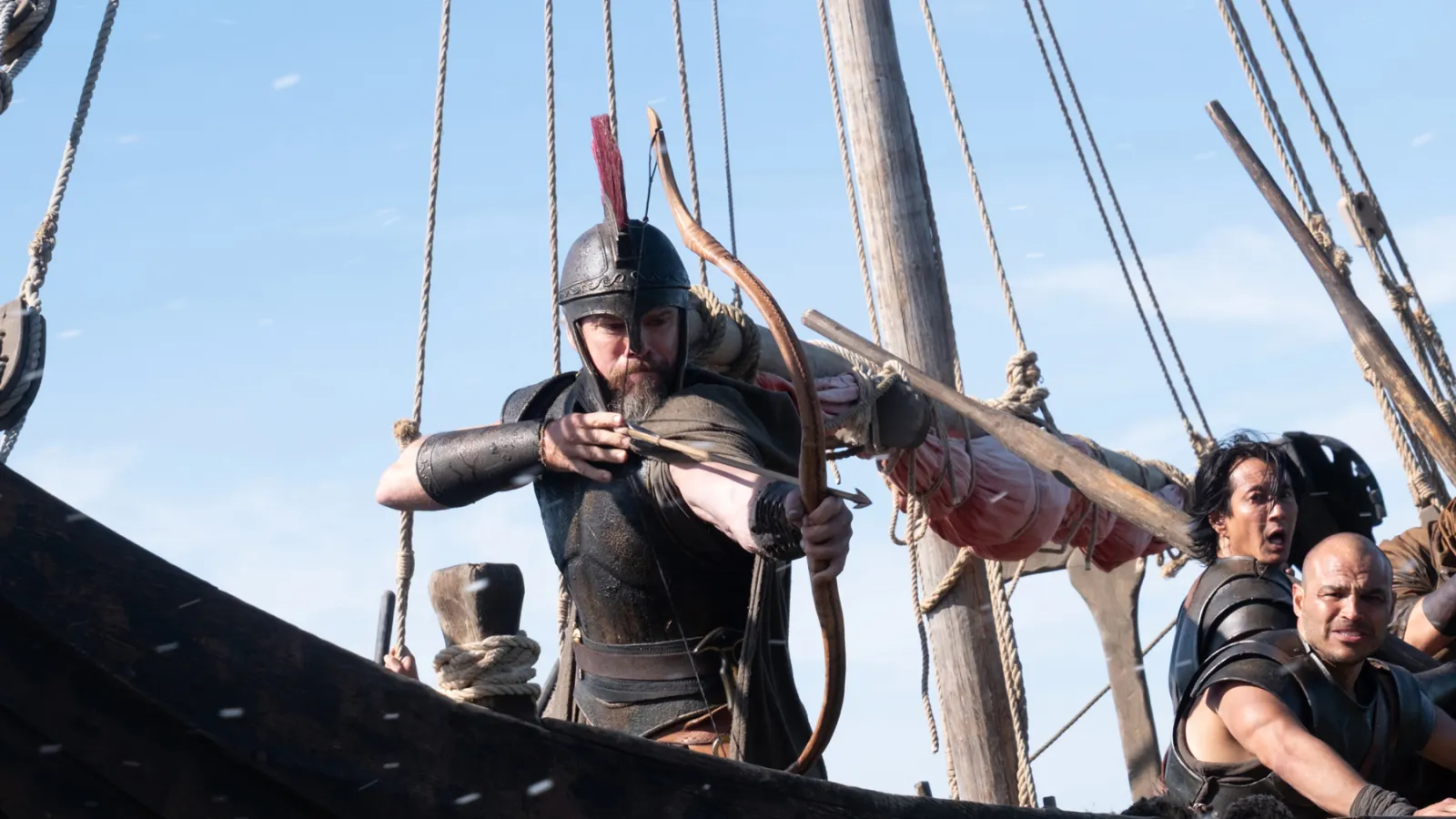
The question is asked by Odysseus — father, husband, warrior, king, and the lost soul at the center of Christopher Nolan's The Odyssey. Our man in the Bronze Age cosplay is none other than Matt Damon, rocking a hermit's beard and perfecting the look of a man who's seen too much, forgotten more than he'd like, and wants for nothing but the familiar comforts of what he once called home. The inquiry is aimed at a caretaker named Calypso, who may or may not have taken him captive. She is played by Charlize Theron. Calypso stares back at Odysseus sadly before slipping him a lotus flower and informing him that many, many years have passed since he'd last trod upon the island shores of Ithaca.
This brief yet highly relevant exchange takes place near the end of Nolan's adaptation of the literary touchstone. Or maybe it takes place somewhere near the middle. Perhaps it's located in what might normally qualify as the third, or possibly fourth act, if the film adhered to anything close to a traditional movie structure. After checking our notes, we're pretty sure it happens shortly after the end of the second hour, yet definitely before the beginning of the 10th or 11th hour. Frankly, it could be days, or even weeks, inside your local theater before a viewer eventually gets to the conversation that will finally send Odysseus back to where he belongs. Time has been the great thematic obsession of the filmmaker behind Memento and Tenet: its passage, its slippage, its toll. And while you, the viewer, are in this great tragedy's thrall, it's virtually impossible to track the amount of time you've spent in the company of The Odyssey's heroes, villains, gods, and monsters. The experience of watching — if that's not too passive a verb in this instance — an immersive, IMAX-sized behemoth like this is intoxicating, transporting, and borderline dissociative. How long have we been gone?
All we know is that we have stepped into a Christopher Nolan film, a phrase that still holds an immeasurable amount of currency in an era when movies are viewed on pocket-sized devices and the concept of cinema is synonymous with a Golden Age as bygone as ancient Greece. Having recently delivered a towering biopic of Robert J. Oppenheimer, political pariah and the brain behind the atomic bomb, the filmmaker found himself wondering how one follows up the story of the man who had become Death, destroyer of worlds. His solution was to rewind to the beginning of narrative, and to render Homer's ode with a scale, scope, and sheer devotion that defies even the larger-than-life standards of most biblical — and pre-biblical — spectacles. Go big or go home, they say. Nolan offers a counterpoint for those entering his take on the Rosetta stone of hero's journeys: Why not do both?
“Tell us of a complicated man,” demands the poem's first line. (This comes from the extraordinary 2017 translation from University of Philadelphia professor Emily Wilson, which has attracted unsolicited controversy from trolls who make the usual Nolan bros online seem downright chivalrous.) Once upon a time, Odysseus ruled over Ithaca alongside his queen, Penelope (Anne Hathaway). They had a baby boy named Telemachus (Tom Holland). King Agamemnon (Benny Safdie, briefly glimpsed without a face-obscuring helmet) and his brother, Menelaus (Jon Bernthal), enlisted Odysseus as their military strategist when they decided to wage war on Troy — there was this whole thing with a lady named Helen (Lupita Nyong'o), her face launched a thousand ships, yada yada yada. Go read The Illiad, it'll fill you in on the details.
So off Odysseus goes, leaving behind his family and his loyal subjects. He helps the Greeks win the war after a decade's worth of battle, courtesy of a cunning plan involving a hollow wooden horse. Most of the Greek warriors return to their respective points of origin after the victory. But Odysseus and his troops get waylaid on their way back, to put it mildly. In his long absence, Ithaca has fallen prey to legions of suitors who vie for the “widowed” Queen's hand. The main contender, Antinous (Robert Pattinson), is particularly underhanded and aggressive in terms of pursuing both Her Majesty and, by extension, the throne.

Hathaway and Holland as mother and son in The Odyssey.
Melinda Sue Gordon/Universal Pictures
A now-grown Telemachus is not a fan of these hedonistic parasites, nor of the way they've been draining the castle's coffers and wine cellars with years' worth of nightly banquets. Both he and his mentor, Eumaeus (John Leguizamo), believe Odysseus is still alive. Under the cover of night, Telemachus sets off to Sparta to find his MIA father. Time — that word again — is of the essence.
Other than a glimpse of the famous Trojan Horse, depicted as an almost abstract art object half-submerged on a beach — one of several dozen shots that will make you swoon and gasp even without context — Nolan begins his Odyssey on the home front instead of the heat of battle. He's patiently setting up the stakes before getting around to the more mythical, adventurous aspects familiar to readers: the siege on Troy, the Cyclops' cave, the song of the sirens, sacrificing a half dozen crew members to a tentacled beast. The initial emphasis on Telemachus' handwringing and Penelope's mournful resignation amid palace intrigue telegraphs that, despite the spectacle soon to be doled out in bulk, Nolan is essentially concentrating this epic poem into a domestic drama writ large. Strip everything away, and its a story about a family reunion. Nolan wants that intimate notion of a desperate husband, a hopeful wife, and a son seeking answers to be the baseline. Everything else is just sound and fury.
Well, not exactly just sound and fury. The filmmaker may have eschewed the usual propulsive, zero-to-120 mph momentum of modern blockbusters for the more languid, flowing rhythms of a bard's song — his Odyssey replicates the source material's stanza-based lyricism better than you think a $250 million extravaganza could — that will strike some viewers as wallowing. But Nolan is mounting an all-out campaign on eyes, ears, and nervous systems, and he and Oscar-winning cinematographer Hoyte van Hoytema utilize the sheer size of IMAX imagery (it's the first narrative feature film to be entirely shot in the format) to the utmost. Everything from a claustrophobic view from inside a crowded gift horse to a ship being beaten by Poseidon's wrath is blown up to maximum proportions. A tiny figure in a vast landscape turns negative space into a galaxy of emptiness. A “standard” battle scene feels as if you're staring at ceiling of the Sistine Chapel. Nolan and his behind-the-camera collaborators want to wow you. If they can't do that, then they will at least overwhelm you. Yes, it's a human story at its core. But you couldn't separate the intimacy from the maximalist presentation even if you wanted to.
Pattinson as the hateful Antinous
Melinda Sue Gordon/Universal Pictures
This is supersized Homer, an epic of everyone epics, as well as a star-studded ensemble piece amid so many giant-screen vistas and doggedly realistic interpretations of ancient, far-out mythologies. Familiar faces magically appear to deliver exposition or flesh out archetypes — as with buses, if you don't like whichever A-lister is onscreen, just wait a few minutes and a new one will swing by. Here comes Zendaya, in the role she was born to play, aka the goddess Athena; there goes Corey Hawkins as an ill-tempered suitor who would be king, Elliot Page as a sacrificial soldier, and Mia Goth as a scheming maid. Pattinson slips into the sniveling, slimy mode he's perfected over a number of grungy post-Twilight projects; the dude gives great punchable-face villainy. Leguizamo virtually steals every scene he's in. Samantha Morton's chilling take on Circe helps turn a body-horror vignette into a genuine, slow-fused nightmare. We could have watched her cat-versus-mouse exchange with Damon for days. Maybe we did watch it for days.
As for the leads, Hathaway can do teary anxiety and Holland can do boyish wonder flecked with hard-circumstances grit in their sleep at this point. Neither of them do, thankfully, and you can see how they're determined to make these roles their own. The same goes tenfold for Damon. The actor has a knack for wounded he-men. Even his big Bourne-in-a-breastplate action moment during the battle royale climax is offset by what comes right before it: a quiet, coded conversation with a loved one, as big in its emotional resonance as in its visual panache.
There is only one real name above the title here, however. You may either roll your eyes at the cult of Nolan or view the man behind Inception as the second coming of Kubrick. Detractors and agnostics are bound to cry “hubris” and let loose the social-media dogs of wars; anyone who still harbors grudges over those Dark Knight action set pieces being slightly inconsistent will have a field day with some of the messier melee sequences. Ditto anyone who squirms at a movie bending over backwards to present antiwar bona fides while simultaneously delivering a say-hi-to-your-friends-in-hell retribution moment designed for bloodlust applause. Others will simply scream themselves hoarse with hosannas before hitting the halfway point.
What you tend to walk away with after bearing witness to The Odyssey, arguably Christopher Nolan's best work after 2017's Dunkirk, it is an overall sensation of awe. It is one of the most dynamic movies in recent memory, simply in the way it attempts to — and largely succeeds — balance such incredible highs and delicate lows, deafening bursts of divine wrath with quiet pauses of contemplation, episodic moments of old-school Saturday-matinee fantasy with the sort of grounded interactions associated with smaller projects. A cynical wiseass might, sight unseen, crack that it took one of the greatest epic tales ever told to match finally find material that matched Nolan's ambitions. Once you've stepped into this film and let it sweep you up, however, it's hard to deny the accomplishment that he's brought to the screen. You may have no idea how long you've been gone after you've seen it. You just know that you want to go back again.