
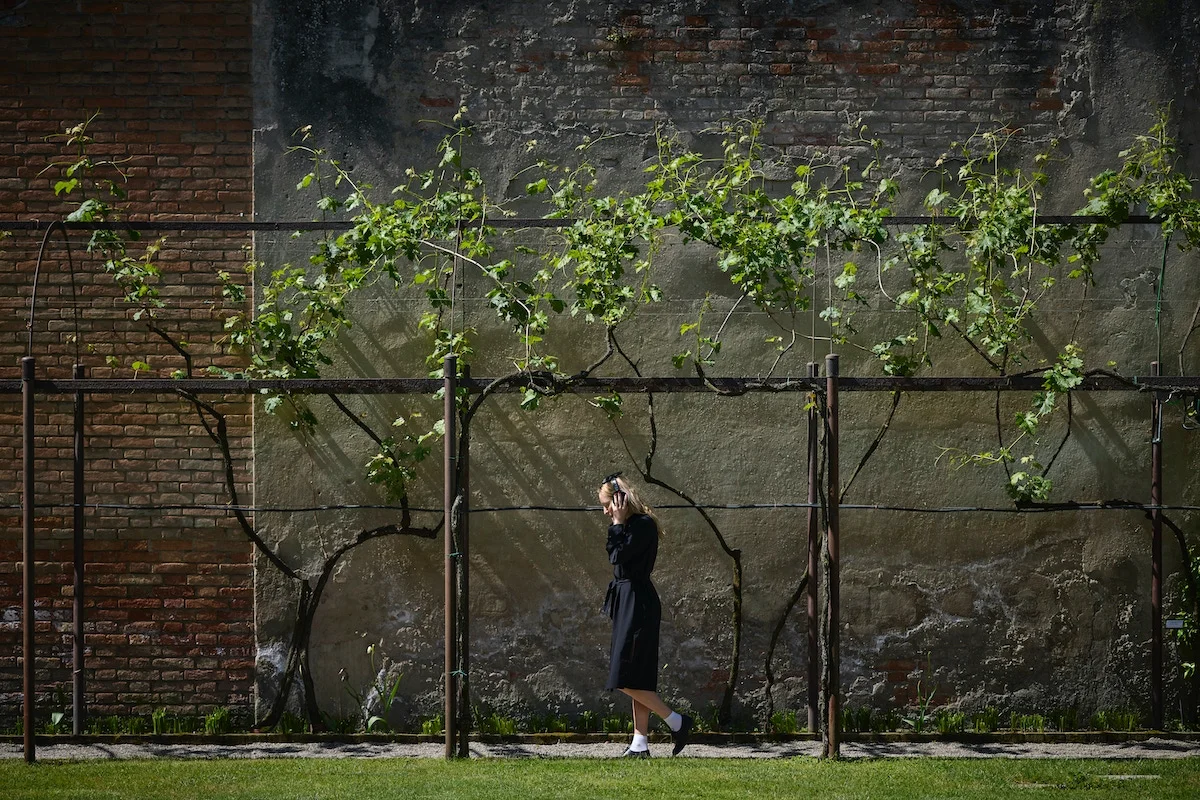
The Ear is the Eye of the Soul (the ear is the eye of the soul) explains the poster positioned at the entrance to the Mystical Garden of the Discalced Carmelites in Venice, a monastic green space hidden inside a 17th century convent which since last week has hosted the much talked about and eagerly awaited Pavilion of the Holy See for the Art Biennale, and from the moment we enter we cannot help but witness the change in sound perception to which we are called even just by the location.
The wind blowing, shaking the leaves. The birds chasing each other chirping. A train whistle. The waves of the lagoon crashing against a small mooring. And then a lady closing the shutters, the chirping of a seagull. Although the garden shares a wall with the Venice Santa Lucia station, the tourists and the confusion of the lagoon seem very far away. Here a spiritual peace reigns, a secret kept among the shrubs and flowers, among the medicinal plants and short rows of vineyards.
There could not be a better place for the soundwalk created by one of the most important curators in the world, Hans Ulrich Obrist, and Ben Vickers, with the support of Soundwalk Collective. A sound walk dedicated to Hildegard, one of the leading figures in the mystical imagination, whose work, in the words of the curators, «presents itself with renewed strength as an invitation to care, to interiority and to the possibility that art – in connection with the sensitive nature of being – can participate in healing».
This is how walking works. Headphones are provided. In silence, you walk through the garden where 21 artists – from some of the key names of composition such as Terry Riley, Brian Eno, Laraaji, Suzanne Ciani, Meredith Monk and pop and rock music such as Patti Smith, Fka Twigs, Jim Jarmusch, Devonté Hynes (aka Blood Orange), as well as our own Caterina Barbieri – have prepared site-specific compositions that resonate in various areas of the space. In practice, the headphones, thanks to receptors, receive the various compositions as we walk. It begins with a sacredly inspired song composition by Holly Herndon and Mat Dryhurst, and after about twenty steps the song begins to relate to the expanses of sound conceived by Brian Eno, whose sounds occupy the immediately following part of the garden. And so, between one station and another, the artists' sound works dialogue.

Photo: David Levene
The experience, let me tell you, is truly sacred. In this little wonder of flowers and plants reborn with spring, we enter a sonic paradise that has few equals. The extraordinarily high quality of the compositions enhances every single centimeter of reality, whether visual, tactile or auditory. Nature and sound are in relationship, in intersection, and we float within them. It is never clear where a composition physically begins or ends: everything is sound. Choirs, keyboards, drones, pianos, recited words. But despite the headphones there is no abstraction, indeed, we are present here, life within life. The seagulls, the trains, the bell towers, the birds pierce the acoustic isolation of the headphones, further mixing the here and the beyond, life and music, the sacred and the spiritual.
At the end of the garden, in a small chapel, Patti Smith recites a poem. On the left side, under the purple Judas tree, Fka Twigs makes us listen to buzzing insects, while on the right we hear the names of all the medicinal and aromatic plants present in the garden. Under the tree of life, if we sit, we sink into the long organ notes of Kali Malone. The compositions play in loops whose duration we cannot know, not allowing us to have any control over what we will hear and what, if any, we will miss. But they allow us to interact with the sound production, inviting us to look for stereophonic differences, or points of intersection between the works. It's a game: because it is in the game that we find purity.
The ear is the eye of the soul, it was said. And after a good hour in motion (but there are those who prefer to sit or lie down, the interpretation of the space is free), we cannot help but fully understand this statement.
The Holy See Pavilion is a tribute to listening, and therefore also to spirituality, and to life itself. It's a time to slow down, getting back to the pace our body should be at. Listening, not only to the sounds of nature or the compositions of these masters, but also and – above all – listening to ourselves. And of everything that is near, around, above us.
