
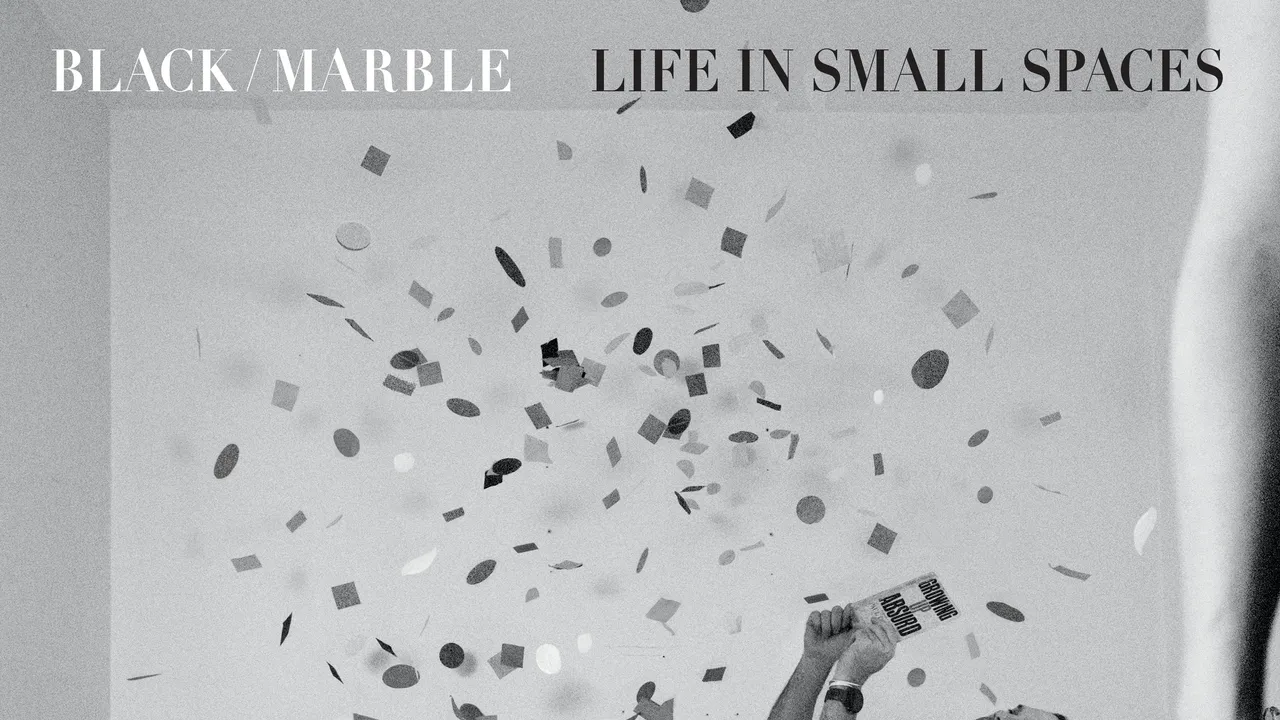
For nearly a decade and a half, Chris Stewart has been diligently plugging away at a very specific kind of synth pop. His earliest music was bleary eyed and hypnagogic, and sounded like he had spent a lot of time hanging out with Blank Dogs and Wild Nothing, as well as his collection of OMD and Human League records. There was a hint of goth, too, but just a smidge, like a guy who only puts on eyeliner when no one else is around to see. Over time, the fog cleared, and Black Marble became a dependable act for purposefully retro, name-the-influence ’80s music—like a sentient Dark Entries reissue come to life. But in spite of Stewart’s obvious talent, the records felt mostly like hero worship, and a move from New York to L.A. and back again didn’t change things. But something’s different on his fifth Black Marble album: He’s discovered guitars.
Life in Small Spaces bursts to life with a bright, shiny guitar riff and never looks back. The melodies are stronger and the songs sound sunnier, as if Stewart’s one-man band made a leap from Movement to Power, Corruption & Lies (or, maybe more accurately, to “Cries & Whispers”). But if you listen more closely to his vaguely Dracula-sounding voice, the vibe is not as chipper as it appears to be. “It Always Comes to Me” is jaunty and upbeat, but underneath, Stewart’s lyrics are manipulative and self-satisfied (“I can wrap you up in words I’ll never mean”). On the ultra-catchy “Anything,” over a riff that sounds like Pylon on amphetamines, the narrator is essentially arguing with himself, peppering the chorus with private interjections (“You’re just crazy”; “No, no”) as he sings about a relationship he’s ambivalent about.
No score yet, be the first to add.
The album presents a series of sketches about people in prisons of their own making, each neatly framed like miniature period-piece dioramas. On “Panopticon Calls,” the narrator luxuriates in the possibilities of social media, taking pleasure in both solitude and the ability to surveil the world around him—the very idea of “bedroom pop” gone wrong. It also has one of Stewart’s best guitar riffs, warbly and warmed over, as though his strings were detuning with each strum. “Get Back Up” smudges its strident rhythm with warped, Boards of Canada-style chords, underlining words that sound like a self-directed pep talk curdling into embarrassment: “Never get the timing right/If you don’t care then at all/Then I won’t/Can’t believe I had to lie.” The new focus on guitar adds an expressiveness—and an incisiveness—that wasn’t there before.
Stewart’s affected baritone often leads him to chew up syllables or shorten words. The lyrics aren’t always clear, and he sings in imagistic phrases and ideas rather than full narratives, which means that Life in Small Spaces strikes a good balance between straightforward and a little out there. If you treat the album more like mood music, Black Marble’s musical personality—a disgruntled but ultimately chill guy—is pretty easy to get along with. There are less sinister tracks, like “Other Man’s Dream,” where briefly covets other people’s lives before recognizing that it’s better to just accept what you have and let the world go by. It makes me think of a synth pop “Watching the Wheels,” the sound of contentment and vague yearning wrapped up in one.
