
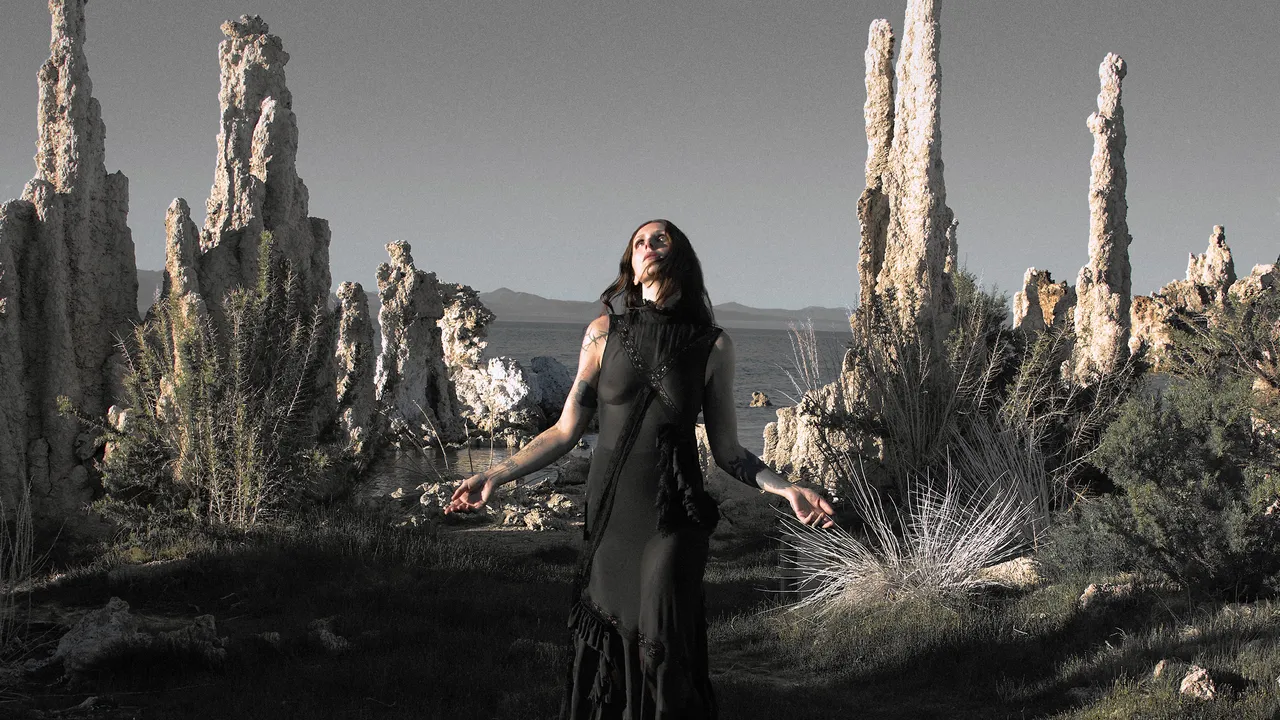
“I’ve shed a thousand skins,” Chelsea Wolfe sang on the opening track of 2024’s She Reaches Out to She Reaches Out to She. She added, in a vicious whisper, “That shit does not define me anymore.” With its grimy production and rusty industrial edge, She Reaches Out was the sound of Wolfe standing atop a turret in a lightning storm, calling down the heavens and casting off old versions of herself. It was the most well-rounded album of her nearly 20-year career, one that felt like the full realization of a project that long swirled dark folk, doom, industrial, and goth influences together. Even when it was just her and an acoustic guitar, Wolfe’s music has had a focused intensity that makes her the kind of artist metalheads love to listen to when they don’t feel like listening to metal. Alas, if her new album The Dark is to be believed, that shit does not define her anymore, either.
Once the cycle for She Reaches Out came to its conclusion, the 42-year-old Wolfe had a common middle-age realization: She’d been living too long by someone else’s values and desires, trying to fulfill their expectations and ignoring her own. The Dark is meant to be something like a change-of-address form: This is where I live now. From this perspective, Wolfe’s view is clearer, as is the voice that she uses to proclaim her newfound spirit. The songs are less volatile, more comfortable, and profoundly wounded. At times they remind me of late-era Nick Cave, or the Nine Inch Nails Tron ballad “Who Wants to Live Forever?” This is prestige goth: Never before has she sounded as direct or grand. As a psychological transformation, it’s admirable, but such transparency can be artistically dodgy, especially from a musician whose work has often been powered by mystery.
No score yet, be the first to add.
The songs are more technically sharp and expertly rendered than anything in her catalog. With longtime colleague Ben Chisholm and newcomer Jennifer Decilveo collaborating with her on the production, Wolfe unfolds the album in a space that’s still and eerie, like the air after a tornado. Nearly every song feels like it takes place in an aftermath of some kind. Perhaps because of this, The Dark grows in power and confidence over its runtime. When she reaches the penultimate “Death is Not the End,” she’s “floating in the ocean/an angel in the kelp” while a swell of guitars from Chisholm and Nine Inch Nails’ Robin Finck lifts her like the waves at Praia do Norte.
It can be fascinating to hear Wolfe put herself back together, but the album suffers for its structure. Particularly in its first half, she writes in plain language about the relationship that cut her off from herself. “I’m letting you go/I’m letting you win/I need to know who I am without you,” go the opening lines—lyrics delivered in a warm and certain voice that falls somewhere between Florence Welch and Christine McVie but come across as generic, particularly when placed over the song’s dusky Americana. Many of the songs are addressed to “you,” and while we get the sense that Wolfe is shooting for the kind of austere language that comes when a person finally musters the strength to confront their antagonizer, the relative lack of sharp edges and Wolfe’s conventionally beautiful voice keep things too clean. By revealing herself so plainly, she risks anonymizing herself.