
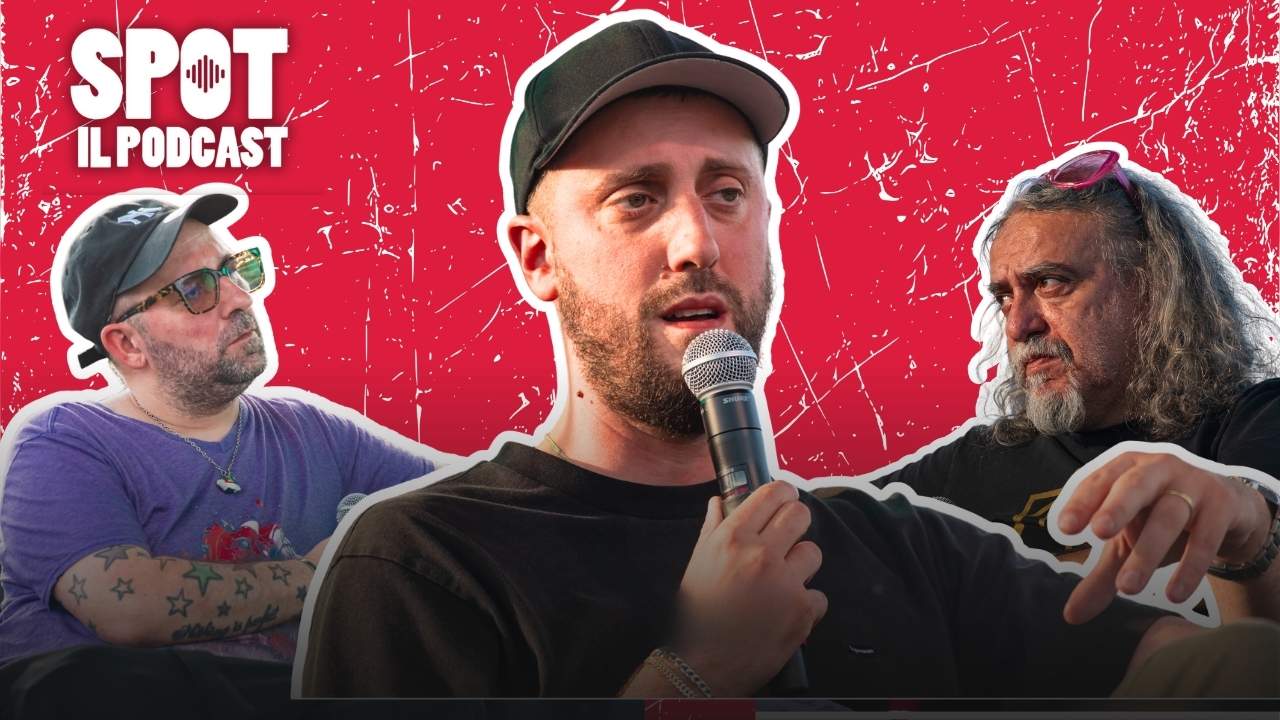
Marco Masoli was a guest of SPOT – The Podcastthe format hosted by Michele Monina And Massimiliano Longo which is recorded live, outdoors, at Spot Music Fest of Bareggio, in the Arcadia Park on the outskirts of Milan. Label Director of Atlantic Records Italythe label of Warner Music which in the first half of 2026 established itself as the strongest on the market, Masoli brings to SPOT a story that dismantles the image of the record company all algorithms and numbers.
What emerges is the story of an anomalous path, from Bocconi to consultancy for banks up to the recording industry, and at the same time a lesson on how the A&R profession really works today: what matters in scouting, how important numbers are, and why intuition and relationships still beat artificial intelligence.
An anomalous path: from Bocconi to the banks
Masoli doesn't come from music. Graduated in economics from Bocconi, he began with the classic path of a graduate in economic disciplines: five years of consultancy in Accenture, working for banks, wearing a jacket every day. An experience that, he says, he doesn't deny at all.
In the meantime, however, music was already there, cultivated as a hobby in every free moment, on weekends and during breaks. He opened independent labels, managed small artists, booking, artistic direction of clubs in Milan. All without the expectation of making it a profession: he had never tried to work in music, because he didn't see it as his future. An activity which, however, had built him a small network and the concrete practice of almost everything a record company does.
From Spotify to discography: “I follow people more than work”
The turning point came in 2016 with a position as strategy manager in Spotifyat a time when the platform was beginning to establish itself. These were the years of the trap explosion, a world that Masoli didn't know at all, used to listening only to international music, and which he had to study from scratch because his job was to bring the content that people wanted onto the platform. That experience allows him to get to know the majors on the other side, with their teams who come to propose artists to him.
From there a path guided more by people than by seats: a colleague follows DAZN for three years, then in 2021 it finally enters the real discography, in Sonyas A&R. In 2023 he moved to the artistic direction of Warnerup to the new adventure driving Atlantic. The key to all his choices, he says, was following people rather than work.
The numbers matter, but they come later
On the relationship between instinct and data, Masoli is clear. The numerical part, he explains, comes later: monitoring the progress of the songs and albums in a schematic way is fundamental, but the choice of signatures and singles remains immaterial, uncountable. You don't sign an artist just based on the virality of a song.
At a time when thousands of songs are released every day, what makes the difference is that original thing that stops you scrolling: a defined aesthetic, a precise identity, a melodic line that stays in your head. A sensitivity which, he says, is not even completely explainable or teachable, and which depends above all on how much music you have listened to in life.
The chameleon record company: “in a record company you don't show up in a jacket”
One of the values that Masoli claims is that of not being a genre A&R. Working with artists who are very distant from each other, from Geolier to Annalisafrom Shiva to Achille Laurorequires an almost mimetic ability to adapt to the context.
The concept summarizes it with the image that sets the tone for the whole episode: being credible for the artist you want to sign. If you're going to sign a 17-year-old rapper, you have to be credible aesthetically and linguistically, the same way you have to be with a pop pianist. And this is where the direct comparison comes in: if you go to an interview in an investment bank you show up in a jacket, with a certain language and a certain aesthetic, but if you go to an interview in a record company in a suit you can't show up. Understanding who you have in front of you and how to talk to them, for Masoli, is a value that applies to everything.
How scouting has changed
The most interesting story concerns the evolution of scouting. Once upon a time we went to clubs to see the artists live, and perhaps after the concert we stopped to talk to the artist and his team. Today the mechanism has been reversed: if an artist is already doing live shows, an A&R is most likely late, because it has already been signed by someone else.
You have to move in reverse, early and very quickly, because the competition is very high. We often move when we see something happening on a single song on social media, TikTok and Instagram in mind, and then understand how futuristic the artist can be. But one method remains valid forever, Masoli underlines: word of mouth. If you work well with a manager and he trusts you, when he meets a new artist he is more likely to bring him to you rather than to a competitor.
The artificial intelligence that is not enough
On the role of artificial intelligence in scouting, Masoli is disenchanted. Many tools for doing research are arriving internationally, and there are a thousand discussions around AI that should help A&R. But in practice, at least at a local level, the automatic reports with the unsigned artists to be signed often prove useless: in most cases they have incorrect metadata and propose artists who are already signed, or already known and evaluated.
A tool still very late, he says, compared to intuition, practice and word of mouth. In a small industry like the Italian one, when an artist begins to emerge we talk about it, and the most precious thing is having people who point it out to you first.
Atlantic and the pressure of numbers
In the first half of 2026 Atlantic was the strongest single label in Italy, with 29% of the entire Top 100 Singles, driven by names like Geolier, Achille Lauro And Annalisa. A result that brings with it a precise pressure, that of international expectations on market share and budget.
Marco Masoli he doesn't hide it, but scales it down by character: he likes what he does too much to experience it as a burden. He says he considers himself lucky to have work and passion coincide, which pushes him to never switch off. The pressure remains, especially because Atlantic it has relaunched for three years with very strong growth and has a weaker catalog than its competitors, which forces it to focus on a lot of frontline, many timed releases to avoid suffering peaks in market share. And then, he admits, you also need luck: because the songs aren't made by the record companies, and you have to have the artist who gives you the right album or single at the moment you need it.