
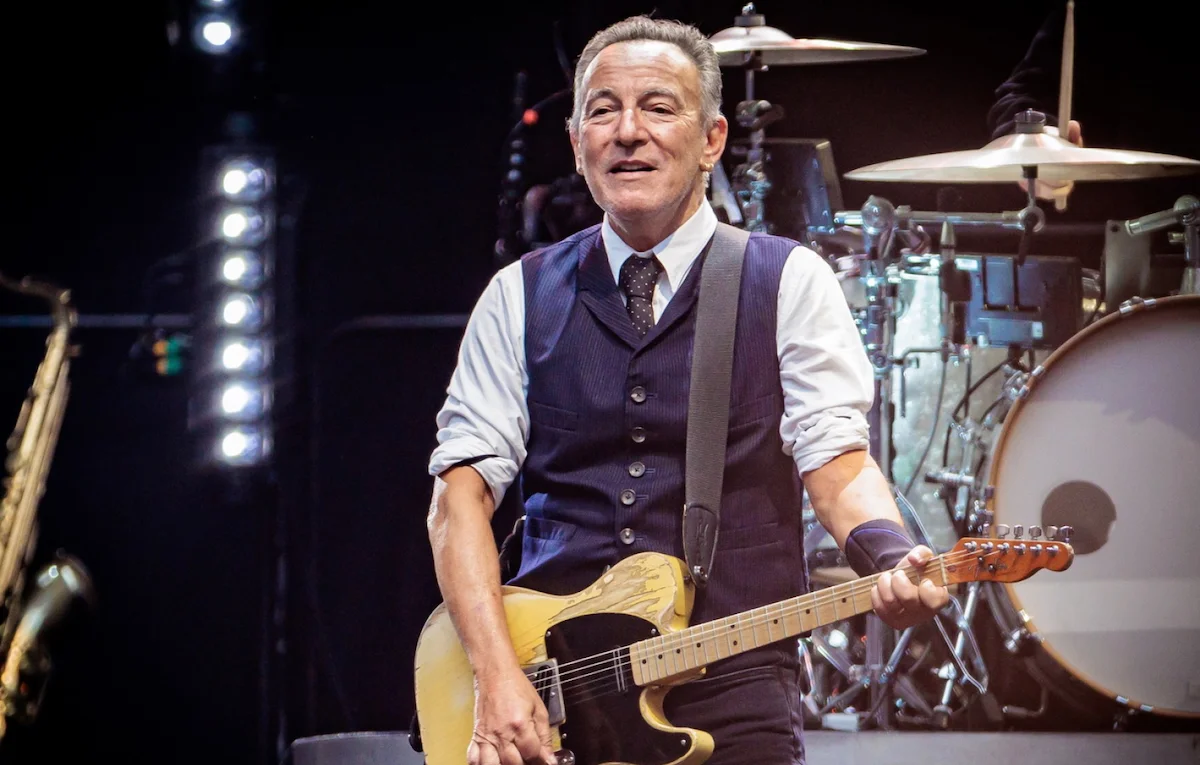
Museums dedicated to the idols of when you were a teenager shouldn't be made. Will they end up making one for David Letterman and one for Reggie Jackson? They will invent a study center dedicated to the bunny of Penthouse Corinne Alphen? When I listened Born to Run on the record player in the basement of my house in Edison, New Jersey, or when I sang the lyrics with 22,000 other people at Madison Square Garden on the nights when Bruce Springsteen preached hope and did it for three and a half hours, I wasn't looking at a work of art, I was consuming the fuel necessary to get through adolescence. Springsteen is no more a guy who can be locked behind a display case than a 1am bike ride to sneak into Samantha Blodgett's house.
And so yes, the idea of going to visit the Bruce Springsteen Center for American Music, which cost 50 million dollars and opened in June, excited me a little and made me a little nervous. Time can sterilize feelings just as history can reduce miracles to dates to be learned by heart. I know there are Catholics who go on pilgrimages to see the bones of saints and feel the presence of God, but I have visited the Hiroshima Peace Memorial, the National September 11 Memorial and Museum, and the Holocaust Memorial Museum and none of them made me cry because of the history they carry with them. The Rising And Streets of MinneapolisYes, those made me cry. Looking at a real Chagall painting or entering a Frank Lloyd Wright building is a first-hand experience. I feared that it would require a leap of faith that I wasn't capable of and that I would distance myself even further from my old self.
Even the land on which the center sits was important to my teenage me. It's on the campus of Monmouth University, where I spent a summer in high school smuggling alcohol under the noses of the hippies who taught us public policy analysis at the Governor's School of New Jersey. The museum was created to collect in one place the memorabilia donated by fans to the Asbury Park public library, which had stored it in a warehouse. They were invaded by visitors and overwhelmed by donations. In 2011, the library offered the Springsteen collection to Monmouth, which first rejected it and then placed it in a small Cape Cod-style building across the street. When a former student, Bob Santelli, heard about it, he called Springsteen.
Santelli was a music journalist. He met Springsteen in 1968 and began writing about him in 1974, later co-signing Max Weinberg's book about the E Street Band. He left journalism when the founder of Rolling Stone Jann Wenner asked five authors to work on the launch of the Rock and Roll Hall of Fame. Since then he has continued to create museums dedicated to music such as the Experience Music Project and the Grammy Hall of Fame. Over the past decade, many new music museums dedicated to individual artists have sprung up: the Buddy Holly Center in Lubbock, Texas; the Woody Guthrie Center and Bob Dylan Center in Tulsa, Oklahoma; the Louis Armstrong Museum in Queens, New York; the Johnny Cash Museum in Nashville, Tennessee; and the future Beatles museum in London. And so in 2016 Santelli proposed to Springsteen to do something similar.
Springsteen feared that a museum dedicated exclusively to him was not compatible with his image as a man of the people and so he proposed donating his archive consisting of 48,000 pieces if Santelli placed it in the context of a center dedicated to the entire history of American music. Furthermore, it was something that the former journalist had been trying to do for about twenty years by promoting the idea of a large museum in Washington to tell the story of the most important American cultural export product (no offense to fast food). Springsteen's idea is that as time passes and his relevance diminishes, his story will be reduced to a single showcase.
“Bruce,” says Santelli, recalling the two inaugural concerts, “told me: 'I'll be there, but I don't want to be the star. When you advertise it, I want to be low down, under the letter S in Springsteen.' Except that the second show was dedicated to post-war music and I told him: “You'll have to open by playing Elvis.” And he: “I never open”. He did it and sang Jailhouse Rock.
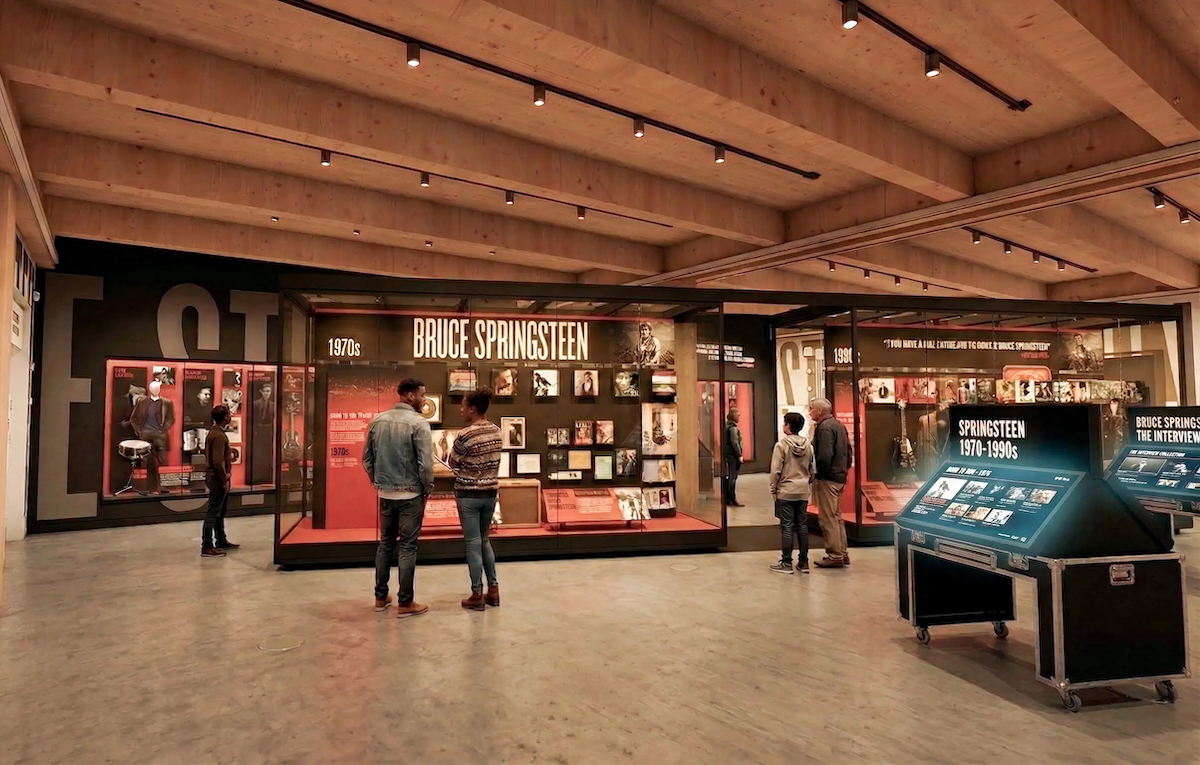
Photo: C&G Partners LLC
Along the narrow road that leads to the museum, designed to resemble a walk along the seafront surrounded by dunes, you arrive at a two-story steel building that has been specially rusted to resemble the carpet factory where Springsteen's father worked. It really feels like you're four blocks from where Bruce wrote Born to Runalso because that's where we actually are.
The visit begins in a 240-seat auditorium with denim-covered seats where a 25-minute film is shown in which Springsteen holds a sort of introductory course on American music seen through the lens of a baby boomer. After the screening, Melissa Kozlowski takes me to the ground floor where there are two rooms dedicated to a temporary exhibition on American music without any reference to Springsteen. My enthusiasm fades to zero just as it did at the Academy of Motion Pictures museum, where C-3PO and R2-D2 seemed to have gotten lost looking for a Hard Rock Cafe.
“This shouldn't be a celebrity display,” Kozlowski says. «It should make people think. It's not simply a tag that says, “This is Madonna's bra and these are Madonna's panties.” It tells you about the role of gender and expectations of women in American society. We try to stimulate deeper conversations than those that would be had over mozzarella sticks.” Madonna's bra and panties, like much of the material on display downstairs, were lent by the Hard Rock Cafe, the score of God Bless America It was purchased on eBay and I'm starting to crave mozzarella sticks.
I meet Santelli on the upper floor, the largest one, dedicated to Springsteen memorabilia. There is a high school notebook in which he proposed names for musical groups (almost all of them contained the word “Buffalo”), the tiny black leather jacket he wears on the cover of Born to Runthe TEAC Tascam 144 Portastudio with which he recorded alone Nebraska. And again, the Telecaster that he took on tour for years, the jeans he wears on the cover of Born in the USAwhich a Levi's employee visiting that week identified as already ten years old when they ended up on the cover, and the red hat peeking out of his back pocket, a gift from a friend. It says “REMBASS” on it, the name of a military system developed at a New Jersey Army base for use in Vietnam.
Santelli, 74 years old and with arms protruding from his black t-shirt sculpted by a life spent surfing, understands my fears. «We are not a museum, we are an archive with exhibition spaces and a theater for performances». He is aware of the limitations of the memorabilia put on display. “Millennials aren't impressed when they see Bruce Springsteen's boots, you have to fit them into a bigger story.” He borrowed material from the Hard Rock to construct this kind of narrative, which will be enriched by the newly acquired Jann Wenner archives and another collection he hopes to obtain soon. He is convinced that the music museum of the future must be interactive and is planning exhibitions that go in this direction. And if on the one hand it is fascinating to scroll through the drafts with the changes to Springsteen's lyrics on a screen (the phrase “Well, they blew up the Chicken Man in Philly last night / They blew up his house, too” was present from the first draft), on the other hand there is the risk that concert footage and interviews will not be very different from what can be seen on YouTube.
Springsteen, who has curated his artistic legacy with the same care he dedicates to his lyrics, writing an autobiography and telling his story in the Broadway show, was not involved in the creation of the center. He simply donated the items, reserving the right to take some of them back to wear or use in concerts. «He made no contribution. Zero. I didn't even know if I was going in the right direction,” says Santelli, who panicked when Springsteen visited the center just a few weeks before it opened. “Sooner or later I'll have to ask him: why did you let me do it?”.
I like to think that Springsteen didn't get involved because he believes this will never become a museum dedicated to him. Of course, in the first few weeks people like me will come on pilgrimage to see that Telecaster. But, as Kozlowski explains, while pointing to Madonna's bra and panties, the center's goal is to fill the parking lot with school buses. “We don't want to talk to the converted, to Bruce fans,” says Santelli. “Bruce and I are most interested in talking to their grandchildren and making sure they have the opportunity to observe American history and culture through music.”
It's a museum designed for high school me. A museum that would push me to read A People's History of the United States by Howard Zinn, which I saw among the books in Springsteen's personal library and which is on sale in the shop. It would push me to find out who Jackie Wilson and Benny Goodman were. Getting to know Woody Guthrie's protest music. And then go home and listen to the music of this guy called Bruce Springsteen.
From Rolling Stone US.
