
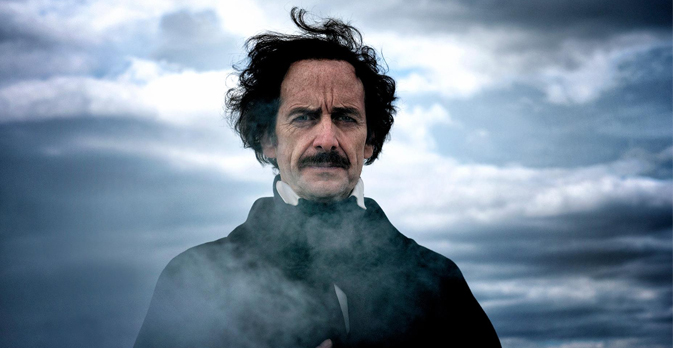
Whether for study, or for pleasure, I often – and with unchanged enthusiasm – find myself leafing through the works of Edgar Allan Poe. Not only that: it is equally common to see a film, a TV series or artists belonging to the visual and figurative arts dedicating their efforts to the genius born in Boston on 19 January 1809. Having practically shaped a good part of the DNA of contemporary literature (from the deductive detective novel with Dupin, the forerunner of a certain Sherlock Holmes to the adventure novel, to horror: in the most psychological and complex forms to the most grotesque and gothic ones) without forgetting his poetic production, Poe's legacy is exterminated. And he was welcomed wholeheartedly by an infinite list of more or less devoted followers. From the unforgettable transpositions/revisits with Vincent Price to the worried thoughts of Mike Flanagan intent on directing “The Ruin of the House of Usher”. The case of “The Lighthouse” by Eggers is emblematic, born from the inspiration of an unfinished story of the same name by Poe (a story also present in the TV series “The Following”), never finished due to his premature death. Poe is a pop icon, in short (perhaps too much so), as the Simpsons established.
And the world of music? Fortunately, just as frequently, with headphones in your ears, you happen to listen to songs more or less inspired by the works of the Baltimore genius. Mister Edgar A. Perry, as he registered for the military draft, whose verses were translated by Baudelaire (who called him Edgarpò), also left a lot to the universe of the seven notes. There will be space in the playlist for both musicians who have briefly mentioned a Poe composition in a verse or in the title, as well as authors of an entire album or a song linked to the writer's work. Without forgetting those who, as a supreme act of devotion, chose a reference to Poe as their nom de guerre.
Obviously the playlist is not the list of every composition in which the American is mentioned, but a targeted selection that includes both the most interesting revivals and solutions capable of covering as many genres as possible, thus ranging between styles and decades, between songs in which the writer is mentioned and others in which his words echo evocatively. For the first case, here is the narrator par excellence Bob Dylan and “The Murders in the Rue Morgue” cited in “Just Like Tom Thumb's Blues” and the Lysegical-Lennonian Beatles of “I Am the Walrus”:
“Semolina Pilchard
Climbing up the Eiffel tower
Elementary penguin singing Hare Krishna
Man, you should have seen them kicking Edgar Allen Poe”
For the second front, the famous verse stands out – echoed in a historic line by Agent Phillip Jeffries/David Bowie – from the title of the poem “A Dream Within A Dream”, whose halo is revealed in “The Reflecting God” by Marilyn Manson for the peak of “Antichrist Superstar” and in “Sweat” by Tool.
“Il Corvo” has made the leap into the world of rock several times: from more “hidden” songs such as “Nevermore” by Queen, entirely conceived by Freddy Mercury, or the milestone by the Stranglers where “the cover, with a disturbing black crow that seems to have come straight out of an Edgar Allan Poe novel, already suggests the atmosphere that will be felt in the album”. With “The Raven” we also reach the concept signed by Lou Reed in 2003. The publication took place three years after the theatrical work called “POEtry”, in which the leader of the Velvet Underground and Robert Wilson brought the author's lyrics and writings to the theatre. Among the many tracks present (some are introduced by actors of the caliber of Willem Dafoe and Steve Buscemi), the duet with David Bowie was chosen: “Hop Frog”.
Connected to the composition of Reed's double album are Antony and the Johnsons and the EP “The Lake”. The title of Antony Hegarty's publication is taken from Poe's poem of the same name, one of the most beautiful, where beauty and love coexist with death and a sense of restlessness and cold terror, rendered in the unmistakable style of the American writer. Another much cited poem is the splendid “Annabelle Lee”, published two days after Poe's death in the New York Tribune. There are numerous musical reinterpretations of it that testify to its beauty, from Joan Baez to Claudio Baglioni, who was inspired by the text for his first ever composition. Of all the remakes, we opted for the one signed by Marissa Nadler.
Another important one concept it's the Alan Parsons Project. The 1976 debut album “Tales Of Mystery And Imagination” is all for Poe: we point out that the 1987 reissue also features the narrative voice of Orson Welles. Remaining in the prog field, here is Peter Hammill, founder of Van Der Graaf Generator, who in 1991 published a work of the same name focused on “The Ruin of the House of Usher”.
There are also numerous references to Poe's stories: “The Masque of the Red Death” animates the notes of the White Stripes as well as those of Iron Maiden up to Arcturus, while an entire extreme musical front will boast of a contact with Poe: the historians Rotting Christ, Cultus Sabbati and the electronics of Maelstrom which cannot fail to recall “A descent into the Maelström” (“A Descent Into The Maelström”), up to the album “Imps Of Perversion” by Pop. 1280 debtor of “The Imp Of The Perverse” (“The Imp Of The Perverse”).
And from Italy? After the first Baglioni, there are those who choose Poe right from the name, like the dark and psychedelic Tuscan trio Metzengerstein, those who pay tribute to him entire albums like the Florentine GOAD by Maurilio Rossi (“Tribute To Edgar Allan Poe”, 1994), those who sing him together with Rimbaud like Management, up to the “Cristina” immortalized in the splendid “Fantasma” by Baustelle, where:
Ghosts inhabit Gothic mansions,
as happens in Edgar Allan Poe.
But the ones who are most scary are here,
to remind men of time.
The ghosts agitate historical consciences,
epochal events, small massacres,
faults, sins, trails of ashes.
What scares us is us.
Without forgetting the soundtrack by Massimo Volume of the silent film masterpiece “The Fall of the House of Usher” by Jean Epstein from 1928. In short, any musical pretext is good for approaching Poe's work.
PS If I forgot any equally beautiful ones, don't hesitate to report them.
Signed, The Tomahawk (name with which he signed his ruthless reviews…).
Antonio Santini for SANREMO.FM
