
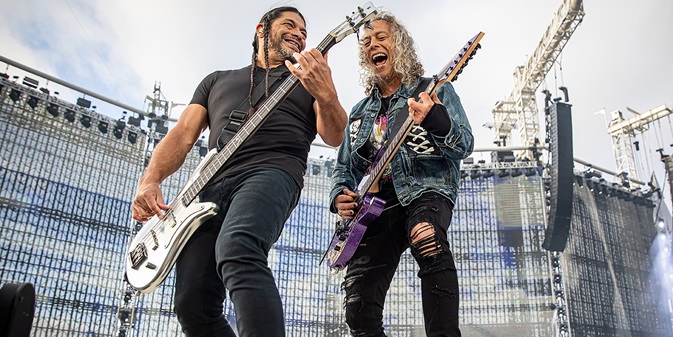
On September 6, 2017, during the very long WorldWired Tour (February 2016-August 2019), Metallica played the second of the two scheduled dates at the Ziggo Dome in Amsterdam: at a certain point, towards the middle of the setlist, James Hetfield and Lars Ulrich left the stage, to make room for guitarist Kirk Hammett and bassist Robert Trujillo. In itself it was nothing new, the two had already taken that space to play some jams on other occasions: the unusual factor is that in this case they performed “Radar Love”, anthem by the historic Dutch band Golden Earring, dating back to 1973.
It was the first episode of what from then on would become a sort of tradition for the band, namely paying homage to local artists.
The following September 8, at the Paris-Bercy arena, in that same space in the lineup, the couple performed “Antisocial” by Trust, a masterpiece of French-speaking heavy metal from 1980.
Two days later, still in Paris-Bercy, rather than boring the audience by repeating the same gimmick, the duo presented a new cover: “Les Champs-Élysées” by Joe Dassin (published in 1969 and already a cover of “Waterloo Road” by Jason Crest).
If the two previous homages were in line with Metallica's musical formation, moving between hard rock and metal, the latter was originally an orchestral pop piece with a radio-friendly edge, completely foreign to their path.
The game continued on September 12 at the Cologne Arena, where they performed “Zehn kleine Jägermeister,” a 1996 reggae hit for the German punk band Die Toten Hosen.
At that point Metallica embarked on the British section of the tour, with covers that will not be covered in this article, coming from the repertoire of universally known Anglo-American artists.
On November 1st, at the Antwerp Sports Palace, Hammett and Trujillo performed “This Is Rock 'N Roll” by the Kids, a local punk band not even particularly famous, although they have a great cult following. Since the song was in English, the bassist tried to sing it: the covers listed so far had in fact only been sung by the crowd, following the two instrumentalists.
Two days later, at the same venue, the bar was raised: the song honored was the famous “Ça plane pour moi” by Plastic Bertrand, which is actually in French, but Trujillo decided to sing it anyway. It will be the first of many non-English-speaking songs that he will sing in the following years.
There is no other band or artist, at least with a prominent profile like that of Metallica, who has made a similar effort, paying homage with such consistency to the music produced by the various local cultures and underlining several times, during the presentation, how important they believe it is to keep their memory alive.
Coldplay made some attempts in this regard (“Napule è” by Pino Daniele in Naples, “Madonina” by Giovanni D'Anzi in Milan, “De música ligera” by Soda Stereo in Buenos Aires, “Sen o Warszawie” by Czesław Niemen in Warsaw), but these were exceptions, while Metallica did it on every single date for several years (since September 2017 to August 2019 and then again from May to September 2024).
Of course, if you were brave enough to go to YouTube to listen to the results you might be surprised in a negative sense: Trujillo is not a singer and it shows, just as Hammett is not a particularly technical guitarist. The result is full of inaccuracies, blunders and errors (the version of “Caruso” by Lucio Dalla, performed on 14 February 2018 at the Unipol Arena in Bologna, is downright embarrassing).
However, look at the glass half full: the two had to learn one new song after another, with sometimes tight cadences, and Trujillo did his utmost to sing in languages often recognized as difficult even by the most expert linguists and polyglots, from Polish to Hungarian, passing through Finnish, managing in several cases to be quite comprehensible, at least according to the comments of native speakers found on the Internet. All of this is good reiterate it, without anyone having forced them to do any of this.
Whatever opinion one may have on the controversial recent production of the most popular metal band of all time, this series of covers represents a laudable and meritorious operation of a celebratory article, especially on OndaRock, which has focused heavily on covering the musical scenes of non-English speaking countries (a fact which makes the site a sort of unique of the Italian panorama, but also worldwide if desired: there would be Beehype, which however only covers new releases, ignoring the past stories of the various countries covered).
For the occasion, the complete playlist of the 62 covered songs was reconstructed on Spotify, in chronological order of performance: it was thought to exclude the most famous pieces, such as those by Abba, Europe, A-Ha, Scorpions, Falco or Rammstein, but all in all it is a small minority. Most of the material is known only in the country of origin and it is a journey that is worth undertaking, both for the stylistic variety, sometimes bordering on the surreal (moving from the most abrasive post-punk to the lightest pop, from metal to traditional music, passing through polka and cumbia), and more generally to open one's horizons… and finally, why not, also to meet again giants already celebrated on OndaRock, from the Mexicans Caifanes to the Poles Maanam, from the Russian Kino to the French Indochine.
Antonio Santini for SANREMO.FM