
In the artwork of Lero Lero's first album there is a crocodile emerging from Vucciria. Its legend passes through underground Palermo, from the underground Papireto, from a city that has hidden even its own rivers under the asphalt. An absurd and perfect story: something comes from afar, disappears beneath the surface and then resurfaces when you least expect it.
The project was born from something that comes back. A tradition far from the identity postcard and the nostalgia of the music of the past. Here there is a rougher, more ambiguous, older and more alive body of sound. The one kept in the Sicilian sound archive of the twentieth century, made up of voices of farmers, shepherds, washerwomen, carters; and then songs of indignation, lullabies, laments, melismas. Remains of a world that seems very distant but is instead just around the corner of family memory.
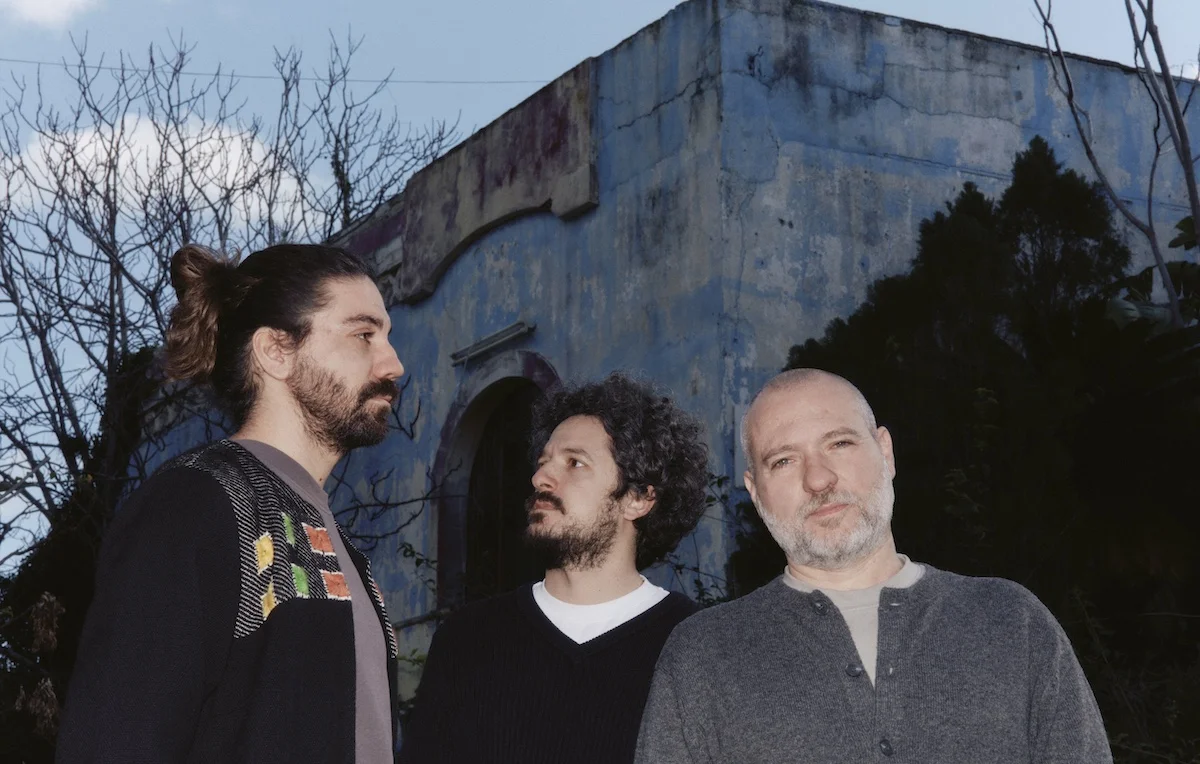
Behind Lero Lero there are Alessio Bondì, Donato Di Trapani and Fabio Rizzo. Bondì is a singer-songwriter from Palermo, whose voice has been immersed in the Sicilian language for years; From Trapani he is a keyboardist and musician with a path that also passes through Paolo Nutini and Colapesce Dimartino; Rizzo is a producer, guitarist and central figure of the Palermo independent scene. The debut album starts from traditional Sicilian songs selected, arranged and produced by the collective, supported in recording by the percussionist Giovanni Parrinello. Calling it a recovery job, however, would be an understatement. In the land of Battiato, Rosa Balistreri and Alfio Antico you enter an old sound ruin to discover how it breathes today.
«Our sound comes from a body-to-body encounter with the voices of our traditional singers», they say. «And he launches into a suggestion: what if, on the basis of those ancient melodies, we reinvented Sicilian music from scratch?». From devoted respect to the possibility of betrayal. And betrayal, in living cultures, is often the only way to avoid embalming. Lero Lero thus try to imagine what can happen if those voices, those melodic ways, timbres and obsessions are dragged into the present without taming them. They add: «Not only the betrayal of tradition, but a real hallucination in which Mediterranean electronics, raw voices and melismas, the timbre of microtonal strings and the mantra of frame drums coexist».
Hallucination is the right word: the record does not reconstruct a lost past in a linear way, but deforms it, summons it and lets it appear in flashes. He makes it concrete piece by piece: How did you do it? opens with a washerwoman's voice and transforms the mother's absence into a larger, almost collective wound. Franculina it starts from a carter's song and stretches it between microtonal guitar, synth bass and tambourine. Salinai comes from a work count of the salt workers: the fatigue, the hunger, the nursery rhyme that at a certain point stops playing. Hearts re cane instead it starts from a song of disdain and turns it into a kind of nervous liberation.
An archaic and futuristic music, crossed by echoes of marranzani, work songs, mantras, short circuits. The issue at the center is identity-related, political, almost metaphysical: «Behind these songs there is a world that has mostly disappeared, very distant and very close at the same time». Because that Sicily seems to belong to another era, yet it is not that remote after all. It is enough to go back to the time of our grandparents, open certain audio documents, and we find ourselves faced with an imaginary that modernity has removed rather than overcome: “We didn't get hooked on this burning material out of aesthetic fascination, but because of a question that had been buzzing in our heads for a few years: but who the fuck are we?”.
What remains of us when modernity has asphalted (almost) everything? What happens when the music of a place is reduced to decoration or canceled because it is considered poor, crude, not presentable enough? According to them, «the absurd thing about the acceleration we experienced with the economic boom is the fact that it is enough to go back a few decades and in the sound documents of a place like our island you find melodies, melismas, words that indicate a philosophy of nature, of the human, of the profound, which has nothing to do with the man of the technological age».
In those recordings there is a way of being in the world: a relationship with nature, but also with the sacred, pain, work, the body, the cosmos. A way that disturbs the idea of progress as a work of erasure: «You come into contact with a way of seeing the cosmos which is that of the pre-Socratics, of the archaic Mediterranean, which was very present in Sicily until the time of our grandparents». Here the record becomes more interesting than the usual roots operation. Its strength lies in the absence of nostalgia and in the choice to keep a conflict open: between memory and invention, between belonging and distance, between oral singing and contemporary production, between real Sicily and Sicily imagined by others. Music is anti-folkloristic precisely because it uses memory as a detonator, not as a reassuring confirmation of identity. It explodes it in the present. It makes her unstable. It works like a successful séance, rather than a guided tour into the past. The voices are not samplings to be ennobled: they are presences to be reckoned with.
«For us this is a very living and present matter, in the face of which any temporal problem or nostalgia for the past disappears: what is fiery is eternal, it is not subject to the dress or filter of a specific era». There is no nostalgia, because there is really no distance to bridge. That which is still incandescent continues to act, even when it is buried. Or perhaps precisely because it is buried: «It is essential and great and therefore always alive, as long as it is celebrated and sung. You can hide it under a blanket of asphalt and concrete, or under the table with shame. He will bite you whenever and however he wants.”
A buried thing that doesn't ask permission to return. Like the Vucciria crocodile, precisely. Like Sicily which does not coincide with its tourist, television, holographic or criminal version. From this point of view, Lero Lero are not isolated. Their trajectory intercepts a broader movement, still difficult to clearly define, but evident: artists who return to oral, ritual, dialectal, ancestral matter without making it a museum. «We are not sure we can talk about a real scene, but certainly artists like Davide Ambrogio and Maria Mazzotta are following a path very similar to ours, communicating with their ancestors but with a spirit aimed at the future».
The discussion, however, does not stop at Italy: «In other Mediterranean countries all this is nothing new: an entire generation of Egyptian, Lebanese, Tunisian, Syrian and Greek artists is creating bridges between the past and the future with an incredibly vital mix of ancestral sounds and contemporary production which in no way seems to be affected by the inferiority complex nurtured for decades by us Italians towards the music of Anglo-Saxons or other countries considered more advanced». In these parts we have often looked at musical modernity as something that always came from above, between Northern Europe, the United Kingdom, the United States. As if the future had to necessarily speak another language. Lero Lero's debut suggests the opposite: perhaps a part of the future remained below, in the invisible South, in the despised voices, in the irregular scales, in the songs forgotten because they seemed too poor to be important.
«We like the idea, for once, of changing scene and perspective and turning our gaze not only to the North, but also to the invisible, submerged South, often just a handful of kilometers away from us but for some reason always judged to be lateral, exotic, outside the confines of the music that matters». Their closing is dry, almost cartographic: «Hic sunt leones». Their album leaves Sicily dirty, bright, ancient and alien. It is the sound of roots moving under the asphalt: buried, and for this very reason it lives.