
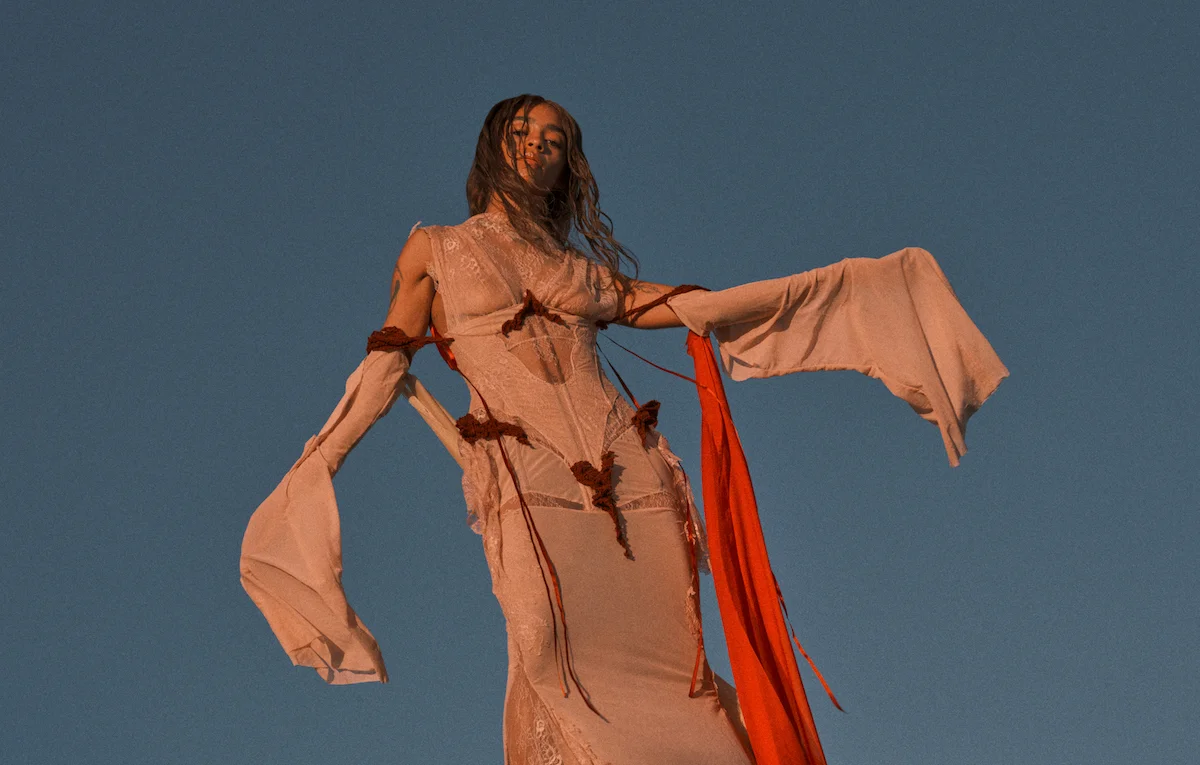
It comes out in 2019 Blooda debut that seems to come from a place all its own. Inside there are classical training, R&B, electronic experimentation and a voice capable of moving from fragility to power in the space of a few moments. Critics hail it as one of the most surprising debuts of the year, finding themselves faced with something that really doesn't resemble anything else out there. And for many it is the first meeting with Kelsey Lu; an artist who grew up among the discipline of classical cello, escaped from an extremely religious upbringing, with collaborations with Solange, Blood Orange and Skrillex and a style that is still difficult to place in a precise category. Blood it works precisely for this reason: it is a record that escapes definitions, capable of holding together spirituality, desire, avant-garde and accessibility without sacrificing any of these elements. It feels like the start of something important. But Kelsey Lu, at least apparently, disappears.
What happened to him from that moment on? While the music industry continued to measure time through albums, tours, comebacks and promotional cycles, Kelsey Lu was working in another way. Soundtracks, performances, collaborations with internationally renowned artists. And even immersive installations, participation in programs of museums and artistic institutions, up to the cinema. A trajectory that makes it almost impossible to describe Kelsey Lu with just one word. Musician, of course, but also composer, performer, soundtrack author, visual artist and builder of worlds.
And maybe that's exactly why So Help Me Godthe artist's new album after 7 years of apparent recording silence, doesn't really sound like a return. “People love stories, they love comebacks,” he observes during our conversation. It's a phrase that tells a lot about the way we consume artists today. If something is not continuously updated, published, told, it seems to cease to exist. As if growth only has value when it is visible. But So Help Me God it was born precisely in opposition to this logic, from long time and uncertainty, from a crisis that was in no hurry to resolve.
And if an episode is needed, as the artist suggests, to help understand the genesis of the album, we must start from the story of his cello, or rather, more precisely from its end. In 2020 the instrument that had accompanied Kelsey Lu for almost twenty years suddenly breaks in her hands. That cello, as she tells us, was not just an object for her, but a presence, an archive of memory, a part of her identity. «Me and that cello faced everything together. When it broke it opened like a wound, and from that fracture all the experiences it held resurfaced” And at that point everything seems to collapse at the same time. The arrival of a pandemic, the “divorce” from a major label, the abandonment by its management. The end of personal and professional structures that until then seemed stable. For days, she says, it became impossible for her to even get out of bed. And this is where it really comes from So Help Me God: not as a story of healing but as a reckoning.
The first time the public met So Help Me God it wasn't through a song, a single, but during the Venice Biennale, in the spaces of Palazzo Diedo. There Kelsey Lu presented Penumbraan immersive performance capable of escaping, once again, any categorization. Not a concert, not a listening session, nor even a simple preview of the album. But more of an environment to cross, a threshold, an invitation to enter an emotional state even before a collection of songs. The public could walk on the red earth that covered the floor of the building, moving and following the artist and the other performers involved, unconsciously participating in the construction of the work itself. When we ask why he chose this method for the first meeting with the public, the answer is immediate: «I wanted the public to feel involved and an integral part of the project. Dissolving the concept of who is on stage and who is a spectator.” An answer that allows us to not only understand Penumbrabut much of Kelsey Lu's work, where connection is perhaps the most important theme of her artistic practice, even more than spirituality, transformation, healing. A connection with others, with one's body, with what normally remains hidden beneath the surface.
And it is perhaps precisely from here that we need to start to understand So Help Me Godbecause, although the title may suggest a spiritual search, the album is populated above all by human presences. Past loves, old versions of oneself, fears that keep resurfacing, ghosts. The songs are crossed by presences that never stop returning, incarnated in ex-lovers, ghosts and shadows. The striking thing is that these ghosts are never truly defeated; there is no moment of definitive liberation, there is no promise of salvation. Kelsey Lu's work seems to gravitate around a different question: what if some things aren't meant to disappear? What if the real work wasn't overcoming them, but learning to live with them? “For many years it was depression that guided me, together with fear,” he says. And he adds: “Today they remain as passengers on my ship, but now I am the captain.”
We are therefore not faced with a religious album, the question is much more complex. Catholic education continues to resonate in Kelsey Lu's imagination, but not as a system of answers, rather as a space of research, as a desire and instrument of tension that results in open questions. Spiritual language is everywhere: resurrection, devotion, surrender, light, shadow, but it is a spirituality that always passes through the body, desire, contact.
The same goes for the visual universe that accompanies the album. The films made together with Savanah Leaf are populated by volcanoes, wind, fire, primordial landscapes and bodies immersed in nature. Monumental images to tell deeply intimate experiences. When I ask why he chose Lanzarote and such an epic dimension to accompany such personal songs, the answer comes as a poetic declaration: «That landscape reflects the emotional territories that we all carry inside». Nature is therefore not a background, but a language that serves to give shape to what normally remains invisible, to anger, fear, melancholy, joy. Especially the shadows.
The most fascinating thing about So Help Me God is that it doesn't try to offer solutions, it doesn't promise a rebirth, it doesn't talk about a healing and it doesn't transform every crisis into a lesson, but prefers to stay inside the questions, accept the contradiction. Recognize that light and darkness are not opposites, but parts of the same experience. At the end of our Kelsey Lu conversation we're not talking about victory or overcoming an obstacle, but about peace. A peace achieved not by eliminating the ghosts, but by finally learning to look them in the eye. In an era that continually demands spectacular transformations, Kelsey Lu continues to choose something much rarer, complexity and the courage to inhabit it.