
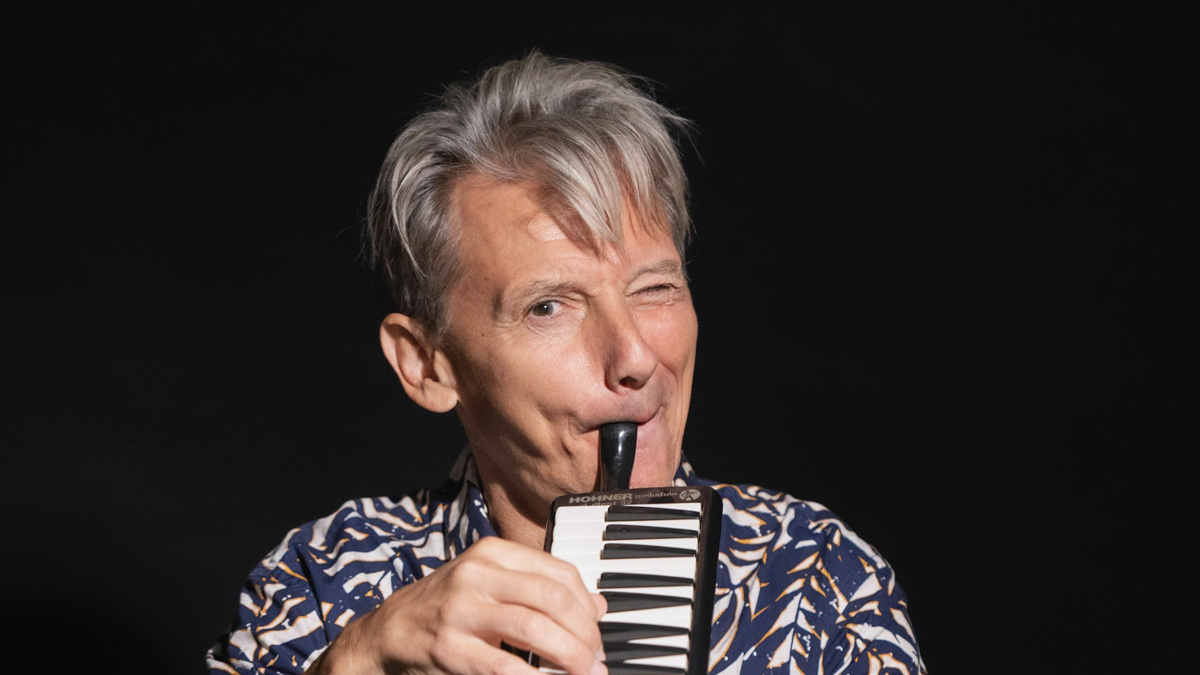
With its universe made of music, imagination and creative freedom, The Melevisione it continues to occupy a special place in the imagination of entire generations today. Among the creators of that magic is Paolo Serazzi, known to the public as Ziopolauthor of the most loved music born in Fantabosco. With the new album The Songs of Melevisione vol.2published by RaiCom, Ziopol returns to give voice to that poetic and surreal universe through thirteen songs that intertwine irony, depth and imagination, speaking to children without ever giving up complexity.
Ziopol he will be a guest of the talk hosted by Margherita Schirmacher entitled On board the songs (and readings) of the Melevisione composer which will take place at Turin International Book Fair, Saturday 16 May at 2.00 pm in the Oval square of the Lingotto as part of the Camper del Libro / TichetToRead.
In this interview the composer talks about his personal connection with the Melevisionthe creative work behind the new album and the approach with which for years he has been building songs capable of involving children and adults together. Between unexpected musical influences, reflections on childhood and the desire to defend that “child part” that continues to inhabit the world of adults too, emerges the portrait of an artist who has made sincerity, lightness and irony the heart of his musical research.
What personal relationship do you have with the Melevisione universe?
When I joined it, I practically didn't know it. But it only took a few weeks for me to be completely absorbed by it. It was beautiful! The TV studio in which the Fantabosco scenography was set up was a multi-sensory experience that cannot be described in words. Real water flowing in streams, smoke from the witch's pots, lights and sounds beyond belief. The actors: numerous, very good and overwhelmingly cheerful. The whole team of technicians, make-up artists, operators… And then the mastermind of it all, those who invented the program and who knew every subtle nuance: the Authors. I mainly dealt with them, who welcomed me right from the start and yet examined every note I made very carefully! Several times they even asked me to redo a song from scratch. At the time it wasn't something that pleased me, but in the end I had to admit that something better had emerged. I learned a lot from them.
What sounds did you favor on this album?
In this Vol. 2 I wanted to group together – among others – some songs that belong to a very specific period: the years in which the director was Paolo Severini, who wanted a very specific sound for Fantabosco, made mainly of acoustic sounds, a little “woody” and a little rattling, instruments played with a very free-range groove, even a little dirty and imprecise. To clarify: he wanted something like a Tom Waits parachuted into Fantabosco! Impossible, you say? Well… now listen to some songs from the album in light of these indications of mine and you will tell me. I can tell you that I (equally a Tom Waits lover) threw myself into it with all my heart and I'm satisfied with the result.
Does writing for children require more simplicity or more complexity?
On the issue of “complexity” I have my position, which I am happy to explain: I know (also from experience as a father, if it were needed) that children have no problem in grasping a certain complexity, both in the lyrics and in the arrangements. I find it silly to offer children overly simplified work, as if they were incapable of grasping more advanced discourse: it is an insult to their intelligence. I focus mainly on frankness and on passionI think those are the factors that kids really pick up on. For an adult it's an excellent exercise: sending messages (in my case artistic, musical) in which you totally recognize yourself, sweeping away every frill. And giving his all. Upon closer inspection, it is a universal recipe, not to be relegated to children's work.
How do you construct a song capable of speaking to children and adults together?
I think the answer is already contained in my previous answer: if you have respect for children, for their fantastic intuitive and emotional abilities, you can compose music for them tout courtwithout introducing limitations of any kind. I would add that with the words of the text we can say many beautiful things, but true communication occurs throughexample. Children see what you do, understand who you are and take messages from it. If we focus on giving the best of ourselves, offering them what we are most passionate about, our music will be more likely to reach straight to the heart. At this point, the age of our audience won't make much difference.
What values do you try to convey?
Among others, three values that are close to my heart: trust, lightness, irony.
Trust in one's possibilities, in being able to allow oneself to play, sing, dance without thinking too much about it, without fear of anyone's judgement. It's the right approach, at least to start with. Furthermore, trust in the things of life: “when in doubt, it will go well”.
Lightness in the meaning of Italo Calvino: “lightness is not superficiality, but gliding over things from above, without boulders on the heart” (I quote the sentence in full because it is of dazzling beauty and impossible to paraphrase without ruining it!)
THE'ironythen, it's a bit like my trademark. I cultivate the art of not taking myself too seriously and I reserve the same treatment for others and life situations. Irony is free, fun and helps you live better!
What kind of emotion do you aim to leave the audience?
I go on stage with a mad desire to play. The emotions that the public transmits to me every time are at least equal to those that I transmit – if not superior. In the concert there are many pieces in which the audience is an active part: they sing and play with their hands and feet, the children perceive perfectly that without them those pieces would not stand up, that in that moment they are the orchestra and that – yes – they are actually playing!
For me it is a privilege to feel that children welcome me into their world with enthusiasm. I reciprocate, I give carte blanche to my “child part” (which in my adult life I have always defended tooth and nail!) and I enjoy unrepeatable moments.
If there is a message that children can take home it is that yes, you can become adults without letting that spontaneous, cheerful and imaginative child part of you wither. They saw it firsthand: Ziopol and his musicians are proof of this.
Daniel D`Amico for SANREMO.FM