
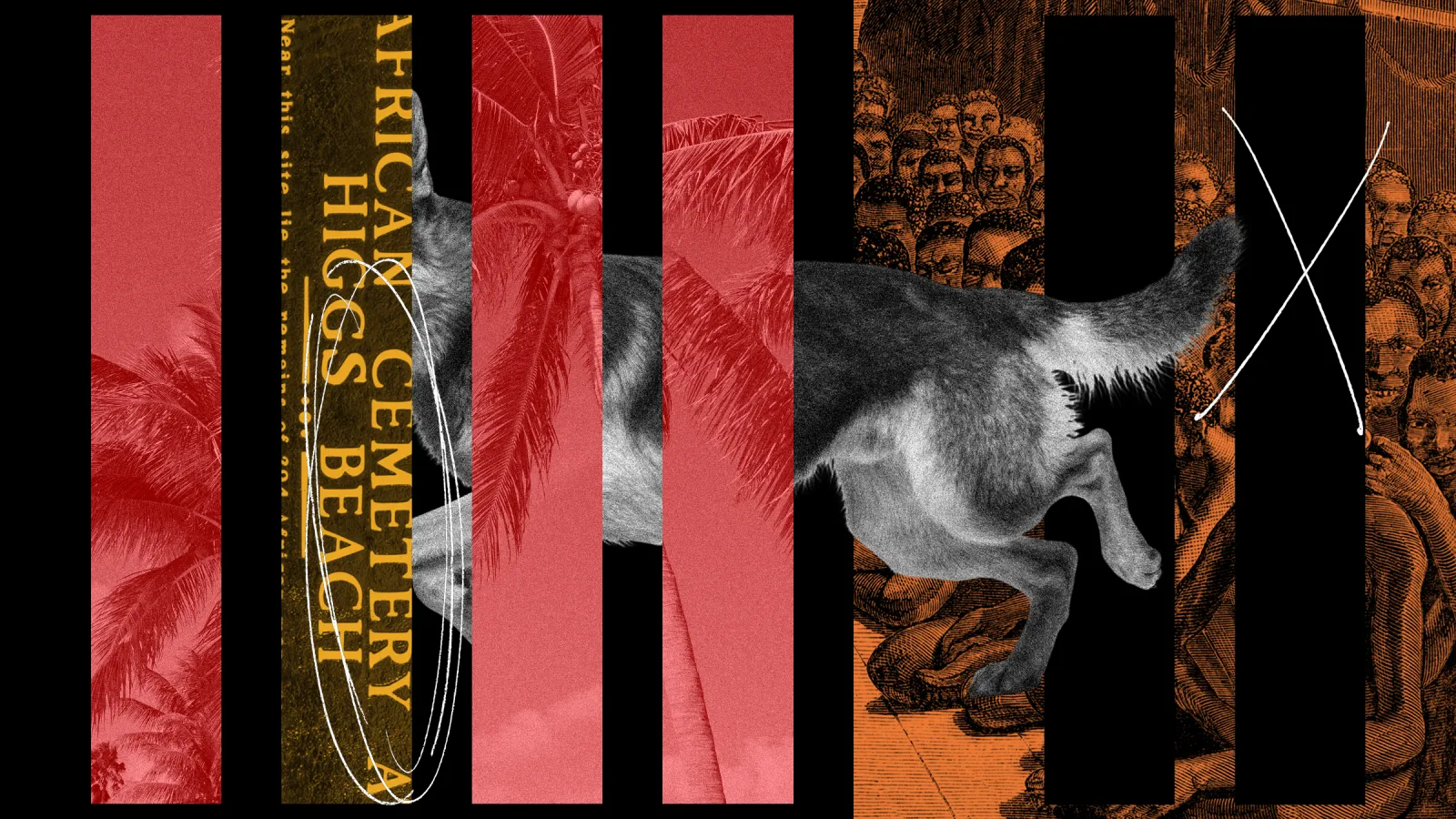
Editor’s note: This story is part of a special series by Princeton University journalism students reporting on the discovery of an African burial ground in Key West, Florida, and how the legacy of slavery still reverberates through the island community and beyond.
I
t’s a breezy Sunday morning in March at Higgs Beach in Key West. The Straits of Florida glisten and the sun leaves a feeling of hazy contentment. Bright pink flags and a yellow sign announce the Key West Orchid Society’s annual orchid show, hosted at the Key West Garden Club. A freckled purple flower, contestant No. 298, is vying for top honors.
Just across the sidewalk from the West Martello Tower, a Civil War-era fort where the Garden Club is housed, lies an unkempt field of grass, worn out by dehydration and footsteps. Beneath the plot sit six unmarked graves, and across the busy throughway of Atlantic Boulevard, over 100 more. Dogs run joyously next to the 100 graves — a fenced-in dog park, a locals’ enclave on an island otherwise thirsting for open space.
For more than 15 years, officials in Key West and surrounding Monroe County have known about those unmarked graves, which date to 1860 and hold the remains of some 295 Africans who’d been rescued with hundreds more from illegal slave ships and brought to shore, only to die a few weeks later of illnesses like yellow fever and dysentery. A decorative concrete memorial covers the first 15 graves found nearby in 2002, but nothing identifies the location of the bodies that remain.
The story of why these graves remain unmarked is one of local gripes and bureaucratic red tape, but it also raises questions of whose lives deserved to be honored and which histories should be remembered. As a liberal enclave in an otherwise conservative state, Key West is already under attack when it comes to how public spaces are utilized and public funds are spent: The Florida Department of Transportation removed rainbow crosswalks in the city last year, and a new state law limiting government funding for projects and events deemed to be pro-DEI (diversity, equity, and inclusion) threatens Key West’s festivals — including, potentially, future initiatives at the African burial ground.
“Since it is a Black cemetery and it has the stigma of slavery, nobody wants to touch it,” says Veronica Stafford, a longtime local activist, of the stagnant situation at Higgs Beach.
Some local politicians see the causes of inaction differently. “At some point, you don’t keep expending taxpayer money on something that’s not going to come to fruition,” Heather Carruthers, a Monroe County commissioner from 2008 to 2020, says. “[The county] tried for years to do something about it.”

A state historic marker stands over one portion of the African cemetery site, but 100 graves nearby remain unmarked.
Now, an ownership transfer of Higgs Beach Park from Monroe County to the City of Key West, initiated May 1, has reignited the question of development at Higgs Beach, and along with it, the graves underneath the surface.
ON A HOT, CLEAR DAY in September 2002, a small crowd gathered for a ceremony at Higgs Beach where the first 15 graves had been found. A wobbly fence surrounded the area, located on a patch of sand next to two palm trees and near the West Martello Tower. “African Cemetery 1860,” read a makeshift sign roped onto the fence. Adegbolu Adefunmi, a Yoruba leader, performed a ritual.
The year before, a state historic marker had been installed. “Near this site lie the remains of the 294 African men, women and children who died in Key West in 1860,” the sign reads — one off from the correct count of 295, which includes a six-week-old child who had died early on. But those were minor wins in the battle to more fully and respectfully recognize the burial ground.
In April 2005, a dog park — split into sections for small and large dogs — opened across the street from the fenced-off gravesite. But the grounds received little attention otherwise. By the time Carruthers was elected to the Monroe County Board of Commissioners in 2008, Higgs Beach had fallen into neglect. Carruthers, a former classical vocalist from New York who owned a well-known guesthouse on the island, was determined to address the problem.
“Higgs Beach was in disrepair. It was becoming a haven for the homeless and local people didn’t want to use it,” Carruthers, now a business development director at the architecture firm K2M Design, said in an interview at the company’s Key West office in March. “A lot of people felt like it wasn’t safe.” Her goal was to “reinvigorate the park,” and local architect William Horn was tapped to lead the development process and get feedback from community members.

Following the initial discovery of 15 graves, a makeshift sign identified the site.
In 2010, after preliminary meetings had been held with key stakeholders, marine archaeologist Corey Malcom, who had spearheaded the discovery of the first 15 graves, and Dinizulu Gene Tinnie, an artist who led the design of the African Cemetery Memorial that now covers them, raised the possibility of additional unmarked graves in the area. “I said, ‘OK, you guys are making all these wonderful plans, but you need to know, there’s a lot of people in that park somewhere, and they’re missing, and we haven’t found them,’” Malcom says.
So, a new ground-penetrating-radar survey of the area was commissioned by the county. The results — displayed in rows of blurry squiggles on the radar diagrams — showed more than 100 distinct graves beneath the small-dog park, with more likely located underneath the road, where GPR could not reach. That December, in response to the discovery, a plan was presented to move the small-dog park and shift Atlantic Boulevard, a main thoroughfare along the coast, north so the entire gravesite could be unified into a green space.
“The location of these graves is a significant archaeological discovery, one of the only known cemeteries of African refugees in the United States, and presents an opportunity for preservation of this historic discovery,” the development master plan read.
However, not everyone was happy about the proposed changes. Community members concerned about the new road’s proximity to their houses requested additional meetings with Carruthers and Horn. The group, calling themselves the Higgs Beach Preservation Committee, had a range of other objections as well. (Among them, a chain link fence for the dog park did not meet a high enough “aesthetic character.”) A compromise was struck, and after adjusted plans were approved by the Key West Planning Board, a development agreement was formed between the county and city in 2012.
But there would be a new roadblock. A community member who opposed the redevelopment plan found a 1983 grant from the U.S. Department of the Interior, through the Land and Water Conservation Fund, which stipulated the scope of development permitted within the park, and that major changes had to be approved by the federal government. Atlantic Boulevard could not be moved without approval from the Department of the Interior.
Faced with the lengthy process of obtaining federal approval, county officials left the park largely untouched for years. The small-dog park remained on top of the 100 African graves — though pets are prohibited from frolicking in the island’s other cemeteries. With redevelopment plans in limbo, county officials also didn’t move to commemorate the unmarked graves in any physical way. The county did, however, in May 2012, apply successfully for the site to be named a National Historic Landmark.
IN 2017, NAJA AND ARNAUD Girard, the owners of The Blue Paper, an independent local publication that’s now defunct, learned about the unmarked graves after attending a Day of Remembrance ceremony for the slave trade and its abolition that is held annually at the African Cemetery Memorial. Before then, Arnaud says, he had “no idea” about the existence of the burial site. Moved by what they had learned, the couple decided to make a short documentary about the graves beneath the dog park, alongside journalist Amber Nolan.
The French-born Arnaud had come to America after law school, military service, and international travel that included sailing a boat alone across the Atlantic Ocean from Senegal to New York. In the United States, he met Naja, and the two moved to Key West in the mid-1980s. They became journalists for The Blue Paper while living with their kids on a boat off of Wisteria Island, and took over ownership of the paper in 2011. Right away, the Girards shifted some of its focus: They were interested in telling the story of Bahama Village, the historically Black community in Key West.
“One of the things that we had noticed,” Arnaud says, “is that the Black community was never talked about.”
That mission continued with their documentary about the burial site, Do All Graves Matter? With the help of Stafford, who features prominently in the film, they interviewed local leaders on camera. Clayton Lopez, then a Key West City Commissioner, stated that he wanted the dog park to be moved. Carruthers, who was not in town during filming, shared an email with the filmmakers outlining why progress was not being made on Higgs Beach redevelopment or the dog park, including challenges with funding and the approvals process.
According to the Girards, when they were getting ready to post the documentary to The Blue Paper’s website, local politicians including Carruthers tried to intervene. “All of a sudden, the phone starts ringing from every side,” Arnaud says.
Naja believes Carruthers “didn’t like the story because it was kind of embarrassing. Why are you saying this is a cemetery and then also saying this is a place for your dogs to poop?”
“If there’s anything that we did [to intervene] or to ask them to postpone any press, it was probably because at the time we were trying to negotiate with the federal government about changes to the the site that would allow us to better honor the graves that we knew were there,” Carruthers says in a follow-up phone call. “Our intention was always to try to change that park…and, in fact, move the road so that the souls that were buried there would have the appropriate kind of respect.”
The Girards went ahead with the release of their film in August 2017. Within a week, Monroe County confirmed plans to move the small-dog park into a portion of the large-dog park, leaving the land over the gravesite open. Still, the county’s announcement cast uncertainty on the presence of the graves, saying the move was made “out of an abundance of caution that there may be possible graves beneath the current small dog park.”
“I DON’T THINK IT’S EVER been proven that they are graves,” current Monroe County administrator Christine Hurley says at her office in the former E. H. Gato Cigar Factory, just a five-minute drive inland from Higgs Beach. She adds, citing the delicate nature of the undertaking, “I don’t think we want to excavate it to figure out if it’s really graves or not. … Anomalies are not for sure remains.”
As for the idea of marking the gravesite with any plaque or signage, Carruthers said in March that the county commissioners had never discussed the matter. “They felt, I think, that the African Memorial that’s there covers the whole space.”
Hurley echoes that sentiment, saying, “We believe there’s already a commemorative spot.”
Hurley also claims there is no current plan to move Atlantic Boulevard, despite the initial intention to unify the entirety of the gravesite. “The only reason the road was going to be moved was to get funding to improve the park,” she says. When the area’s Tourism Development Council changed an earlier position and said it could fund improvements on both sides of the road, rather than only the beach side, she explains, “the county dropped that request to try to move that road.”
Regardless, Monroe County didn’t want to own the park anymore, citing disagreements with the City of Key West over what should be built there and the distance of the park from the county’s other operations. At a March 5 City Commission meeting, an ownership transfer of the park from the county to the city was proposed. No mention of the gravesite was made at the meeting. On April 1, the Key West City Commission voted to approve the transfer, and the city officially took control on May 1.

Arida Wright, seated, at the 2025 Day of Remembrance ceremony at Higgs Beach.
Courtesy of Rob O’Neal
Sam Kaufman, a former city commissioner and the recently inaugurated mayor of Key West, voted against the ownership transfer, citing the increased tax burden on Key West residents in case the park did not turn a profit one year. However, he said in a March interview that, if elected, he would take steps to commemorate the graves.
“Would I do anything? One hundred percent. …First and foremost, better signage, not just for the graves, but also for the history,” Kaufman said, adding, “I would probably put a lot of weight on what people like Dr. Malcom say, people in the Art and Historical Society, people in the African American community.”
MEMBERS OF THE AFRICAN American community have aspirations not just for Higgs Beach, but for their presence in the city at large.
Arida Wright, an organizer of the Day of Remembrance ceremony at the African Cemetery Memorial, which is paid for largely through fundraising, says, “It would be nice just to have a grant” for the annual event. She dreams of having enough funds to cover “the performers we want to bring, the speakers we want to bring, not every year needing money and never having [it], having to raise the money.”
Tinnie, the artist who helped raise the alarm about possible additional graves, still believes the relocation of Atlantic Boulevard is a possibility, and suggests an “obelisk or something in the middle” of a roundabout near the African Cemetery Memorial and the neighboring AIDS memorial: “Something that lets people know you’ve entered a sacred space here.”
With the ownership transfer and a potentially sympathetic mayor, the future of the graves at Higgs Beach enters another period of hope and uncertainty. The city could take steps to acknowledge the location of the 100 unmarked graves, but the long-term future of the site is in question. The new state law that broadly prohibits local government funding for anything related to “DEI” may make renovations or an expanded memorial difficult.
In the meantime, local Black activists continue fighting for their history to be recognized and told.
Stafford, for one, wants a docent on hand. “That burial site should have someone there guiding the tourists that come along and come to check the site out with historical information,” she says. And when it comes to signage, she adds, “I would like to see a huge sign or billboard erected at the Higgs Beach where the cemetery is — the biggest billboard.”