
Out of all the sins of the Trump administration — wars, ICE raids, anti-vax lunacy and the return of measles, the empowering of Kash Patel and Stephen Miller, and so much more — Secretary of Transportation Sean Duffy declaring war on “DEI bike lanes” is surely a small thing. But it’s also such a monumentally stupid act, so counterproductive, so anti-MAHA as to be completely maddening. NPR recently reported that staff at the Federal Highway Administration have been asked to purge any references to bikes and bike lanes from the agency’s website.
Additionally, Duffy, a former Real World and Road Rules participant, retired member of Congress, and devoted Donald Trump sycophant, wrote: “We urge Congress to restrict competitive and formula grant funding for bicycle lanes and other bicycle infrastructure that reduce travel throughput [sic] for motor vehicles and support removal of existing bike lanes that contribute to congestion.”
Despite protests, the feds moved to dismantle a beloved D.C. bike lane earlier this year, but that action was halted when a judge, in response to a lawsuit brought be a local bicycling group, paused the destruction, writing in a 61-page opinion: “The Court’s review of the record reveals the absence of a reasoned explanation.”
Logical arguments are out but irrational attacks are a constant feature of the Trump administration. And in this case, Duffy and Trump are going after something that is widely popular and spinning it into partisan nonsense. According to a 2025 YouGov poll, three quarters of Americans support having bike lanes. Broadly speaking, Americans think bike lanes increase quality of life and safety for drivers and cyclists alike. Bike paths and rail trails also bring tourism to places in rural America hungry for visitors and are a huge boost to local economies. The Empire State Trail in New York stretches from Manhattan all the way to Canada and generates a whopping $1.87 billion in economic activity, according to a recent study. Some 9.75 million visitors have ridden parts of the trail.
Nor are bike lane projects particularly expensive, especially along urban routes. Certainly not compared to, say, lobbing more than 850 Tomahawk cruise missiles into Iran at a cost of some $2 million a shot. For an administration that claims to want to make people healthy again, the declaration of war on bike lanes may be as bizarre as spending billions to attack Iran. Biking is an excellent low-impact cardio endeavor. Riding a bike helps to clear the mind, brings people outside, and is a fun family activity. Moreover, in the winter, cross country skiers and snowmobilers can enjoy those same paths in rural areas.
What bike lanes have to do with DEI is unclear. Likely this is the Biden administration’s fault for some admittedly political language touting the infrastructure bill’s grants. The Biden team announced they would “consider how projects can address climate change, ensure racial equity, and remove barriers to opportunity.” Which could be seen as lofty goals when many Americans were desperate for pot hole and bridge repairs. But that’s not really the issue here. If the Biden people were for something, then the Trump people must always be against it. This is a ridiculous calculus, counterproductive, and why voters are so sick and tired of our broken political system.
In a maneuver worthy of a North Korea apparatchick, Duffy apparently ordered data showing that bike lanes make driving safer scrubbed from a federal website. Time and again, like the pharaohs of Egypt, the administration will simply excise information that doesn’t fit its agenda. Duffy, the former pro-lumberjack turned MAGA cheerleader, is also leading the charge to rename New York’s Penn Station after Trump, and using access to much needed federal funding for a necessary renovation as leverage to make his case.
Not surprisingly, Duffy and Trump’s hostility extends to high-speed rail or really any kind of investment in public transport. The very successful congestion pricing program in New York City was declared an enemy by the Trump folks — even after data showed 27 million fewer cars entered Manhattan after just one year of the program. After all, if we can’t all be stuck in Midtown traffic while riding in a giant gas-guzzling SUV then what’s really the point of being American?
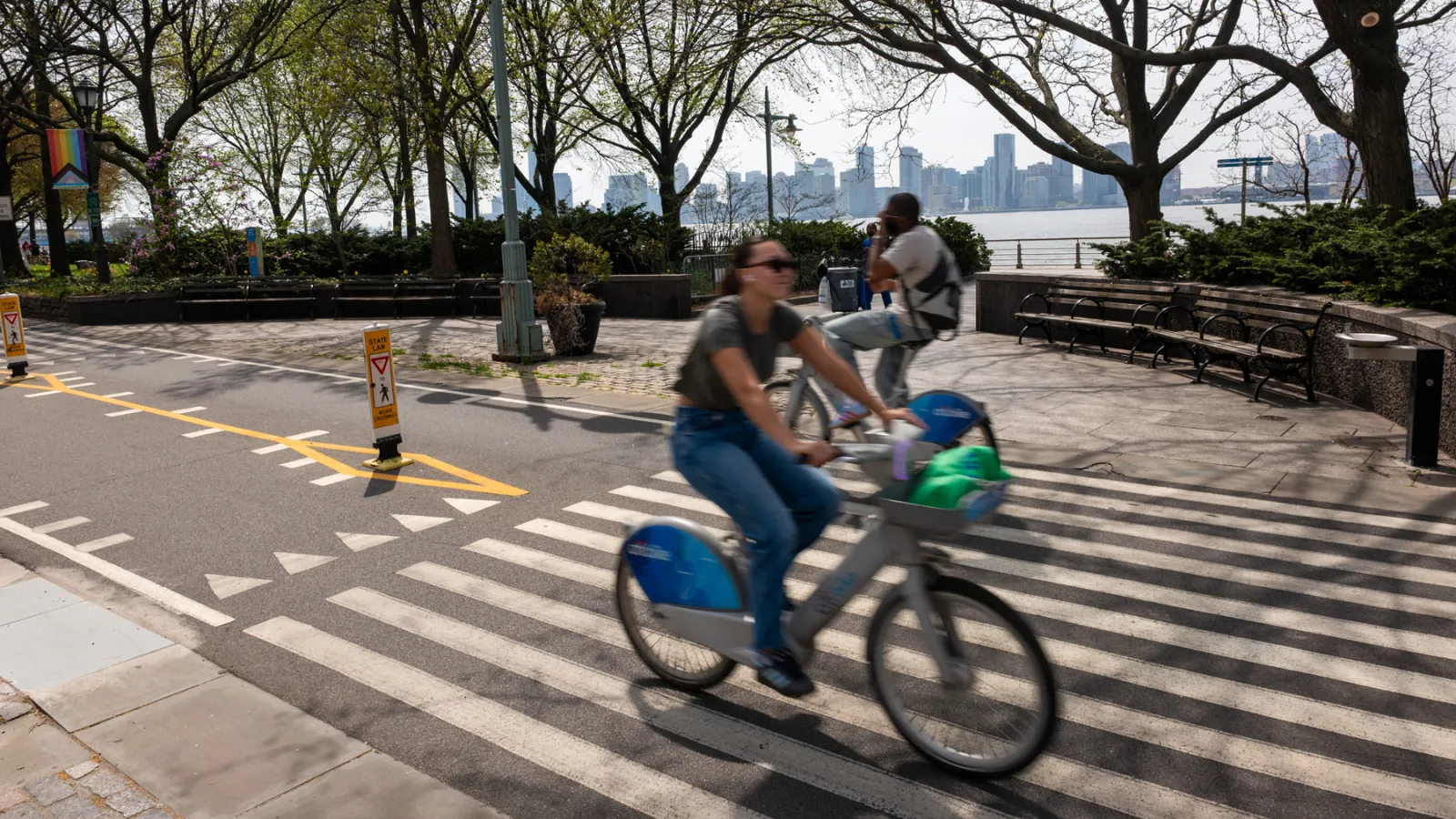
None of this makes any sense. Surely we can have roadways for our cars and our cyclists. Recently, my childhood best friend was visiting New York and I took him on a Citibike ride around lower Manhattan, on the same city streets where we grew up during the 1970s and 1980s. Back then, biking those streets was the kind of high-risk activity many parents simply wouldn’t allow. Or in our case, they closed their eyes and prayed. There were virtually no bike lanes at the time. For kids, it was extra dangerous because you are smaller and less visible. Speaking of busted infrastructure, I learned to ride on the abandoned elevated West Side Highway, dodging broken bottles, garbage, and much worse. On our ride this year, my friend was amazed. Perhaps it was the beauty of riding on a protected path watching a Manhattan sunset along the Hudson River, or maybe he was seeing a city so completely reborn while gliding along on two wheels. Sometimes when you are on a bike, your eye just catches the world passing by differently.
During the early 2000s, it was Michael Bloomberg, the billionaire Republican mayor of the city, who pushed for hundreds of miles of bike paths, making the city infinitely safer for bikers and alleviating pressure on mass transit. It’s one of Bloomberg’s most positive legacies. And yes, there are plenty of cyclists who ride like jerks and don’t obey traffic laws — but we can and should police that just like we do reckless driving. Of course there’s an inherent risk in riding a bike, but dedicated bike lanes make our country safer and better.
Two exceptional but wildly different people have said things about riding a bike that have always stuck with me. Albert Einstein used cycling as a metaphor for existence: “Life is like riding a bicycle. To keep your balance, you must keep moving.” Truer words were never spoken. And basketball legend LeBron James has made the case for biking as an equity engine of sorts, recalling how his first bike changed his life: “[My bike] gave me the freedom to not only get to places, but to access things that otherwise would have been out of reach. Even now, riding a bike makes me feel like a kid again. There’s nothing like feeling the air on your face and that freedom to just ride.”
Daniel D`Amico for SANREMO.FM