
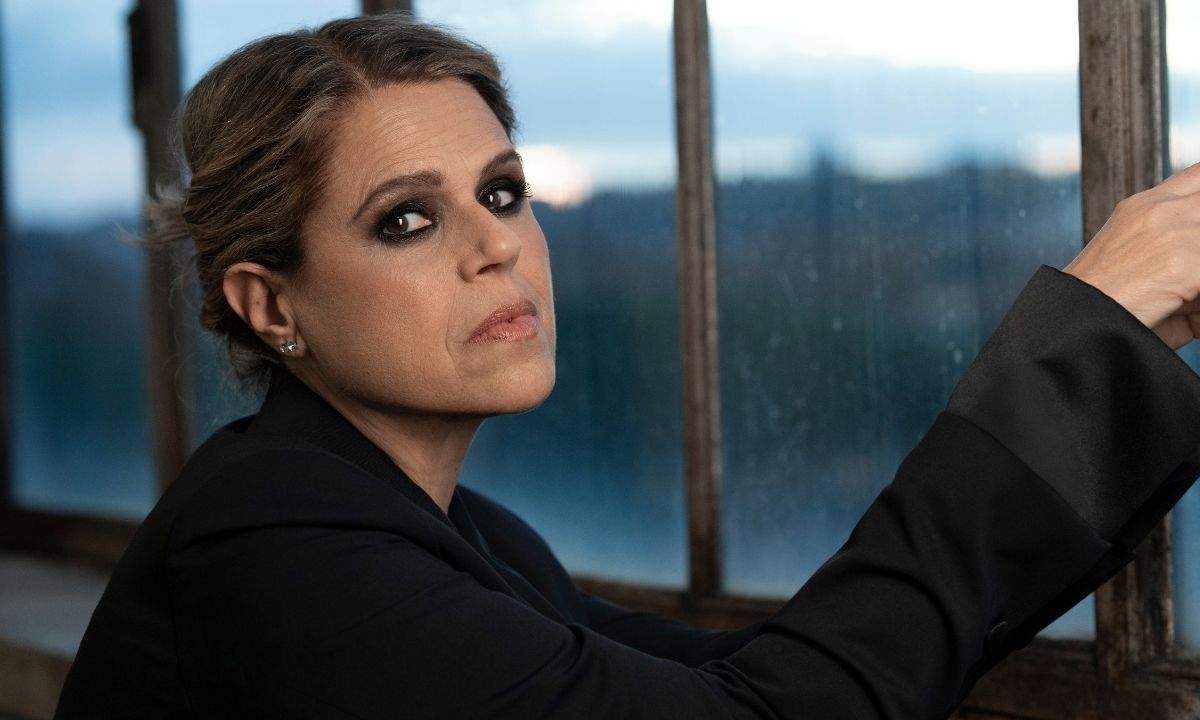
Tosca he chose the Cascina Cuccagna of Milan to tell Feminaean album born after seven years of work and maturation. Not a classic press conference, but a small meeting, with nearby tables and space for dialogue.
“I wanted it to be a moment as if we were in a house”he explained, opening up to a real discussion with those listening.
tosca feminae meaning – A record that arrives when it is ready
Feminae it does not arise from an urgency of publication. Tosca says it clearly: the songs had already existed since 2019, but something was missing. “They were a bit like limbs, but it wasn't the heart that was beating.”
The point is not to write, but to recognize when a work is alive. “The music itself speaks to you. If you know how to listen to it, it tells you where to go.”
Loss and personal turning point
Between 2020 and the following years, Tosca's life changes radically. The loss of parents marks a decisive transition, experienced in a period in which even closeness was difficult.
From here comes a reflection that enters the album:
“Death teaches you more than life. It puts you in front of all this daily worry and you understand what really remains.”
It is in this space that Feminae takes shape.
Spring, the first real beginning
The song Springwritten with Pacificis the real starting point of the project. It arrives after a strong human encounter and after the death of the father.
“That night he wrote this song and a year later he found the courage to send it to me. That's where I started this book.”
It's a song about letting go, but also about what remains. “Despite the pain, you are left with beautiful things that realign you”.
An album of female voices born without a program
Only at a certain point Tosca he realizes that the album is taking a specific direction: the collaborations are all female. It was not an initial choice, but a natural process.
That's where the title comes from Feminaesuggested by Renzo Arbore. “I want to reclaim this term. Not in the sense in which it is used today, but for what it is: welcome, origin, protection”.
The meetings that build the album
Collaborations are not operations, but relationships.
With Carmen Consoli the bond goes back a long way: “I heard her sing at Sanremo 1997 and said: this is a genius”. From there a relationship was born which over the years has transformed into a continuous exchange.
The meeting with Maria Bethânia it is instead a very high point: “When I heard his voice in my song I said to myself: I might as well stop now.”
Next to them too Silvia Perez Cruz, Stacey Kent And Cristina Brancoartists who have often chosen to sing in Italian. “This time they are the ones who came to our house.”
The popular song as memory
One of the strongest themes of the meeting is the popular song. For Tosca it is not repertoire, but living memory.
“The popular song is us. It's all we've experienced”.
When he says “get up, the popular song is coming up”the meaning is clear: “It means there is something to say, something to do.”
The memory of Ornella Vanoni and “the orphan girls”
Among the most personal moments of the story is the one linked to Ornella Vanoni. Tosca he remembers the first meetings, when he was still young: “He always scolded me, said that I was too sulky, that I didn't show myself enough”. Also Lucio Dalla he called her “the teacher”, for that rigorous way of being on stage, always with her blouses closed.
Over time, however, that distance transforms into mutual esteem and an increasingly direct exchange. That's where the idea of working on those songs came from Ornella he defined “the orphans”, songs that remained on the margins, without the recognition they deserved.
Tosca chooses For a friend and the voice of Ornella it becomes the piece that completes everything. A meeting that finds space inside Feminae and which returns the deepest meaning of the album: recover, listen, put back into circulation.
Exposing yourself is a responsibility
Tosca does not avoid the political theme. In fact, he addresses it directly.
“I don't understand when they say: I don't talk about politics. You can't.”
And he adds an image that comes from afar: “My father took me to Berlinguer's rallies. I was so little that I thought he was a singer, he was so charismatic.” For her to expose herself it is necessary: “If you don't define yourself, life decides for you.”
Women, space and new generations
Speaking of feminine, Tosca avoid theoretical reading and focus on concrete examples.
“You have to be stronger than your charm”. The risk, he says, is becoming part of a system that uses the body as an instrument of recognition. The answer lies elsewhere: “Let's talk about the good things that are happening now”. And he mentions new artists who build their own space starting from the talent from La Nina to Anna Castiglia.
A record to listen to over time
Feminae it is not meant for quick listening. Tosca describes it like this: “It's not a record that comes in forcefully. It's a record that can stay with you.” Fifty minutes to go through without haste, letting the details emerge.
At the Cascina Cuccagna this emerged clearly: Feminae it is the result of a long, personal and shared process. A record that arrives only when it finds its center.
Photo by Riccardo Ghilardi