

vote
7.5
- Bands:
JUNON - Duration: 00:42:29
- Available from: 05/15/2026
- Label:
-
Voihanger Records
Hidden In The Fog, Imha Tarikat, Temple Koludra, here are some of the groups these Junon come from, all German and all specialized in black metal for some time; nothing else is known about the members of this new group: evidently they want to maintain the mystery, which in certain contexts helps to create the right atmosphere.
“The Golden Citadel of the Astral Sphere” is their debut album, which follows last year's acclaimed “Promo MMXXV” and differs only in part: in fact, the last song of the three that make up this work is missing, nothing more than a short piece of sidereal dark ambient, but it contains two others, one of which, the last – very long, twenty minutes or so of atmospheric and psychedelic black – which strongly characterizes the work and perfectly frames what the Junon propose to do.
But let's go in order: the first thing that certainly catches the ear and is immediately intriguing and original is the female voice that dominates the album, raw and wild in the screams, virtuoso and avant-garde in the clean parts; an excellent business card that the Teutonic people manage to exploit as best as they could.
In the more strictly black metal parts the singing refers to the classics of the second wave of the early nineties – from which tremolo picking and blast-beat, cornerstones of the genre, are also taken; in situations where the clean voice is used, however, we can cite as possible influences Farida Lemouchi of the Dutch occult rockers The Devil's Blood, the legendary vocal researcher Diamanda Galás, and, above all, Synne Diana Larsen of In The Woods, and in particular her performance on the experimental “Strange In Stereo” from 1999; but the mysterious Junon singer still moves with personality and confidence, bewitching and intriguing the listener with warbles, recitations, screams and chants.
The roughest black metal is therefore peppered with ambient passages and hybridized with psychedelic rock, in a compositional context that winks at the avant-garde: the result is a singular and occult setting halfway between demonic possession and the mental state caused by the use of psychoactive substances.
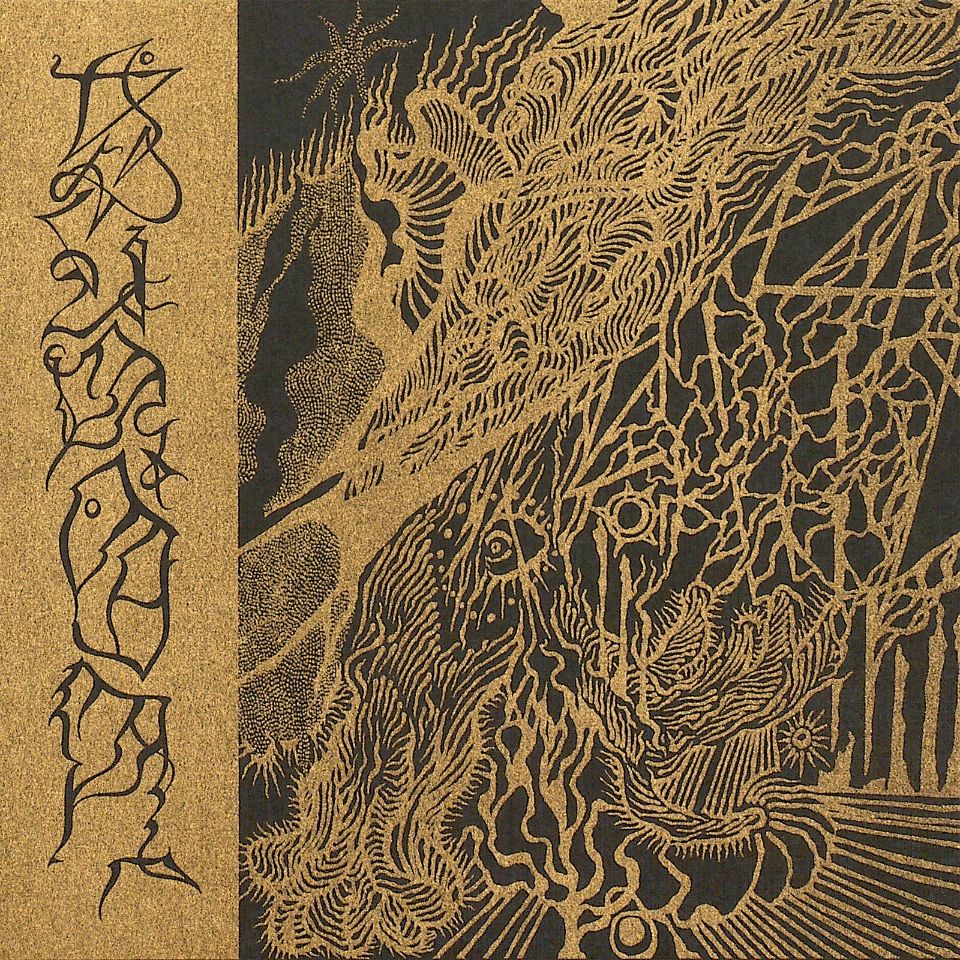
Beautiful in an unconventional way and perfectly fitting with the dark and indecipherable atmosphere created by the music is the cover by Sindre Foss Skancke: truly sinister and unusual, it is the perfect support for the sound scenario created by the Teutonic group.
As anticipated, the album culminates in the extended final track, entitled “Dolorosa”, which contains all of Junon's musical paraphernalia, who break down and deconstruct the consolidated classical forms, dismantle and reassemble the typical styles of the genre, sublimating everything into a crazy and seductive auditory experience. A long journey that requires patience and total concentration to be fully enjoyed; therefore not easy listening and not suitable for all ears.
The first track “Propheten der blauen Flamme” is certainly more accessible, very similar in sound and attack to “Nattestid Ser Porten Vid”, Taake's first album, but with some interesting forays into microtonality, recently brought back to the fore by the Canadian duo Angine De Poitrine.
A piece of limited duration that miraculously manages to keep together Norwegian black and avant-garde, as well as the subsequent “Unterm Glutmond”, capable of also referring to the raw but refined black of the first Emperor or Ulver and is embellished with a very successful hypnotic chorus in the central part that recalls something from the latest album by the Finnish-Swiss experimenters Sum Of R released last year.
There is also space for a male voice on “Inanitas Cedit Profundo (Die Leere weicht der Tiefe)”, with a slow and almost ritualistic pace; The idea of expressing oneself in one's mother tongue is also excellent, but with some forays into Latin which gives a surplus of solemnity to the work.
The recording is absolutely up to par, the rough edges are certainly intentional, but they do not compromise the usability of the music, at least for those who are already accustomed to black metal or experimental music; the instruments can all be heard perfectly, including the bass, which is sometimes a bit sacrificed in this type of proposal.
An extra edge is also given by the attention to small details, which are revealed gradually as you listen; at times Junon's music recalls the convulsive brushstrokes of an abstract painter, a bit like that of the Dutch Gray Aura, other contemporary innovators of the black flame.
Junon's stylistic signature is already sufficiently refined and personal, the balance of the various elements is managed with experience and authority, what is still missing is greater incisiveness in the songwriting, already good, but not always capable of maintaining high attention and making the songs truly memorable; however, these luxury debutants should certainly be kept an eye on, because they possess first-rate artistic baggage.
Daniel D`Amico for SANREMO.FM