
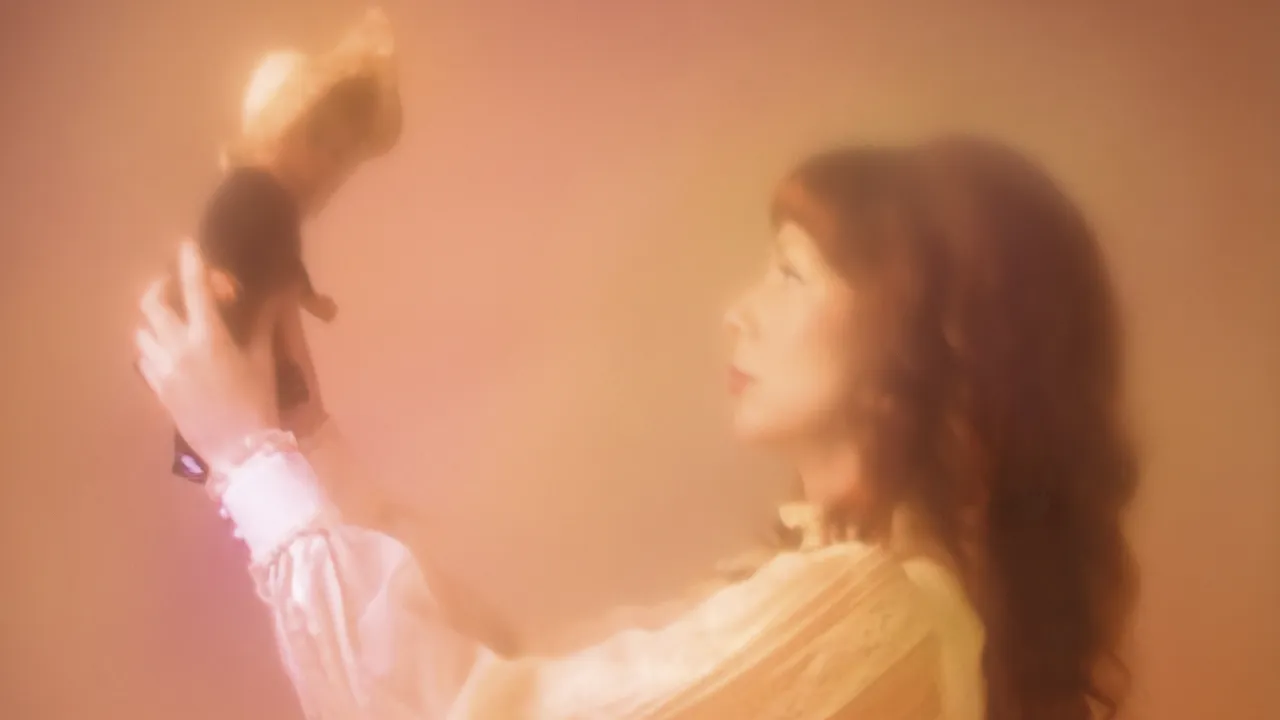
Beneath the Last Dinner Parties and Wet Legs of U.K. indie rock lies a smaller, more earnest niche, one that’s both kinetic and deeply emotional. These artists have a lot in common with their aforementioned peers—though they often embrace an earnest attitude, rather than a fashionably arch one—and even if they aren’t equally famous, their songs sound enormous. Among the best of this category is Catherine Anne Davies, who performs as the Anchoress, mixing ’80s pop with the gritty ’90s rock of Richey Edwards-era Manic Street Preachers.
Davies has breached containment, at least in her home country: Both 2016’s Confessions of a Romance Novelist and 2021’s The Art of Losing received acclaim, as well as co-signs from Elton John. The latter was an unflinchingly dark album informed by the loss of Davies’ father, multiple miscarriages, and a reckoning with sexual violence, all buoyed by glistening synthesizers. But as well-crafted as the individual parts were, they didn’t always jell; the songs’ many layers sometimes drowned out Davies’ incisive observations.
No score yet, be the first to add.
As We Once Were, her third album, also arrives after personal upheaval: Having a daughter in lockdown caused Davies to come to terms with her own generational trauma, which she navigated during a harrowing time where tabloids invaded her private life. While Davies bristles at being labeled a “confessional” writer, this context makes the elaborate productions on her third album feel like a refuge. Davies has said she spent hours on one particular ARP 2500 synth texture for “I Had a Baby Not a Lobotomy,” for example, and almost every song on the album is swimming in similarly odd little sounds. Here, lavishness is a life raft.
Davies has gotten somewhat reductive Florence Welch comparisons over the years; the grandiose, Virginia Woolf-quoting “Throw Over Your Man” is the first time she’s truly courted them, and it’s a great fit. Here, she fully indulges in campiness, particularly in the song’s come-ons—after she sings the title, she follows it with, “Let me love you like a woman can.” It’s the most upbeat song on the record, offering a glimpse of joyful possibility before the record’s true stakes creep in.
These production choices elevate her captivating songwriting. Even the sparser ballads, like “She Knows Her Place”—written as a sort of sequel to the Beatles’ “She’s Leaving Home”—have unconventional instruments, like the inclusion of taishogoto, a Japanese instrument with a typewriter-esque sound, and glitching baby coos. On the interlude “Happiness Don’t Show Like It Should,” Davies forms a call-and-response with a backmasked version of herself. That said, Davies pushes it on the six-minute track “Hand to the Tide”—even as it recounts a tragic accident, its strange heavy-breathing backing vocals and uncharacteristically buried prog-metal guitar solo come across as melodramatic.
The occasional overwrought moment never overwhelms Davies’ lyrics, which showcase her dry wit more readily than her last two records. On “I Had A Baby, Not a Lobotomy,” she lines up misogynistic microaggressions she’s received from others in her industry in new parenthood: “Are you still doing that? Oh what for? Guess now there won’t be any more tours?” In isolation, some of these lines might sound like they mean well (“So good for you for bouncing back!”) but taken together, they share a subtext of denying women’s creative and personal autonomy.