
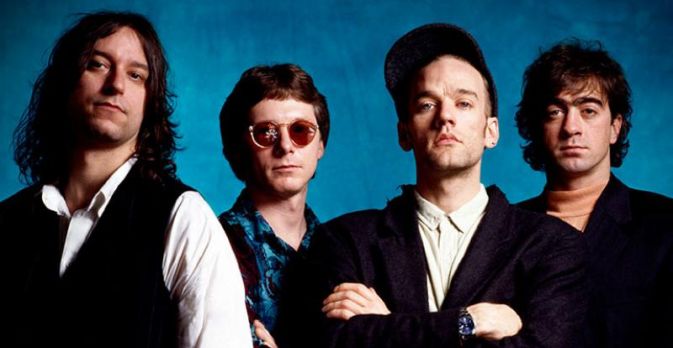
Released on February 19, 1991 as the first single from “Out Of Time”, “Losing My Religion” is theevergreen of REM. Its success spanned over three decades, transforming it into the symbolic song of the Georgian band and one of the musical manifestos of the nineties. Yet, the most famous song by the band from Athens is also one of the most misunderstood: the title, in fact, led many to believe that it spoke of religion or loss of faith, when in reality Michael Stipe's lyrics say something completely different.
To really understand the meaning of “Losing My Religion” we must start from the historical moment in which it was born. At the beginning of the nineties REM were ready to make the definitive leap towards the general public. After having established themselves as a point of reference for American alternative rock with albums such as “Murmur”, “Reckoning”, “Lifes Rich Pageant”, “Document” and “Green”, Michael Stipe, Peter Buck, Mike Mills and Bill Berry were called to a delicate challenge: conquer the international market without losing that identity built during the years of college radio and the American independent scene.
“Out Of Time“, published in March 1991, represented the meeting point between these two souls. The band expanded their sonic language by introducing strings, keyboards, organ, horns and richer arrangements, while maintaining their melodic sensitivity intact. Peter Buck's mandolin, destined to become one of the most recognizable elements of the album, contributed to defining a new sound, capable of reaching a much wider audience without betraying the spirit of REM
It is precisely in this context that “Losing My Religion” was born. Since its publication, the title has generated incorrect interpretations, also fueled by the video clip directed by Tarsem Singh, full of images inspired by religious iconography and Renaissance painting. In reality, as Michael Stipe explained already in 1991, the expression “losing my religion” is just an idiomatic expression, in vogue in the southern States, which roughly stands for “losing patience” or “can't stand it anymore”. In the circumstance, due to a desperate and obsessive love story. Although, of course – as per practice remmiana – the term “love” will never appear.
.
Life is bigger
It's bigger than you
And you are not me
The lengths that I will go to
The distance in your eyes
Oh no I've said too much
I set it up
That's me in the corner
That's me in the spotlight
Losing my religion
Trying to keep up with you
And I don't know if I can do it
Oh no I've said too much
I haven't said enough
I thought that I heard you laughing
I thought that I heard you sing
I think I thought I saw you try
Life is big
Bigger than you
And you are not me
I would do anything for you
An indifferent look in your eyes
Oh no, I said too much
I combined it
Here I am in the corner
Here I am in the spotlight
While I lost my patience
Trying to keep up with you
And I don't know if I can do it
Oh no, I said too much
In fact, I haven't said everything yet!
I thought I heard you laugh
I thought I heard you sing
I thought I saw you try
In short, the song opens like the most classic of declarations of impotence. A story of unrequited love, despite every possible attempt. Stipe once again reworks the thread of the Police's favorite “Every Breath You Take”, to comment on a new sentimental pathology, which also mixes his condition as a star “in the spotlight”. And there is no doubt that this is the only meaning of the song, even if in the following the author does not give up on inserting new religious expressions, as if to play on the misunderstanding of the title, fueled by the “hieratic nature” of the related video clip, directed by the Indian director Tarsem Dhandwar Singh, who will even be accused of blasphemy and censored in Ireland.
Every whisper
Of every waking hour I'm
Choosing my confessions
Trying to keep an eye on you
Every whisper
Every waking hour, I stay
Choosing my confessions
Trying to keep an eye on you
But if the term “confessions” appears deliberately ambiguous, the final verse, admitting that the romantic illusion was only a dream (“just a dream”) reiterates the conceptual heart of the song: a song full of desperation for an unrequited love.
Stipe himself said that among the sources of inspiration for the song was “Every Breath You Take” by The Police. If the classic from Sting's band addressed the theme of sentimental obsession from a disturbing and possessive perspective, “Losing My Religion” instead talks about the fragility of those who love without being reciprocated. It's a song about insecurity, waiting and the fear of rejection, rather than love in the romantic sense.
Alongside this sentimental reading there is also a second interpretative level. According to what is reported in the volume “A Companion To Media Studies” by Angharad N. Valdivia, the lyrics could reflect, at least in part, Michael Stipe's discomfort towards the fame suddenly achieved by REM. Verses like “That's me in the spotlight” would thus take on a further meaning: the desire to be seen as a person and not just as a rock star, just as the band was entering a completely new dimension.
After all, “Losing My Religion” arrived at a decisive moment in the group's career. The success of “Green” had already opened the doors of REM to the general public, but it was “Out Of Time” that definitively transformed them into a worldwide phenomenon. And it was precisely this song, born as an intimate confession and far from the logic of the perfect radio single, that became the ideal bridge between the band's alternative past and its future as the absolute protagonist of international rock.
The music contributes to making the message even more powerful. Peter Buck builds the song around a riff of mandolin destined to become one of the most famous in the history of rock, while the strings, acoustic guitars and Stipe's painful voice give life to a melancholic and suspended atmosphere. Despite lacking a traditional refrain, “Losing My Religion” manages to imprint itself in the memory from the first listen, demonstrating how a structure far from the canons of pop can become a global success.
It is “the song” by definition of Rem, the trait d'union between their “alternative” origins and their destiny as rock stars, the anthem that – like it or not – will represent them forever, with that initial verse “life is bigger” which almost sounds like a prophecy: starting from “Losing My Religion”, the life of Georgians has become bigger. Explains Mike Mills: “There have been few epochal events in our career, because it has progressed very gradually. If we really need to talk about a historical change, I think the closest thing to it is 'Losing My Religion'.” It will also be their most successful 45 (No. 4 in the US charts) and will win two MTV Music Awards. Paradoxical, for a band that, only a few years earlier, had declared war on video clips.
Daniel D`Amico for SANREMO.FM
