
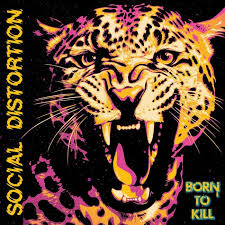
It's good news to find Social Distortion again. Not only because “Born To Kill” arrives fifteen years after the last album of unreleased songs and Mike Ness' well-known health vicissitudes, but above all because the band proves to still be fully recognizable and artistically vital.
The most comforting aspect of the album is that it does not simply certify the survival of the group. On the contrary, it reaffirms with conviction all the elements that have defined its identity: rough and dusty guitars, essential but incisive riffs, melodies with a strong emotional impact and that peculiar synthesis between punk rock, rock'n'roll and American tradition that Social Distortion have been able to make personal like few others.
The opening with the title track it's the best we could expect from a long-awaited return. “Born To Kill” shows off an evident Stoogesian ancestry: the circular and obsessive riff, the groove elementary but irresistible and that rough garage-rock tension that seems to come straight from the dirtiest suburbs of American rock. It's a song that wastes no time on preambles and immediately reaffirms the band's identity. The following “Way Out” picks up the baton without lowering the pace, confirming the Californian group's ability to build solid, bloody songs around a few, proven elements.
“The Way Things Were” represents the most intimate moment of the album and one of the most convincing ballads in the band's repertoire. The musical writing is highly effective, while the lyrics, all about memory and loss, sometimes go too far in sentimentality. However, it is difficult not to read this nostalgia in light of the frontman's human journey. “Tonight” is more balanced, benefiting from more nuanced lyrical writing and an immediate but not banal refrain.
With “Crazy Dreamer” Social Distortion instead allow themselves an openly country deviation. Not a simple contamination, but a true immersion in the American roots that have always fueled the group's sound: used with intelligence and measure, it gives the song a peculiar physiognomy and makes it one of the most successful and recognizable episodes of the album.
Not everything, however, maintains the same level. Some songs prove to be more interlocutory than indispensable and the umpteenth rereading of “Wicked Game” leaves some doubts, especially in a work that would have benefited from a greater abundance of original material. However, they are marginal limits in a record that still manages to offer several songs destined to find a second life on stage.
Social Distortion do not chase the present nor do they try to deal with the weight of their past: they continue to follow the path they traced decades ago, with coherence and unchanged credibility. The value of the album lies precisely in the confirmation that their roar still retains strength, character and authenticity.
04/06/2026
Daniel D`Amico for SANREMO.FM