
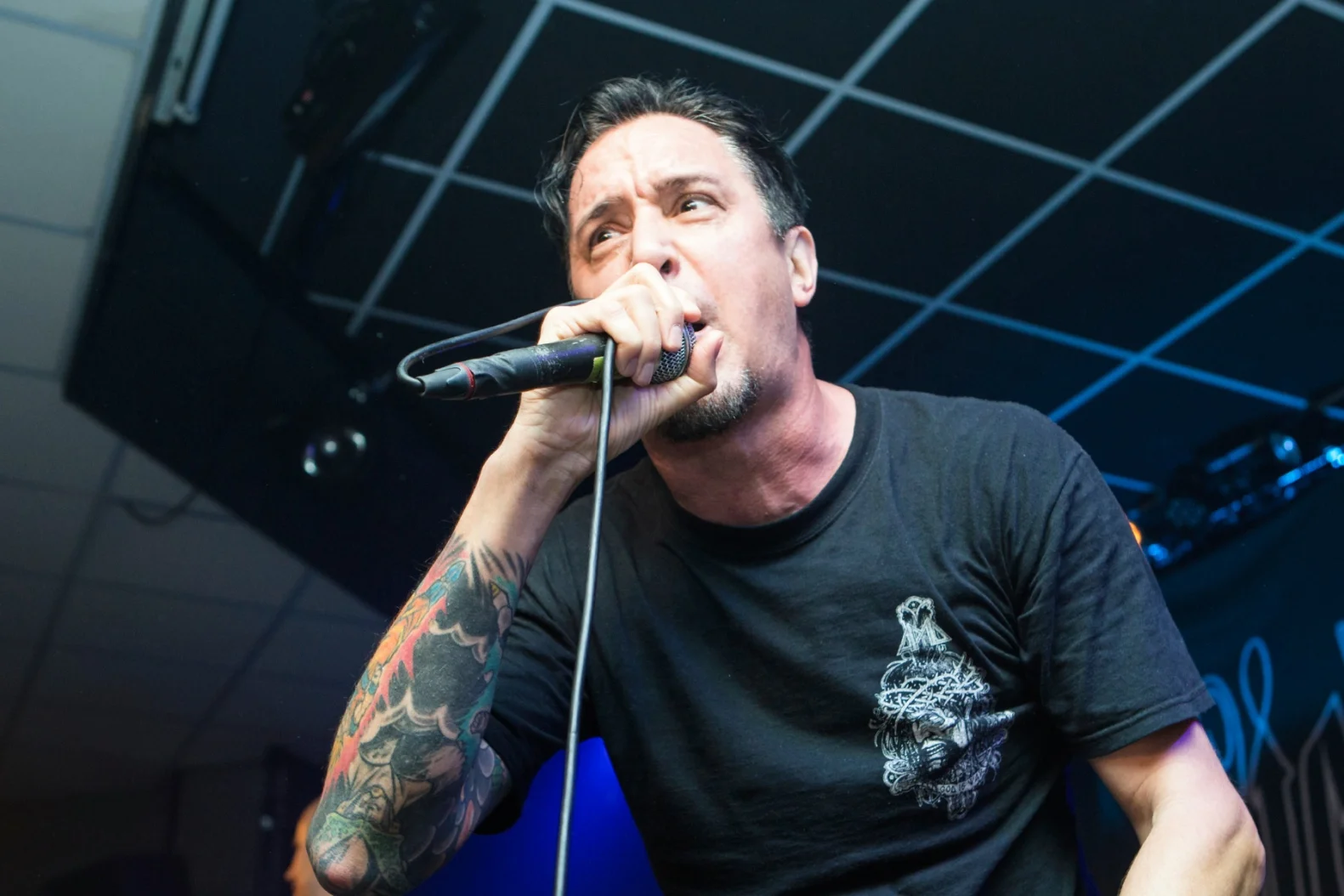
«We have our microphones, but this is yours». When I saw Sick of It All live in Denver in 2001, a couple of years before I moved to New York, it seemed like a revelation to me that a professional band would leave a microphone on the Ogden Theater stage for anyone who wanted to come up and sing along before diving back into the pit. Meanwhile Lou Koller asked everyone present to take care of each other during the mosh pit. I was a metalhead, I had been attending university for a few years and I still knew little about New York hardcore. Metal bands didn't do things like that. I had no idea that that sense of community had already been one of the founding elements of hardcore concerts in New York for decades.
At that same concert there was a guy who kept asking Rat Pack47 seconds of fury about the importance of staying close to your friends, taken from the debut album Blood, Sweat, and No Tears. When Koller hands him the audience microphone, the boy doesn't remember the lyrics. Lou bursts out laughing, admonishing the boy, “Hey, not so fast. If you want to do something like this you at least have to know the words.” Flashing that sly smile that had made him famous, however, he suggests that all is forgiven. He accepted everyone, even those who had just made a fool of themselves in front of the entire audience.
Sick of It All were New York hardcore's most inclusive ambassadors, but their lead singer, Lou Koller, died this Friday. Koller managed to launch sharp refrains like that of Scratch the Surface while maintaining understandable the message that spoke of the effort to give meaning to one's life. On stage he was nothing like other hard music frontmen. He was almost awkward, in the most affectionate sense of the word. Wherever he was, he treated every gig like a matinee at CBGB: everyone was welcome.
“We wanted to show the world what we loved,” Koller tells A Kerrang! in 2018. «This is why we didn't just play with hardcore bands. During our first East Coast tour in 1988, Exodus asked us to open five of their shows. It was a shock for the audience when we went on stage: they couldn't believe they were seeing guys with short hair! When we became more popular someone started calling us “the kings of New York hardcore”, but we have always made it clear that we are its ambassadors».
Sick of It All were founded by Lou and his brother Pete in Queens in 1986. From the beginning their best songs had a common theme: community, being together. When I wrote about earlier this year Blood, Sweat, and No Tears for the list of Rolling Stone dedicated to the best punk albums of all time, I realized that Koller's central message was always the same: “We're in this together.” Pushed Too Far talks about fighting back against bullies. The same goes for Friends Like You. On the next disc the topic returns to Just Look Arounda song that warned against the racism that divides society while politicians thrive – a message that, nearly forty years later, continues to resonate strongly. Sick of It All is a band for people who work hard and just try to get through the day.
The image of New York hardcore, at least the one shaped in the early 1980s by Agnostic Front and Cro-Mags, has always been that of shirtless guys ready to scream all their rage. Sick of It All went in the opposite direction. When I saw them for the first time in 1999, with Craig “Ahead” Setari on bass and Armand Majidi on drums, what struck me was their energy, their spirit of inclusiveness. They were on the bill between Slayer and Meshuggah and, although I'm an avowed Slayer fan, it was Sick of It All that impressed me the most: Unlike the frontmen of the other bands of the evening, Lou was smiling. . “We are all black sheep and we know it,” Koller sings in Hello Pricks in 2000. Sick of It All were a band of ordinary people and that was what made them special.
«Our music was written to make the audience participate», says Koller in an interview contained in the VHSLive in NYC '91which documented a Sick of It All concert at the Ritz alongside Agnostic Front and Gorilla Biscuits. «Because that's how we grew up. Early hardcore was total participation: everyone on stage, everyone singing together, that stuff. It was our outlet. When you put a barrier almost two meters high between the stage and the audience, that energy inevitably dampens.”
My love for Sick of It All pushed me to delve into New York hardcore and discover other like-minded bands. For a few years, however, my knowledge of the scene was limited to the bands that passed through Colorado, and in all honesty there weren't many in the early 2000s. Luckily, two bands returned with some consistency: Indecision and Most Precious Blood, who shared the same guitarist, Justin Brannan.
Brannan would later bring the ideals of New York hardcore into city politics, becoming a city councilor. And on Saturday, in a post published on his social media, he summed up Koller's legacy perfectly: «You brought hope and positivity to places where other bands would never have dared to go. You made marginalized kids in every part of the world feel seen, welcomed and a little less alone. Thank you for the music, for the friendship and for the example you have set, especially in these last years. Your impact will continue to be felt.”
I moved to New York in 2003 and saw Sick of It All several times in the city, including a rare gig at CBGB in 2004. It was there, seeing that legendary East Village venue – dirty, stuffy, wonderful – filled with people who simply wanted to be together, that I truly understood the sense of community that animated the band. In the pit there was barely room to fall, but if someone fell to the ground, someone else would immediately pick them up. The fact that Sick of It All have managed to bring this same spirit to stages in Colorado and around the world is somewhat miraculous. They played to any audience – once even before the Wu-Tang Clan at a festival – and still in 2019 they were doing more than a hundred concerts a year around the world.
When a friend texted me yesterday that Koller had died, the first song that came to mind was Good Lookin' Outtaken from the band's fourth album, Built to Last from 1997. “You're not alone in this / Look around and you'll see,” Koller sings. “The answer is right before your eyes: I'm there for you, and you're there for me.” And in the chorus: “True friends will always be there”.
When Koller discovered he had cancer in 2024 and launched a GoFundMe campaign, his many friends immediately stepped forward. Among the first to donate were Dropkick Murphys, Rancid, AFI and Hot Water Music. Because Lou Koller was the big brother of New York hardcore. He didn't invent the idea of inviting audiences to take care of each other in the mosh pit, but the way he spread this message of New York hardcore unity to the world will live on as the many bands Sick of It All inspired carry on his legacy. A truly special legacy: just look around and you can see it.
From Rolling Stone US.