
When The Open Mind premiered on PBS in 1956, host Richard D. Heffner wanted to do something that had never been done on television before: each Sunday for an hour, have a weekly dialogue about ideas, not merely events, scrutinizing not just what we are doing as a country but why we are doing it. Sure, TV hadn’t been around that long — a decade earlier, only one percent of American homes even had one — but Heffner’s creation was revolutionary. He broadcast Martin Luther King Jr.’s first televised interview in 1957; he discussed “Living Within Our Means” with Milton Friedman, the “Modern Woman” with Helen Gurley Brown, “Good Sex” with Dr. Ruth Westheimer, the Holocaust with Elie Wiesel, and feminism with Gloria Steinem. He had a formal approach, introducing his guests at length before they started their discussions, but his genuinely curious interview style kept viewers in their seats.
After Heffner’s death in 2013, his grandson, Alexander Heffner, took the reins. “It’s easy to get lost — even coming of age in the Eighties and Nineties, in the collage of TV — [on] why is this the outlier, and why is this a legacy to carry forward,” Heffner tells Rolling Stone. But he’s managed to carve out a new style for himself, and during Covid reimagined the show as something that could exist outside of a studio, traveling to meet his subjects around the globe. After recently completing a seven-part series, Mayors of the World — where he visited South America, Europe, and multiple cities in the U.S — he caught up with Rolling Stone to talk about The Open Mind’s 70th anniversary, the future of the Democratic Party, and what we can learn from Trump’s approach to America’s 250th birthday.
Let’s start with the Mayors of the World series. Why did you decide to do that for the 70th anniversary?
After doing two years of interviews with U.S. senators and governors, I had exhausted myself in the silly proposition that bridge-building was our destiny in the immediate future, or even the foreseeable future. That was a bit of unreality. I recognized when President Trump was re-elected that if we were going to actually perform this mission in a way that is relevant to people’s lives, that you have to go to the municipal [level] — to the lifeblood of your city. That, to me, was a person that I think most voters and Americans still regard as accountable to the people.
Mayors have to get the job done in ways that presidents and senators just don’t. That was a takeaway from these exchanges, from Athens to Dusseldorf, feeling as though there is a pure connection to the populous life and genuine concerns of people. That was felt in Atlanta with two initiatives of the mayor there: one to build a supermarket in downtown Atlanta — it was a food desert — and the other to take shipping containers and convert them into permanent housing. I think the most tangible, like, big picture, was Toronto, with [Mayor Olivia Chow’s] successful implementation of a vacancy tax. [Zohran] Mamdani’s pied-a-terre tax proposal [in New York City] and the billionaire ballot initiative in California are the most evident examples of Americans’ thirst for that type of reform. But Mayor Chow was actually empowered to deliver that.

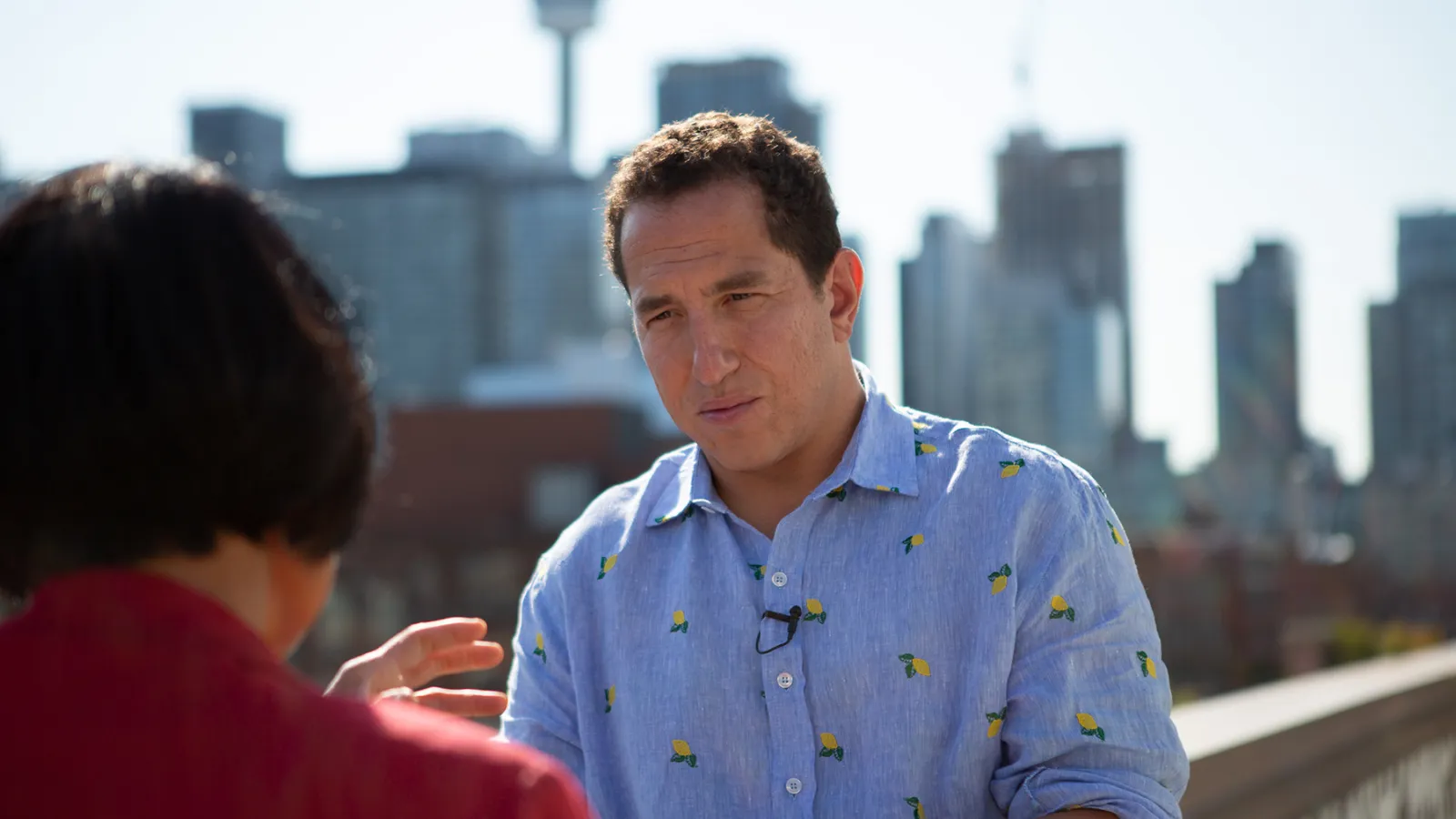
Heffner interviewing Toronto Mayer Olivia Chow for part of his Mayors of the World series.
The Open Mind
One of the people you interviewed was Henriette Reker, who served two terms as mayor of Cologne, Germany, from 2015 to 2025, and was stabbed in the neck in 2015 because of her pro-immigrant stance.
I’m passionate about Mayor Reker of Cologne. Just to be able to interview someone whose campaign directly resulted in the assassination attempt on her. Americans have the tendency to take for granted the tranquility that we’ve achieved in, not all of the 250 years, but generally, the perseverance of the Constitution.
To be able to feel and touch the community of Cologne, and this person who suffered that ordeal and overcame it — and then managed to carry out the courage of her convictions with Ukrainian refugees. A refugee just randomly [came] up to her while we were walking in the town square, to acknowledge her help, her assistance. It’s moving to experience that inflection.
How often do you go back to the archives to watch your grandfather’s interviews to prepare for your own?
Whenever there is an episode that I’m doing that has in its DNA some relation to something that was covered in the past. When I was interviewing Bernie Sanders, I would look at the episodes on the New Deal with the historians like Bill Leuchtenburg and try to understand how my grandfather saw it, and how his guests saw the politics of the New Deal, and the counter-revolution we’ve experienced now. But certain interviews there’s almost like a gravitational pull — it’s like looking at baby pictures or something, like you just have to watch it at least once a year. That’s certainly King, or one from the dozens that he did with Elie Wiesel or Ruth Westheimer.
A really interesting one that I’ve watched from time to time more recently is [the 2003 interview] with Al Franken. I’d say that that Franken episode when it comes to understanding the dynamic of right wing-left wing media, and the pressure on liberals to exist in this climate, and to compete in this climate. Of course, Franken himself succumbed to the same type of allegations and insinuations. I think that Democratic Party voters and liberals are recognizing that they’ve been playing two different sports for a long, long time. That Franken episode, like the Bernie episode, explains where we are. But [I also like watching it] from the perspective of just appreciating a probing discourse. So I guess I return frequently to my grandfather in order to keep alive the sensibility that’s grounded in the show.
Are there any episodes that you’ve encountered from the archives that you feel haven’t aged well?
That’s a good question. There are episodes that reflect the tendency to lionize the Founders in a way that is incomplete. The [show] was super precocious on civil rights for Black Americans, and one of the things I recognized in the Open Mind archive is the lack of gender equity and representation. I mean, my grandfather would argue that women were not the shapers of policy, and that is a fact when it came to much of the ideas encircling The Open Mind, right? Speaking as if I were his defense attorney, my grandfather, I [would say that] there were successful women in every place of endeavor, but they weren’t actually the shapers of policy outcomes. I think that the archive illuminates the most important voices — Gloria Steinem [for example] — but they are in every blue moon, and I wanted to make sure that our show had the most women representation of any of the Sunday [shows], and I think we achieved that.
My grandfather was devoted to Lincoln — as a scholar, as an admirer. I would say I’m an admirer of [abolitionist] Charles Sumner. And I think that is a bit of a sign of the times, that sort of blind fidelity to these framers. I’m always fascinated by the counterfactuals in American history. If Lincoln hadn’t replaced anti-slavery VP [Hannibal Hamlin] his second campaign with a pro-slavery VP Andrew Johnson, the whole arc of reconstruction in this country may have been different. But that means that studying this in 1956 onward, we don’t leave behind Charles Sumner just because he wasn’t in Lincoln’s cabinet.
What have you been your thoughts watching the America 250 celebrations roll out?
The UFC fight at the White House is emblematic of what captures the imagination of the people in charge. There are many ways that we could have meaningfully celebrated and assessed our progress, and I think our memory as Americans of 250 will always be animated by the idea that President Trump was in office.
The fact-based scholarly examination of this country — its achievements and its failures — that barometer was not taken by the federal government. And maybe it will be in the future, but culturally those kinds of examinations are occurring. We all are celebrating 250 in our own way, and for us on The Open Mind, it was Mayors of the World, in conjunction with the 70th anniversary of the show. And it was taking stock of that history, and doing what my grandfather only asked another journalist to do once before: [He asked] Bill Moyers to interview him for the 50th anniversary, and I asked Judy Woodruff and Lawrence O’Donnell both to do that for me — to assume a host chair and take stock of our history. And as you can hear from my own appraisal of The Open Mind, like taking ownership of the good, and shall we say, questionable and more questionable, is the right thing to do, and it’s the honest thing to do.
The other side of the coin here is those who only want to question the integrity of the country, or only want to enumerate its deals with the devil, that’s not healthy either. There still can be that intellectually honest middle position.
Do you think the political center is what most people are looking for?
I think that’s just the place that most of us find normalcy, and the place that our neighbors are in. Yes, there’s always going to be hyper-partisans, but I’ve been struck by the feeling that we are in paralysis. We’re waiting for Godot. Yes, I think the conduct towards the anti-ICE protesters got pretty damn despotic. The Republican Party’s obsession with the Save America Act keeps me up at night. There’s so many ways, tangibly, that we could be saving America — with the state of inflation, which President Trump was correct about — with the state of housing, with the state of wealth disparity, with the state of medical insurance. It’s the abuse of the Constitution, the exploitation of the partisan vitriol, and then just the feeling that nothing matters, and we can’t get to a happier place.
Speaking of paralysis, and do you think that we’re on the precipice of a shift in the Democratic Party? And is Mayor Mamdani going to be part of that?
A lot of the things that Mayor Mamdani and AOC and Bernie Sanders believe in are things that Franklin Roosevelt and Harry Truman believed in, and if they express it according to this heritage, then they are making their message far more appealing. The brutal truth is that their whole way of concocting a green new deal — sure, they used the topic sentence or the chapter of the book, and they modified it, but it didn’t seem genuine in being connected to our history.
[As for Mamdani], I think his practical focus on two things that New Yorkers care about, and that have been the primary forces that have pushed them out of the city, is scaffolding and rent. I think he’s laser-focused on those things — the quality of life. He has his eye on the ball. If it deviates from those two things, then that will be noteworthy, but it hasn’t. And I’m eager to see, as we did in Toronto with Mayor Chow or Mayor Dickens in Atlanta, the proof in that pudding.
I covered the 2016 primary from a perch in New Hampshire, as a fellow at Franklin Pierce University, and I went to some of the rallies, and Sanders was just on point every time. The fundamental thing that he is stating continues to be factual, and that is that [we live in] the most lopsided economy in American history, the most oligarchic that the country has ever seen, and that’s not how we conceived of capitalism. Capitalism always had the Darwinian element, but we lived in a country where the mom and pop store could not just coexist but thrive, and so all this hogwash about policies that are intended to pursue fairness in the economy, how they are a deviation from capitalism, that’s just not true. We lived with a tax code and an ecosystem that was capitalistic and fair at times. As FDR said, he was endeavoring to save capitalism from itself. [When] one person is a trillionaire and controls all the levers of industry, that’s more autocratic than capitalistic, so I think that that is the fundamental point that Sanders made. And it’s the point that would make people who are inspired by him successful, and it’s again the proof in the electoral victories. The question is, can they achieve the policies that they are promising people?
This interview was edited for length and clarity.