
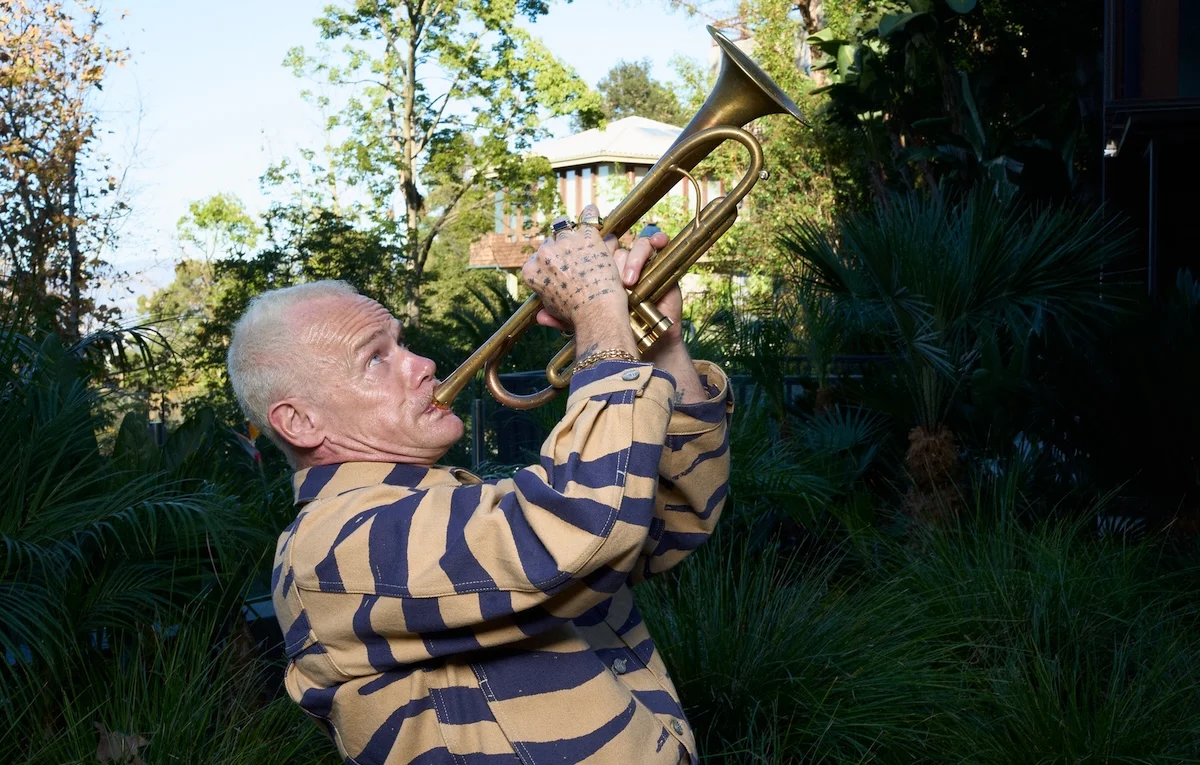
It's a brass invention, he calls it, a powerful device, a tangle of metal and grease. As soon as “a human being places it on his lips and breathes love into it, it becomes alive and fiery, a path to God, a spokesperson for divinity”. When he talks about the trumpet, the toothless mad toxic buffoonish ex-punk brilliant Flea changes his tone and starts to write poetry. For him it is not just a tool, it is the means to live in what he calls the infinite present. “The more love enters, the more heat comes out, and the pistons pressed by the fingers change the shape and speed of the rainbows of air that pass through them,” he writes in his autobiography Acid for the Children in remembering the wonder felt after the discovery of the instrument. «From the moment I placed the cold mouthpiece against my mouth, letting out a warm breath, I felt the desire to create a beautiful sound, to feel my entire being vibrate with the note».
For Flea the trumpet is imagination rather than technique. He played it for decades and just like basketball it made him feel alive, free. The bass has solicited a different kind of imagination, it is sex, rebellion and animalistic strength of the Red Hot Chili Peppers, but Flea has never lost the desire to “vibrate along with the note”, nor has he stopped dreaming of making an album entirely centered on the trumpet, a desire born 35 years ago, while playing the part of Budd in Beautiful and damned.
Once he turned 60, he realized it was time. Now or never. He picked up the instrument again and practiced every day for two years to prepare for the feat. He also studied with Rickey Washington, Kamasi's father. He produced home demos with the idea of playing everything himself. But then thinking about albums like The Way Out of Easy by Jeff Parker of Tortoise with the ETA IVtet e The Omnichord Real Book by Meshell Ndegeocello produced by saxophonist Josh Johnson, he put together a great band of jazz musicians and not just to record Honora. And that's when he got scared. When you find yourself playing with musicians like those you risk feeling inadequate even if you are a rock superstar. And instead the one who was afraid of making himself look like an “incompetent asshole, charlatan and poseur” was accepted and went into ecstasy playing with Parker, Johnson and the gang. “They made me feel like I was under the influence of drugs,” a subject about which he knows two or three things.
Honora it is so varied that it seems messy, but it shows that after a certain age, seeking new paths keeps you alive. And it is better for a musician to be alive and imperfect than predictable and therefore half-dead. The album will be released on March 27th and opens with the 61 seconds of Golden Wingship who tell us: look, what follows is changing and unstable matter, you won't hear a record of Red Hot Chili Peppers songs or even the classic jazz album, but you will have access to the multiple passions of a restless musician.
One of the songs that have already been heard is Traffic Lightsa post-Atoms for Peace piece with the trumpet jumping happily on the voice of Thom Yorke busy singing about little squares you can click on to check if you're human. Another is non-song To Pleathe poetic and political manifesto of the album, a vision of America related to Nuclear War by Sun Ra, seven and a half minutes of be pop (that's not a typo) that roughly halfway through turns into a declaimed essay on the state of the union in which Flea reshapes the hippie myth for today's divided America: “Everything that isn't love is cowardice / Do you want to be brave, do you want to be tough? / Peace and love are the hardest and toughest thing you can aspire to.”
Where there is a lack of technique at the highest levels, as in playful Morning Cry where Flea's trumpet does not have the brilliance necessary to dialogue with Parker's guitar, or where the experiments are strange and unfinished, like the classic Willow Weep for Me with John Frusciante's modular synths, the spirit arrives. This is the case of Thinkin About You by Frank Ocean. It seems to border on easy listening, but stops a moment before thanks to the sweet and surrendered air of the melody which is divided between bass and flumpet, a cross between flugelhorn and trumpet.
Flea even managed to convince Nick Cave to sing Wichita Linementhe Glen Campbell song written by Jimmy Webb that the Red Hot musician loved so much in the Meters version. It's an antique in which Cave confidently interprets the theme of long-distance desire. “Whenever I'm near a stereo playing trash music, I find out it's the Red Hot Chili Peppers,” Cave said about twenty years ago. He regretted it and admitted that “I was a troublemaker, a pain in the ass, someone who felt good when he irritated people.” A year ago, without revealing the title since the album had not yet been announced, he described this Wichita Linemen like a conversation between Flea's trumpet and his voice, «a slowly evolving cosmic dance that takes the form of a reconciliation and a request for an apology».
It won't be a memorable album, but Honora adds a new nuance to Flea's idea of Altramerica, the messy sum of post jazz and freakness, old counterculture and funk that make it a lateral project yet representative of the character and his way of conceiving music. He is an acrobat and a guru, a rebel and a romantic, a seasoned storyteller and a perennial student of music who, even when he plays jazz, or something similar to it, embodies an idea of absolute freedom. This can also be understood from Maggot Brain where Flea plays at home having paid homage to Funkadelic/Parliament for a lifetime. To sing the song to the worms in the brain of the universe he combines trumpet and vibraphone (Sasha Berliner). There are definitely less drugs in this one Maggot Brainless ecstasy and perhaps more bitterness than that of 1971. The worms are eating the brains of world leaders, even literally.
In the past Flea tried to record the final piece a couple of times with Red Hot Free As I Want to Be. «I was in Big Sur, California, it was a sad time, I had a lot of anxieties», says the musician in the notes that accompany the songs. «I was coming out of a relationship. I was wandering around Big Sur, and the view of the sea from that cliff is amazing. I said to myself: I am as free as I want. I don't have to be sad. I don't have to be tied to anything. I can be anything I want, even happy.” To record this mantra, which he imagined chanted by monks in a forest, Flea called teachers and students from the Silverlake conservatory. It's the ending that encompasses the album and its spirit.

On the cover there is a photo of Shahin Badiyan, the mother of the musician's wife Melody Ehsani. On his shoulder he has his pet pigeon. It was Melody, «half of my heart», who suggested using the photo in light of what is happening in Iran. Being of religion Bahá'íhis family was forced to flee to the United States after the 1979 Islamic Revolution, taking few things with them, including some photo albums and this beautiful image.
“I was born in Los Angeles in 1980 and grew up with the constant knowledge that, at any moment, members of my family who were unable to escape could be killed,” Ehsani wrote. That photo is a prayer that people «do not allow any system to divide us into “us” and “them”». Or as Flea sings in his feverish, deranged way, “build a bridge, shine a light.”
Daniel D`Amico for SANREMO.FM