
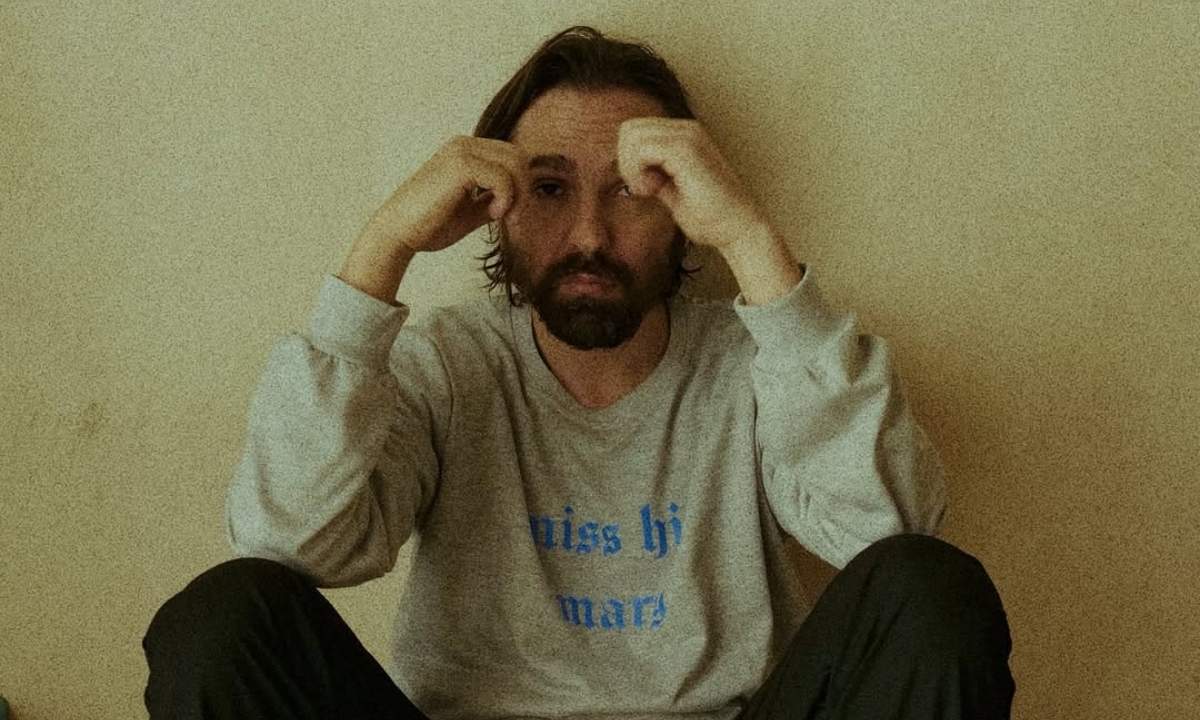
Dimartino returns as a soloist with The unlikely flood of the Oretoa concept album that tells of his Sicily and in particular Palermo, through the river that crosses the city. We met him for a video interview, after the years of sharing stages with Colapesce and the return to the form with which he began his career.
The conversation opens with the question from which the whole album starts: what it means to be Sicilian.
“It means many things, at the same time it means not being able to get out of it. If you are born Sicilian that thing remains with you, Sicilianness is ineradicable. Ferdinando Scianna, photographer from Bagheria, said he was Sicilian even before he was born. Being Sicilian is not always an advantage, it is also a hardship sometimes but that's okay.”
Dimartino and the meaning of “The unlikely flood of the Oreto”
The album title does not arise from a geographical reason.
“The unlikely flood of the Oreto is a title that I chose not for geographical reasons. The Oreto is the river that crosses Palermo, it starts from a clean source, gets dirty and reaches the mouth where there is debris from the sack of Palermo, a terrible historical moment that created an open-air landfill.
With an almost act of resistance, the water managed to overcome all the difficulties and made its way to the sea, and this idea of the river crossing the city seemed to me to be a nice parallel with the human being.
You are born, then you get dirty and the unlikely flood for me also represents a flood on an emotional level. After a certain age, are we still capable of falling in love, of feeling feelings? The human being, little by little, becomes drier. The Oreto flood is a possible flood, not an impossible one. It's unlikely.”
We ask him if he has reached that emotional high.
“A condition that I use to get excited is curiosity. I'm curious about human beings, about stories, and this stimulates my emotions but I have to induce it myself. The further you go, the more you have to find stimuli, becoming dry isn't useful to anyone. An arid society is a society that no longer finds meaning in emotion and it's the worst thing that can happen.”
Nature as an immutable value, from Stefano Mancuso to Garcia Lorca
Nature runs through his entire discography. Here too it has a precise weight.
“For me it has an immutable value. The city changes and is at the mercy of society and personal interests, while nature remains as it is for a large part of the time, and for me it is very stimulating. It is not the main source of inspiration, but seeing how we manage to integrate into a landscape inspires me. I was in a program by Stefano Mancuso, a great scientist who studies plants, who talked about how 99% of living beings are plants: we are a small percentage and nature manages to live without us.”
How the album was recorded: the flow of the Oreto river
The musical choice follows the flow of the river, without pauses between one song and another.
“Together with Roberto Cammarata, co-producer of the album, we decided to record near the river and we imagined this flow without pauses that starts from the first to the last song, in which each song is accompanied by an instrumental coda that leads to the next.
Many times, thanks to a cut-off, we close the frequencies and the sounds that emerge seem like those of the river, but they are synthesizers. This idea of musical flow seemed ideal to us in a world where the listener hears an album from start to finish. I'm a fan of concepts, and this is a record where you have to take half an hour to just listen to it.”
We ask him if he fears that the album won't be understood.
“I have made peace with this thing, I know that this record will never be able to go on the radio or climb the charts and get millions of views. The important thing is to understand what the objectives and limits are. My goal is to have continuity with the other records and go and play it around. Having people who pay a ticket to come and see me is already an objective: the Renzo Barbera stadium in Palermo I already know that I will never be able to do that.”
No featuring and a poem by Garcia Lorca set to music
After recent collaborations, from Colapesce to Thirteen Peterthe album is entirely one voice.
“In my opinion it wasn't a featuring record, there were no pieces that lent themselves to two voices. It's a record that lives if it's just me singing it. There's a poem by Garcia Lorca that I set to music and it excited me more, because it has a melody inside of it: his poetry is as if he were singing, so it was very easy for me to set it to music.”
We point out to him that it is the same operation as the great Italian singer-songwriters, such as Fabrizio De André with Cecco Angiolieri. We ask him if he feels part of that category.
“No, I believe that the heights reached by De André and others are unique. When we talk about names like De André, Lucio Dalla, Battisti, Battiato, we are talking about songwriters who are difficult to have heirs, because the world and the way of writing songs has changed. I feel similar to them when I make a record, in this historical moment, which has nothing to do with the market but with my own needs. I don't take part in their championship.”
The state of music in Palermo according to Dimartino
As Southern Italy continues to emerge, we ask him where Sicily stands.
“Palermo produces many artists, many people who make music and write songs, including rappers with important things to say. I think of Santamarea, born from the bottom but with their own language and objective: it's not easy at that age to have your own way of writing, and Stella from Santamarea has it.
Despite being a geographically secluded city, there has always been the ability to reach unexpected levels. In my time there was no one in the sector who could advise you, we didn't have the tools, we didn't know what publishing or record companies were, and most cultural operators went against the artists. To have survived those years is a huge thing. Let's think of La Representative di Lista, Carnesi, Johnny Marsiglia, Davide Shorty: all people who trained where training was complicated. Now the ground is fertile, so many things are being born and it's beautiful.”
The tour and the final date at the Golden Theater in Palermo
The tour touches Rome, Bari, Milan, Turin, Florence and Fano, while Sicily comes to the end. The closing date is at PalermoThe December 19 at the Golden Theater.
“I wanted to do a tour in small places for 2-300 people and in Palermo I didn't find a place with these characteristics. In my dreams I wanted to do it at Spasimo, but it is closed to concerts after a landslide a few years ago. So I will do the concert at the Golden Theater on December 19th, a party together with many friends and musicians who have played with me in these twenty years. It will be the final party of the tour, and I invite everyone.”
