
There is something extreme in deciding to invest in beauty while everything around you seems to be collapsing. However, it doesn't seem like an escape from reality, but a survival strategy. When Ece Temelkuran wrote How to Lose a Countryone of the most lucid essays on the contemporary authoritarian drift, allowed himself a daily deviation: inventing birds. New and imagined species at dawn to face the day, that is, the story of the disaster. This is where it starts Seedthe project which, from 1 May to 2 August, will bring Brian Eno to Parma together with the exhibition My Light Years. Not from an artistic theory, but from a minimal and therapeutic gesture: creating something edifying so as not to succumb to ugliness.
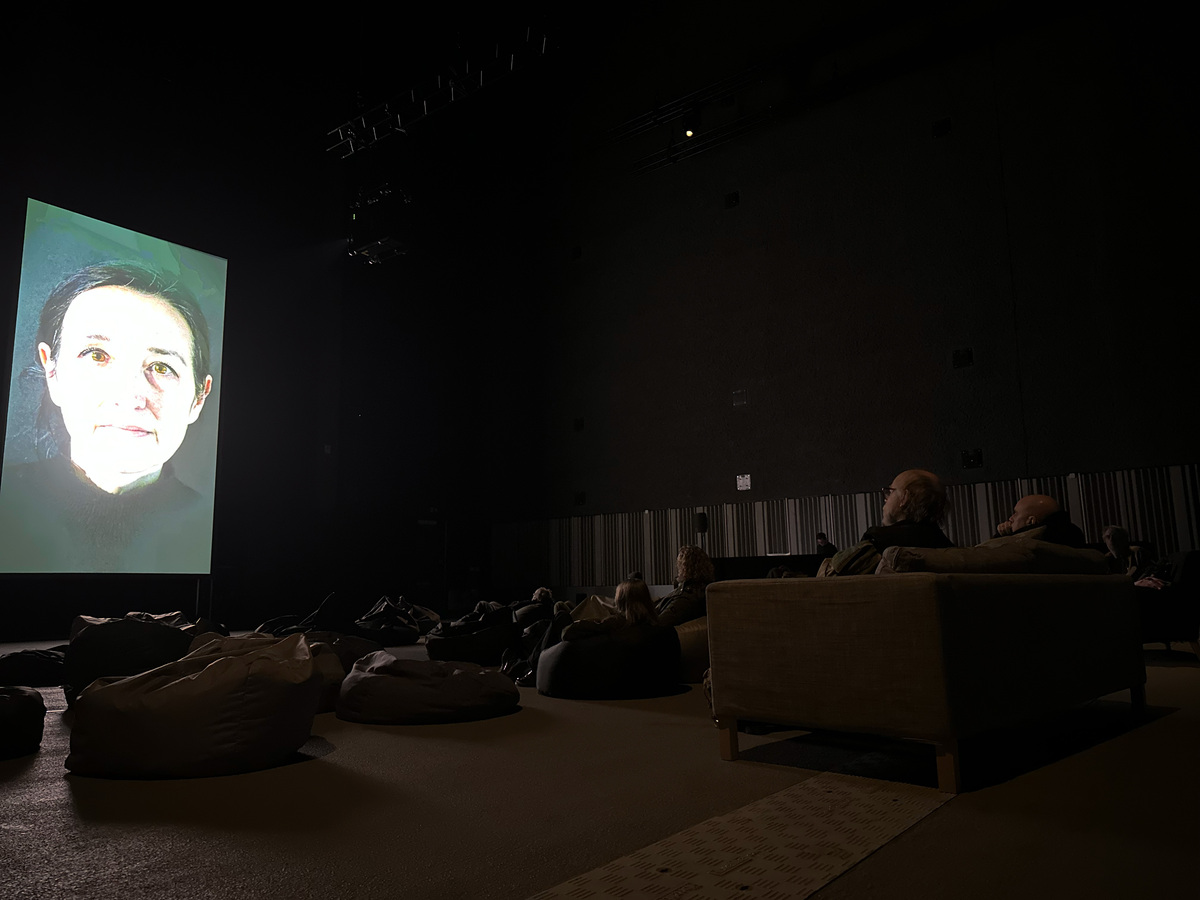
The work 'Face To Face'. Photo: 'My Light Years' exhibition in Parma
The presentation took place today with the protagonists of the project in the Gardens of San Paolo, where sound mixed with the world. The real songs of birds – blackcaps, tits, serins – were intertwined with those imagined and synthetically generated. No hierarchy between natural and artificial, between real and possible. A composition that escapes control, built on combinatorial and random logic, consistent with Brian Eno's research on generative music: systems that produce infinite variations starting from simple rules. The installation spreads across 8,000 square meters of the San Paolo Gardens, transforming the space into an open sound map. In fact, there is no privileged listening point, each visitor builds his own experience by unconsciously choosing what to listen to.
And, given the times we are living in, Brian Eno himself admitted that it is an inevitably political project. «It's political because what I want to do is create a space where people can stop and think and feel without anyone telling them what to think and feel. Often people are not aware that we live immersed in a river of messages that tell us what to think, how to think it, how much to think it and what you really shouldn't consider. I think that art can be useful, because it has to tell me, think what you want and how you want, about the birds you hear here, sitting on a bench. There are too many messages given to us and this is not my role.” And then Parma becomes a laboratory, not a city that hosts but a place that absorbs and gives back. A delimited garden in which reality can be temporarily rewritten.
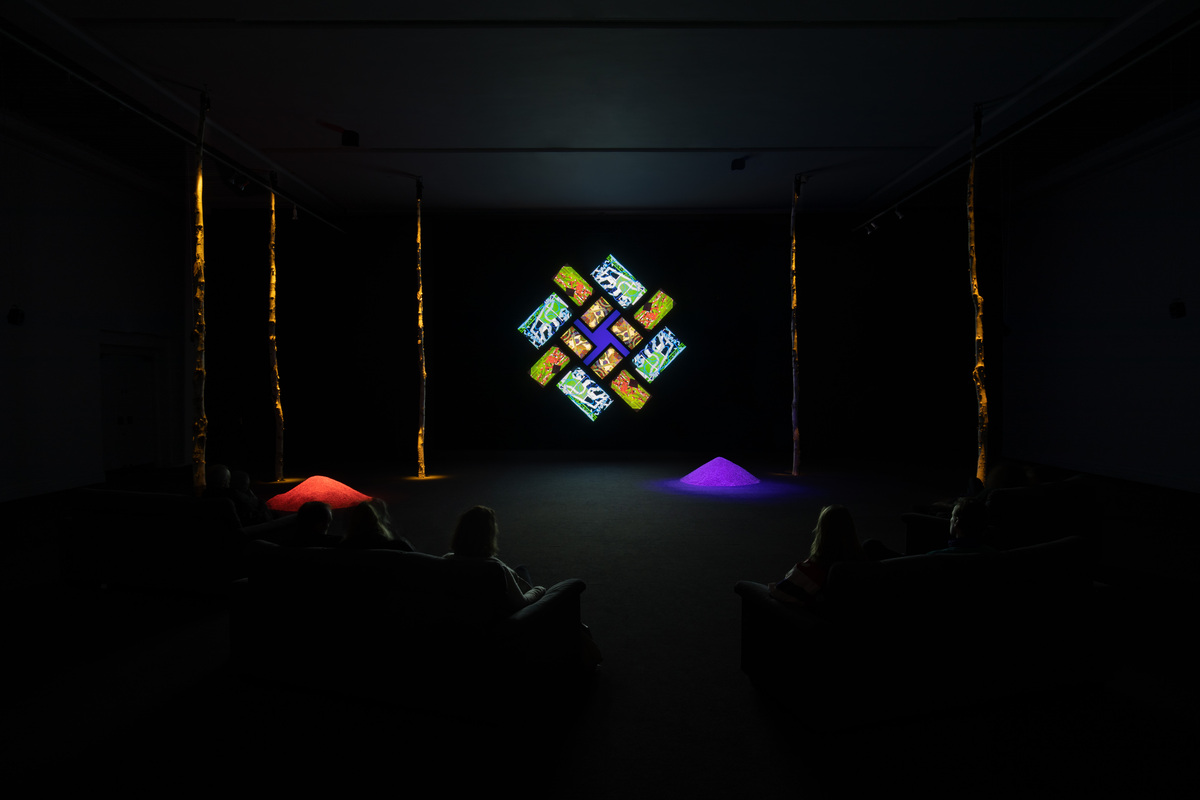
The work '77 Million Paintings'. Photo: 'My Light Years' exhibition in Parma
To really understand Seed you have to look where it happens. The San Paolo Complex is not a simple location, it is a system of thought built over the centuries. Benedictine monastery, cloistered space and symbolic machine. With the Abbess's Chamber frescoed by Correggio which was not just a decoration, but an instrument of knowledge. And bringing a work like Eno's to a place like this is not an overlap between ancient and contemporary, it's a short circuit. On the one hand the Renaissance conception of art as a complex and stratified system, on the other a contemporary practice that works on algorithms, generation and perception among the public. The gardens, in turn, were never just a green space because they were vegetable gardens, places of production, of meditation, of slow time. So today they return to being something similar, but updated to the contemporary: no longer material self-sufficiency, but perceptive self-sufficiency. A space where you can stay without being constantly solicited.
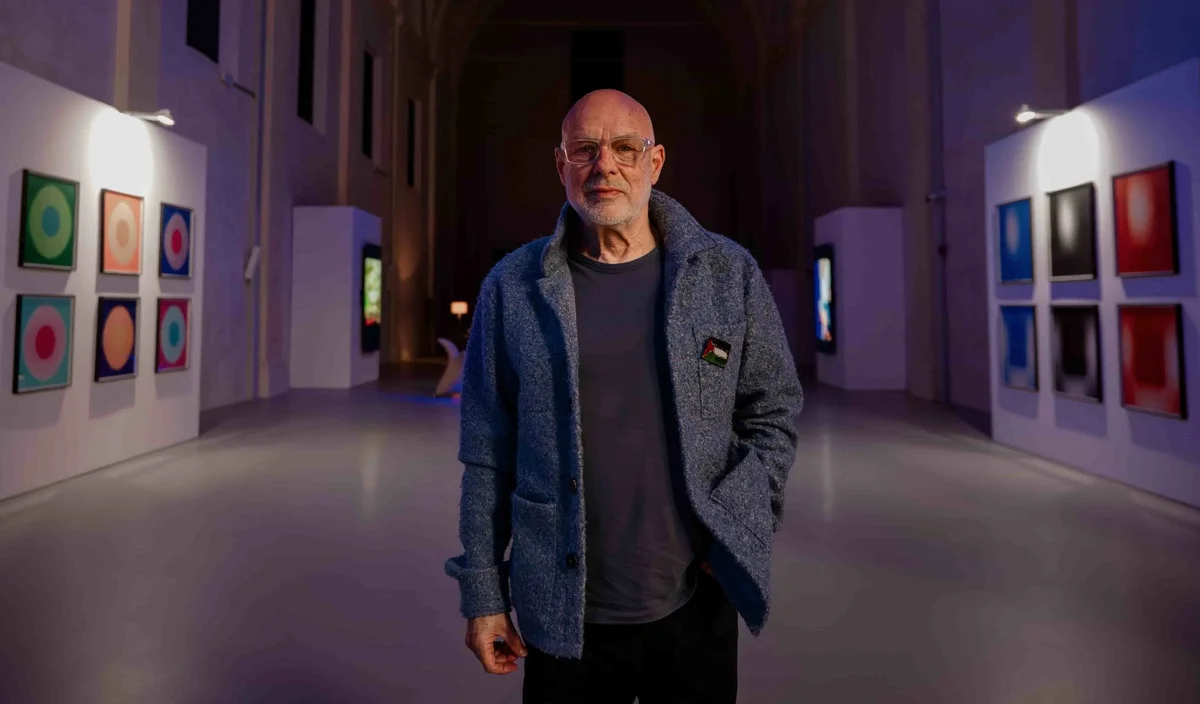
Furthermore, inside the Ospedale Vecchio in Strada Massimo D'Azeglio, the other half of the project takes shape: My Light YearsBrian Eno's first major European exhibition dedicated to light as an artistic medium. A journey that spans over forty years of research, from the first VHS video works of the 1980s to the most recent generative installations. Historical works such as Mistaken Memories of Mediaeval Manhattan (1980-81) e Thursday Afternoon (1984), along with key works such as 77 Million Paintings (2006), continually changing visual system, and more recent works such as Face to Face (2022), where human faces slowly transform, generating new and impossible identities. The exhibition also includes new Light Boxes created specifically for Parma and marks the return of historical works such as Crystals (1984), building a dialogue between past and present that reflects the continuity of research. The project, curated and produced by Alessandro Albertini, is part of a trajectory that in recent years has seen sound art and immersive installations emerge from museums to dialogue with complex, often historical architecture. Both projects are carried out by the Municipality of Parma, with the support of the Cariparma Foundation and, in the case of Seedof the Pac (Plan for Contemporary Art of the Ministry of Culture).
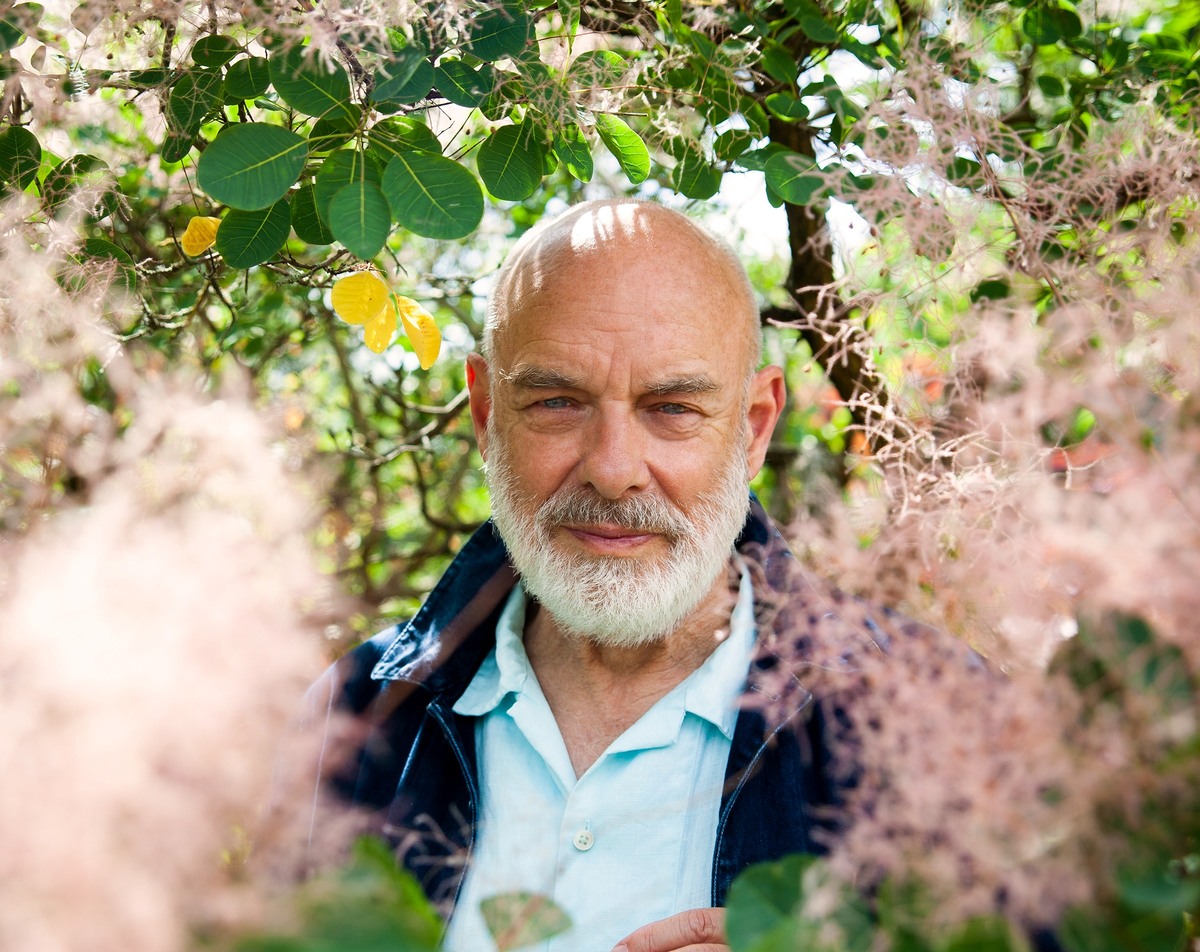
Brian Eno. Photo: Cecily Eno
Brian Eno also showed up at the meeting with the press wearing a pin with the Palestinian flag imprinted on his jacket. And he explained why: «If we try to put into words what peace can be, this is an example: wouldn't it be nice to live like this, instead of a world in which 25 trillion dollars are spent on weapons every year? It would be nice if peace could be captivating and presented in this way, that it reaches people. Because people like peace, this is what they want, so on the other hand there is a lot of propaganda and advertising for there to be so much war.”
Eno, after all, has always worked in this direction. From Roxy Music to production for David Bowie and U2, up to the very definition of ambient music, his path is crossed by the idea that music does not necessarily have to be at the center, but can be an active background. In fact, he did not say he was worried about the loss of strength of music due to quantity: «At every moment in history there are expressive and artistic means that are more important than others. in the 1920s it was painting, in the 1940s and 1950s it was poetry. These means of expression became prevalent as canon. And around this canon people argued, they agreed or not. In the 60s and 70s the role of canonical art was played by music. Now there is so much music, I would say too much, that it is impossible to share it, talk about it and know what we are talking about. There was a time in history when everyone knew what music was available and everyone else listened too. Now that's no longer the case. Music is no longer a canon. although it continues to have an important role within cultural ecology. There's a lot of music now and some of it is excellent».
And he shuns nostalgia: «There are some of my generation who say: “The music we had in the 60s was better”. It's not true, there was a lot of shit around even in the 60s. In 1966, if we take the twenty most listened to songs ever, seventeen out of twenty were things we no longer wanted to listen to, and we never listened to them again. Now there is a lot of music, even new and fascinating, that does not belong to a well-defined tradition. And I can say that, in ten or twenty years, there will still be an agreement on music. It will once again have a fee, which it hasn't had in recent years. There will be another canon period. Not soon, but even if it were soon it's something I probably don't think I'll get to see.”
In the same way, regarding artificial intelligence, rather than the medium, he said he was worried about who controls it: «My source of concern is not artificial intelligence in itself, but who owns it. These are the same minds that created social media, with a divisive and uncooperative attitude. What matters is what it is used for. Besides, we've had it for years. However, a process of reengineering is underway that pursues specific political goals, which are aimed at finding yet another way to control us. In a world where a few extremely rich people will get even richer. It is not the thing itself that is important, but what a system like artificial intelligence does, and what it is used for. And it is used to carry out social control that began with social media, because it is the same people who are behind it. But don't say I'm a pessimist.”
Finally, he did not fail to pay homage to the Italians: «A dear friend of mine, Robert Wyatt, told me: “The Italians are the best”. It's like this, I appreciate the sociability of your country, that people dedicate so much time to being together and that they waste this time, in the sense of eating for a long time together or going to see something in a museum or directly making art. I, however, live in a very different place. I live in the world trade centre, London. The center of finance, where billionaires live who evade taxes, launder money and are corrupt. You should be happy to live in a country that places beauty at the center and appreciates high quality experiences, including sensorial ones.”