When I was a little girl, my father took me with him to watch the future arrive.
I was eight, sitting in a vast Silicon Valley conference hall filled with rows of gray monitors glowing with a fluorescent premonition. It was the 1994 off-the-record unveiling of Netscape for about 150 select advisors and early adopters. Most of the world did not yet know the web existed. That day, I spent my first time online researching white rabbits and fell down a hole of hyperlinks. Forty minutes later, I surfaced, frozen and frightened, not of the technology, but of how untethered I felt from my own body and the wilds of Wyoming that had forged me and four generations of my family before. Could anyone have imagined where we would be three decades later, in the age of artificial intelligence?
My father, John Perry Barlow, was as astonished as I was, and he ran with it. He had grown up on the two “frontiers” of wilderness and culture as a Wyoming cattleman and a Grateful Dead lyricist, and could recognize a third emerging. In February 1996, after the passage of the Communications Decency Act, a landmark law that brought federal censorship to the internet for the first time, he wrote “A Declaration of the Independence of Cyberspace”: “We are creating a world that all may enter without privilege or prejudice accorded by race, economic power, military force, or station of birth.”

The author with her father, John Perry Barlow.
Courtesy of Elaine Parker Barlow
My father’s declaration gave a generation of builders permission to imagine digital space beyond the reach of a government that sought to control what it did not yet understand. He saw the World Wide Web as one of the first systems to actualize global interconnection, a commons where anyone could reach anyone across every border. He spent his life “trying to make it easier for people to be free, often before they could see the forces seeking to constrain them.” He fought to give us a space for freedom of expression, urgent then and even more so today, as the threats grow bigger, faster, and harder to name.
This year marks the 30th anniversary of his declaration and the 250th anniversary of the one that inspired it. Both my dad and the Founding Fathers understood something crucial: declarations are powerful social technologies. They are called for at thresholds: when things begin falling apart and what comes next has not yet arrived and the future remains radically unknown.
Both were documents of separation, colonies from the Crown and cyberspace from the state, making room for something new to grow: a nation, an open web, possibilities not yet fully imagined.
But now, we are living with the consequences of what separation has become: us from them, and bits from atoms.
The internet has become ever more fragmented and polarized. So has America. Corporate interests have captured the web my father fought to protect, the one we have come to depend on. We have watched digital technologies distort our identities, communities, and democracies. What happens on our screens shapes how we work, vote, fall in love, raise children, treat one another, and understand reality.
My father claimed that “identities have no bodies,” but today we must contend with the inseparability of bits from the atoms they are made of. Bits are born in mines, factories, data centers, undersea cables, power grids, and human hands. They hunger for land, water, energy, minerals, labor, and the accumulated expression of millions of people. The cloud is not weightless.
Meanwhile, our attention migrates into screens, while algorithms warp reality with fabricated images and false narratives. We lose our sense of home in the physical world: the one made of blood, bones, water, weather, and soil; the one we actually depend on to survive.
The greatest danger may be forgetting our belonging within a larger whole as we mistake ourselves for gods.
Growing up in Wyoming’s rugged realities left no illusion that humans are solely in control. As the old-timers said, “There are no enemies in winter.” Nature won every time. Our survival depended on knowing our place within it, and on strong relations with our neighbors.
Sixteen years after I first followed those hyperlinks, that same curiosity pulled me through the halls of academic and political power until I arrived at the Pine Ridge Reservation to write a book comparing two concepts of natural law: constitutional and ecological. There, I encountered a history my American education had left out: that the United States Founders’ vision of democratic governance was shaped by the centuries-old Haudenosaunee Confederacy, native to this land. It shook my understanding of this country.
What struck me was not just the influence, but that this system of indigenous democracy arose from millennia of observing the interdependence of the natural world, with women and nature at its center, two forces largely absent from the political order I knew.
In the recently published American Indigenous Democracy: A Call for Interdependence, Haudenosaunee leaders and scholars speak to this influence and name principles core to their governance: peace as the highest calling of government with women and care at the center; reciprocity with the natural world; responsibility to the next seven generations; and law rooted in the sacred and aligned with life.
Interdependence is not soft idealism; it is foundational and pragmatic. Our survival depends on the health of our relationships with one another, the living systems that sustain us, and future generations.
My father’s declaration belonged to the internet’s youth: a moment that called for imagination, defiance, and permission to experiment.
But adulthood demands more than independence. It asks not only what we want to be free from, but what we are responsible for. Whom our choices affect. What we are prepared to protect. And the future we want to create by declaring it together.
My father knew his declaration was imperfect: a lone man invoking the Founding Fathers, planting a flag in the dark. It is time for a second draft, one that empowers every voice as part of a collective and recognizes our inherent relationship and responsibility to one another and the living world that sustains us.
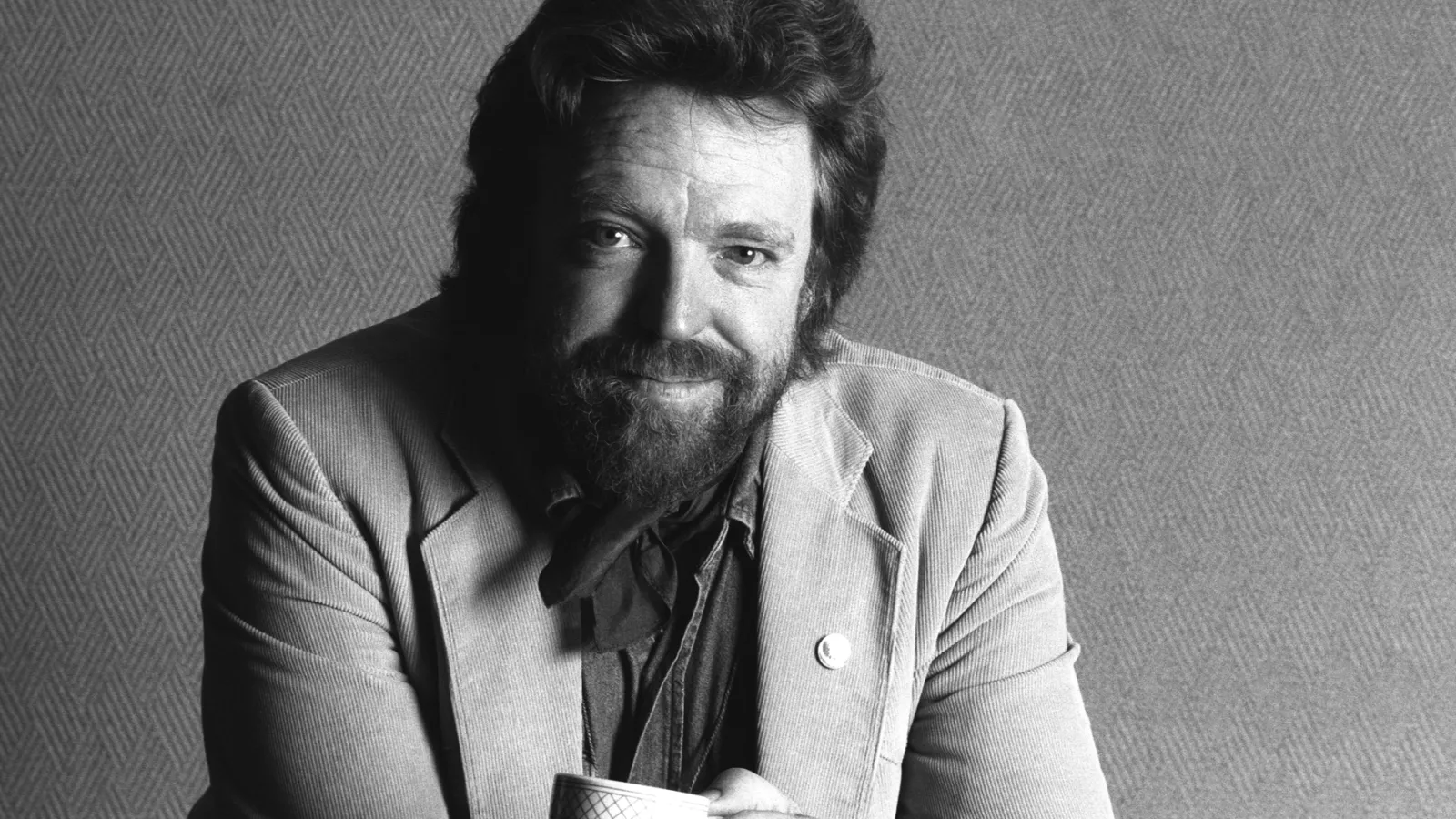
John Perry Barlow (center, with beard) with Bill Gates (right) and others during the annual PC Forum in 1991.
Ann E. Yow-Dyson/Getty Images
We stand, again, at a threshold of an entirely different magnitude. The consequences and capabilities of artificial intelligence are farther-reaching than any technology in history, developing at a pace no previous generation has faced. The future is being born right now: uncertain, up for grabs. Technology that touches everyone should be accountable to everyone, including parents, workers, and the people building it.
It is time to declare our technological futures together, to open our civic imagination and envision what we want, rather than simply accept what we are given. A process of public deliberation across communities, culminating in a national citizens’ assembly on the technology future we want with artificial intelligence before the next presidential election. This process would bring Americans across every difference together to shape what comes next and tell our political and business leaders what we demand.
We are not standing at this new horizon without history. The dawn of the internet taught us that openness without responsibility can become extraction, connection can deepen division, and freedom without care can concentrate power in the hands of a few. We have the chance to learn from those growing pains before they become the inheritance of the AI age.
Nothing about what comes next is inevitable. We have a responsibility to steward this threshold differently: to declare what we believe, practice what we declare, deliberate together on what it demands. Then build the technologies and institutions to reflect it, accountable to the living world they depend on and the generations that will inherit their consequences.
Thirty years ago, my father declared cyberspace “the new home of Mind.”
Today, we must remember our true “home of Mind” is rooted in bodies, communities, histories, and the living Earth.
Independence gave us the courage to cross the last threshold. The wisdom of interdependence must guide what comes next.
Amelia Rose Barlow is the daughter of John Perry Barlow and an adopted daughter of an Oglala Lakota traditional family. She has worked toward interdependent systems across democracy, technology, and climate since 2010, now co-stewarding We The Interdependent and Declaring Our Tech Futures, a campaign inviting Americans to shape our technological future together.