
S
andwiched between two rows of suburban Long Island homes, the fenced-off tract of grass looks like any other nondescript lot ready for construction. But take a walk inside and the ground is laden with faint slabs of rock, gravestones from a centuries-old Indigenous family cemetery that had been obscured by the passage of time and neglect. “When we started working here seven years ago, it was nothing but trees and trash — there were couches buried here, you name it,” says Sandi Brewster-walker, my spry octogenarian guide to the site. She bends over to pick up a discarded beer bottle. “People in the houses throw stuff over the fence, so it’s been a project.”
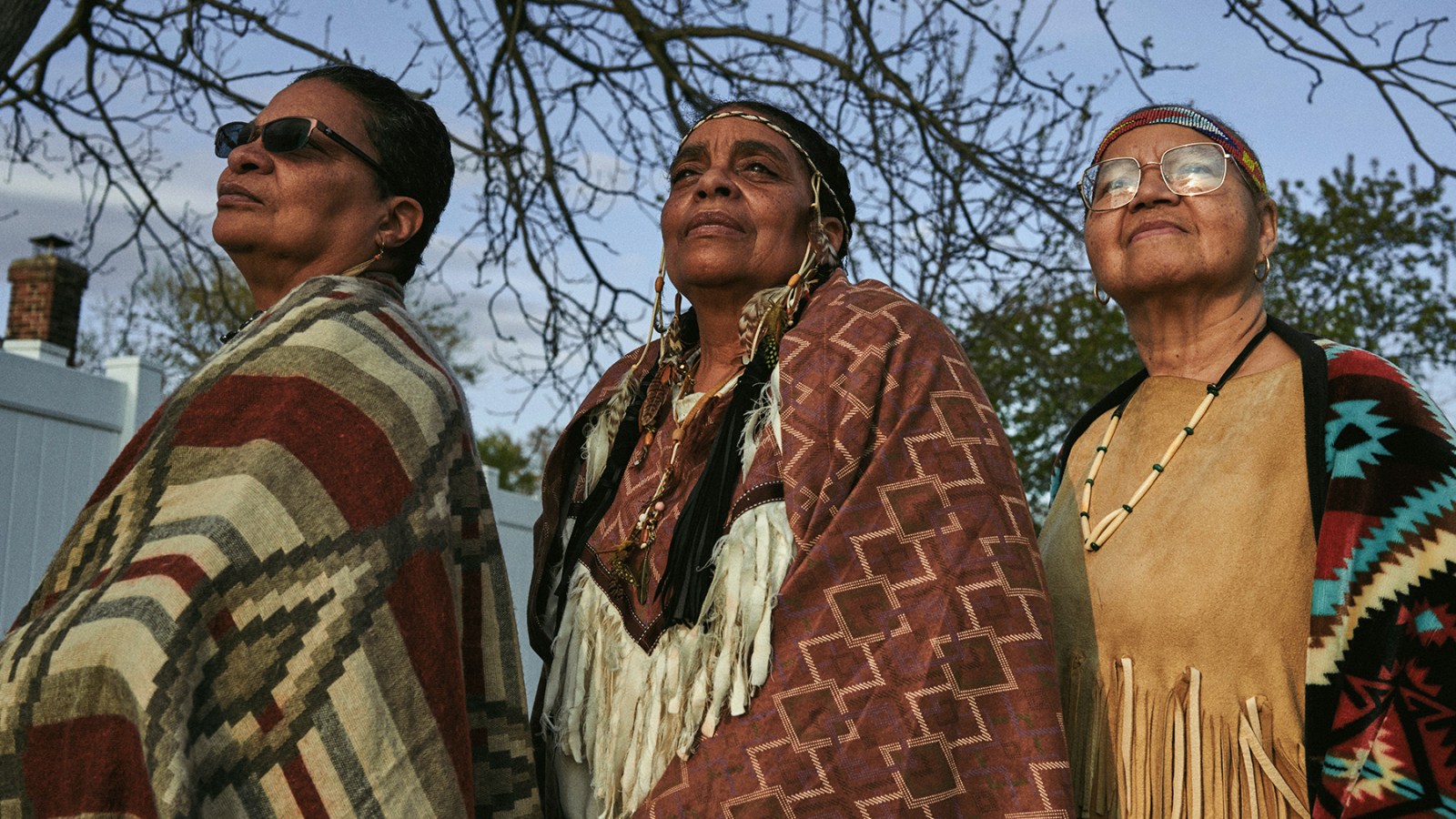
For Brewster-walker, this place is sacred ground. The resting place of at least 80 members of her tribe: the Montaukett. Since she started serving as executive director a decade ago, uncovering lost history and setting records straight have been an obsession for Brewster-walker, whose caramel complexion is framed by warm hazel eyes and a beaded light-blue necklace. She points to the rear of the tract, where authorities are still in the process of removing brush that conceals some 50 additional graves. “It’s probably more than that,” she says. “I have all the names.” Thanks to Brewster-walker’s tireless efforts digging up public records, tracing lineages, and petitioning officials, the town of Babylon will install a remembrance plaque and mow the grass here several times a year, as it has done at other rehabilitated Montaukett burial grounds. It’s a small but meaningful gesture for a once-flourishing tribe that was gradually dispossessed of ancestral lands and then stripped of its official existence — a brazen case of legal erasure that continues to stain the annals of New York state government.
In an infamous 1910 court decision, Montaukett leaders and 75 tribal members were seated in the courtroom when a state Supreme Court judge declared them “extinct,” conferring their remaining lands to a white developer. The verdict came despite an earlier U.S. Supreme Court ruling under which the nation would have qualified for federal recognition, and a 1906 memorandum filed by the then-acting commissioner of Indian Affairs for the U.S. Department of the Interior, acknowledging that the Montauketts were “an existing Indian tribe” and those trying to annex the tribe’s land should be “forever” restrained.
“It’s one of the most racist court decisions in the history of New York state jurisprudence,” says Fred W. Thiele Jr., a Democratic former state assemblyman who sponsored multiple bills to reinstate the tribe. He asserts the egregious case of judicial overreach is the “New York state version” of the U.S. Supreme Court’s shameful Dred Scott decision, which ruled that Black people had no rights, and Plessy v. Ferguson, a verdict that legalized racial segregation: “There’s a wrong that needs to be corrected, and we shouldn’t be making them go back to square one to prove something that we already know is true — we should just be correcting that wrong.”

Sandi Brewster-walker at a tribal grave site she’s rehabbed: “When we started working here seven years ago, it was nothing but trees and trash,” she says.
Jason Motlagh
To date, eight bills to recognize the tribe have passed both the State Assembly and Senate with overwhelming bipartisan support, only to be vetoed by Democratic Govs. Andrew Cuomo (three times) and Kathy Hochul (four times and counting). Year after year, Brewster-walker says, she and tribal leaders have worked in good faith with the Governor’s Office to meet and exceed its every request for supporting materials and clarifications. Yet sometime around the Christmas holiday, a phone call with an Albany area code comes, informing them that the bill did not pass the governor’s desk, a cruel charade that, Thiele says, “compounds the original sin.” (The end-of-year timing all but ensures lawmakers will not be available to overturn the veto.)
The gnawing question is why? In these hyperpolarized times when bipartisan cooperation of any kind is rare, much less unanimous, Montaukett recognition would seem to be a legislative layup. Although the tribe’s ancestral territory in eastern Long Island includes the Hamptons, some of the most valuable real estate in the country, the Montaukett have not made any land claims or requests for compensation. They insist that regaining state recognition is foremostly about correcting a historical error and preventing the tribe’s history from sliding into oblivion.
“I don’t want to throw anybody out of their houses, and I’m not looking for any big pieces of land,” says Robert Pharaoh, hereditary chief of the Montaukett Indian Nation, affirming the tribe has no plans to sue for land. “The only thing I want is a piece of property big enough that I can put a museum or cultural research center on, and maybe put up a natural Indian village outside. That’s all.”

Jason Motlagh
LONG BEFORE THE expressway-traffic snarls, Maseratis, and sprawling waterfront estates, there were Montauketts. Archeological records show their Algonquian-speaking ancestors arrived in the easternmost reaches of what is now Long Island about 10,000 years ago. Surrounding seas offered fish and oysters, and woodlands brimmed with wild game and furnished the tools and building materials used to build wigwams and longhouses, along with dugout canoes that enabled the tribe to establish trade routes and military alliances into southern New England. This included a partnership with better-armed English settlers who arrived in the early 17th century. At the time, the native population was estimated to be upward of 10,000. Within decades, intertribal warfare and disease reduced it to about 500.
In the years that followed, predatory land purchases, restrictive edicts, and forced displacement further diminished their ranks. In his definitive study, The Montaukett Indians of Eastern Long Island, Long Island University historian John A. Strong debunks the myth that the tribe simply “vanished,” asserting the story was manufactured to clear the way for commercial expansion. Among other tactics, the English enforced deeds as permanent property transfers, whereas the Montauketts held them to be reciprocal agreements for shared land use and resource rights. Settlers bypassed local tribal bands and elevated a single Montaukett sachem to sign away vast tracts of land. As disease and intensified raids by rival tribes left the Montaukett more dependent on English protection, they were compelled to concede more land to pay off debts. “The Montauketts,” Strong writes, “were to be drawn gradually into the web of an economic and political system where they would have less and less control over their own affairs.”

Robert Pharaoh, chief of the Montaukett Indian Nation: ““I don’t want to throw anybody out of their houses, and I’m not looking for any big pieces of land,” he says.
Jason Motlagh
As Montaukett territorial holdings thinned out, many intermarried with freed Black residents and other minorities. Bereft of land and fishing rights, they increasingly labored on behalf of powerful business interests, earning a reputation as hardy seamen on the Atlantic whaling ships sailing out of Sag Harbor in the 19th century. When plans were announced for a Long Island railroad extension to Montauk, at the far-eastern tip of the island, a developer named Arthur W. Benson began buying up vast tracts of land to create a summer resort, bypassing tribal consent. Families that did not acquiesce were forcibly relocated. Some saw their properties razed.
In 1896, Montaukett Chief Wyandanch Pharaoh filed a lawsuit to reclaim tribal territory. According to Strong, government policy at this time was based on the premise that Native Americans would be “better off if they abandoned their traditional identity,” and state courts weaponized prevailing racial stereotypes against the tribe. In the devastating 1910 Pharaoh v. Benson trial, Judge Abel Blackmar ruled that because the Montauketts had culturally assimilated and intermarried, their blood had “become so mixed that in many of them Indian traits were obliterated.” In an instant, the Montaukett lost their legal status and right to compensation. An appellate court upheld the ruling, although the U.S. Department of the Interior continued to count the Montaukett population until 1930.
Long Island was the epicenter of eugenics in the U.S., a pseudoscientific movement aimed at “improving” the genetic quality of the population (and would later go on to heavily influence the ideology and policies of the Nazi regime in Germany). In 1910, the same year as the ruling that wiped away the Montauketts’ tribal rights, the Eugenics Record Office was founded in Cold Spring Harbor with a stated goal of maintaining an American hereditary ideal by eliminating the country of the “unfit” and “degenerate.” By the 1920s, it was estimated that one out of seven Long Islanders belonged to the Ku Klux Klan. Federal agencies drew explicit red lines around minority neighborhoods, labeling them as hazardous and refusing to back mortgages, while parkways and overpasses engineered by Robert Moses, the autocratic urban planner, limited minority and lower-income public-transit access to recreational areas and beaches.

Sandi Brewster-walker does research at her favorite diner/office.
Jason Motlagh
With nothing left in their way, state authorities and developers laid the groundwork that made the East Hampton–Montauk corridor one of the wealthiest in America. In 1925, Carl G. Fisher purchased 10,000 acres of former Montaukett land for $2.5 million, with a grand vision of creating “the Miami Beach of the North.” He blasted holes to connect freshwater Lake Montauk to the local port, built golf courses and luxury hotels, and erected a six-story office building nicknamed the “White Elephant.” During the post-World War II construction boom, the Hamptons’ old-money dynasties were joined by affluent New Yorkers, transforming the region into an exclusive summer playground where the average home now lists for nearly $3 million.
“I call them ‘the people behind the hedges,’” Brewster-walker quips as we drive through Southampton, one of the toniest zip codes in the country. Over several day trips from her home in Amityville to towns and villages eastward, she unpacks the tribe’s invisible history with a matriarch’s patience, a stack of folders in her lap for reference. Although the Montauketts’ core ancestral territory encompassed the island’s South Fork from East Hampton to Montauk Point, she reminds me that tribe members had settlements at the edge of Queens. “This was all our territory. Awwwl of it.”
“It’s one of the most racist court decisions in the history of New York,” says a former Democratic state assemblyman who sponsored bills to reinstate the tribe. “There’s a wrong that needs to be corrected.”
A five-minute drive from East Hampton’s Prada boutique, the Fowler House is the only official landmark in the U.S. recognizing Montaukett Indian history and culture. The small, saltbox-style home was once owned by George Fowler, a Montaukett born and raised at the Indian Fields reservation whose family was forced to relocate in the 1870s after their lands were sold at auction to Benson. The home was in a state of collapse until the town board members raised funds for its restoration, an ongoing project that Brewster-walker says would benefit from resources if Montaukett tribal status is restored. (In 2024, East Hampton Town officially recognized the Montaukett Nation.)
Passing beachfront clam bars and a tennis club, we enter Hither Hills State Park, one of two parks made from seized Montaukett territory that tribal leaders say could provide the “surplus land” they seek for a cultural village. Brewster-walker guides me up a back road to a grassy knoll dotted with gravestones polished smooth by the salt breeze. One belongs to Stephen “Talkhouse” Pharaoh, a sachem, Civil War veteran, whaler, and California Gold Rush prospector with legendary stamina who was known to walk 25 to 50 miles a day round-trip between Montauk, East Hampton, and Sag Harbor. Today his name is more synonymous with a bar in Amagansett that features his portrait behind the stage. “They’ve been capitalizing off his name,” says Brewster-walker. “Stephen Talkhouse didn’t drink.”
Taking back control of her people’s narrative is a part-time job of sorts for Brewster-walker. “People tend to have romantic or unrealistic ideas about who we were,” she says, compelling her to “do battle” with some well-intentioned historical groups. The Montauk Historical Society for many years operated a museum featuring mostly duplicate Montaukett artifacts, a violation of U.S. law, along with some authentic pieces she alleges were dubiously acquired. (The museum recently reopened with an enrolled Shinnecock, who also has Montaukett ancestors, as director.) And while the last registered Montaukett still living in Montauk passed away in June, Brewster-walker laments that plenty of non-natives still claim they are, mistakenly thinking they’ll “get a check” from the government.

Fowler and Pharaoh family descendants photographed in 1924, Town of East Hampton. George Fowler (seated, front) was born at Indian Fields in Montauk, and his family was among the last residents of the Indian Fields settlement at the time of their dispossession from the land in the 1870s.
JASON Motlagh
At land’s end, we park and hike past selfie-snapping South Korean tourists to the Montauk Point Lighthouse Museum. Brewster-walker receives free entry to the exhibit, and walks me through a section devoted to the Montauketts, the “First People.” Family portraits on loan from Chief Pharaoh include his mother, Olive, the former chief; his great-aunt, Pocahontas, in traditional buckskin regalia; the chief and his daughter. Talkhouse, along with a rugged cast of native whalers (for whom Brewster-walker has curated her own traveling exhibit) are also featured. “What a history — what a wonderful history!” an enthusiastic docent interjects.
“Yes,” Brewster-walker replies, “but it’s so much more than this.”
Near the conclusion of the visual timeline, a series of pictures leaves Brewster-walker flabbergasted. “Why are they here?” she asks, poking at an image of a family in native garb at a ceremony. “He’s a fake Indian, too,” she adds, gesturing at someone she claims is an impostor. “These two really should be removed.” Taking pictures of the pictures, she promises to take the matter up immediately with the museum director. “My God, people think anyone with a feather in their hair is Indian,” she huffs on our way out. “It’s horrible.”
GROWING UP IN AMITYVILLE, a diverse working-class community on Long Island’s South Shore, Brewster-walker got accustomed to people confusing appearance and race. Though of mixed Montaukett, Black, English, and Irish heritage, anyone who wasn’t white was marked “colored” by the census takers of the day. She credits her parents, grandparents, and great-grandparents, all of whom lived on the same street (now Brewster Lane), with instilling her, her three sisters, and her brother with a strong sense of their native identity. Ancestral stories shared at family gatherings and trips to powwows across the island community steeped her awareness into adulthood.
“‘We’ll work with you, we’ll work with you.’ You know how many years we’ve heard that,” says Lance Gumbs, vice chairman of the Shinnecock Nation’s Council of trustees. “That never happens.”
After climbing a male-dominated corporate ladder as an engineer at PerkinElmer, Brewster-walker plunged into Democratic politics. She served as Jesse Jackson’s Connecticut primary director during his two presidential bids, and then as a Department of Agriculture official in the Clinton administration. When her older sister, a longtime Montaukett advocate, passed away, she began devoting more time to the recognition effort, figuring her skills as a writer-researcher and insider-party experience could help the tribe’s push for recognition. In hindsight, she concedes, “I never imagined it would take so long — I thought it would be a piece of cake.”
In 2017, the first year Brewster-walker started working full-time for the Montaukett, then-Gov. Andrew Cuomo rejected a second Thiele-sponsored reinstatement bill and announced the state would hold its own formal historical review. Believing this was “a device to kick the can down the road,” Thiele pivoted with legislation to bypass the administrative process and grant Montaukett recognition outright, which Cuomo vetoed again. Brewster-walker, for her part, remained hopeful Cuomo would ultimately deliver, that recognition was merely delayed by his hands-on, micromanagement style, but a sexual-harassment scandal moved him to resign in August 2021. Efforts to work with his successor, Kathy Hochul, have fared no better, despite the current governor’s stated willingness to work with the tribe.

The oldest known group photograph of the Montaukett. The Pharaoh family at Indian Fields before David Pharaoh’s death in 1878.
Jason Motlagh
In a statement to Rolling Stone, Ken Lovett, a Hochul spokesman, said: “Gov. Hochul is committed to supporting and strengthening relationships with Indigenous peoples and Nations across New York state.” Providing a list of the governor’s actions on behalf of native tribes, he affirmed that she “has worked hard to right some of the horrific wrongs inflicted in the past on Indigenous peoples and takes seriously the responsibility of determining whether to recognize a Native American tribe, which would be a sovereign nation. That includes ensuring any claims of tribal leadership can be substantiated.”
Brewster-walker cites Hochul’s November 2023 veto as the most painful. For months, she worked with the governor’s team remotely and in person to address outstanding queries, raising her expectations. “I was constantly told that the governor wanted to do it,” she recalls. “I thought we had come to some agreement, that we were gonna be recognized.” Hochul announced the veto during Native American Heritage Month, stating she didn’t find sufficient evidence to overturn the original 1910 precedent that declared the tribe no longer functioned as a governmental unit. Eight months later, Hochul hosted a major summit of Native American leaders in Albany that included discussion on removing “offensive imagery and distasteful representations” of native populations from State Capitol artwork. (The Montauketts were not invited.)
Last year, Brewster-walker once more believed success was within reach. But when the bipartisan bill was delivered to the Governor’s Office for a signature, Hochul’s team claimed in an email seen by Rolling Stone that they could not find any submitted information from 2017 to 2025 — thousands of pages of historical records and answers to follow-up queries, including a 54-question review requested by the state the previous year — asking Brewster-waker to resubmit. “It was like someone grabbed you and just slapped you in the face,” she says. The Montauketts’ attorney emailed the governor’s team a memorandum on basic legal principles regarding tribal sovereignty days before the 10-day signing window expired.
In an official statement, Hochul claimed she was “constrained” to veto the bill due to “still outstanding questions and issues concerning the Montauketts’ eligibility for recognition according to traditional criteria,” while reaffirming her pledge to keep working with the tribe. “I still don’t have a clue what those issues are,” says Brewster-walker. “They never communicated them.”
“They think I’ll give up sooner or later. Well, I’m not giving up — and I’m preparing other people behind me,” Brewster-walker says. “Every time we get vetoed, we get stronger.”
THERE ARE VARIOUS THEORIES as to why the governor does not want to reinstate the Montauketts. The cost of adding another tribe to the state’s financial ledger, or potentially having to pay restitution for tribal lands. The possibility other unrecognized groups will try to follow suit. But the general consensus is that Albany’s resistance comes down to land: that re-recognizing the Montauketts could raise new land claims and have a chilling effect on the market, regardless of the tribe’s pledges. “I had heard them say they have concerns about land claims,” Thiele recalls from several Zoom calls he and Brewster-walker had with high-level members of the Hochul administration. “Never in the (official) video messages, but the one thing in meetings where they talked about land claims.”
Hochul has strong ties to real estate power brokers in New York state, particularly New York City. During her 2022 campaign, she raised a record-setting $45.8 million, with maximum-limit contributions from developers drawing accusations of pay-to-play from watchdogs. (Her office rejects the claims.) Others note that a slate of mega-casinos are in the works in the New York City area — one in the Bronx and two in Queens — and influential backers are averse to more competition. (Native casino rights rooted in federal law and negotiated tribal-state compacts permit select sovereign Indian nations to operate Las Vegas-style gaming facilities on their lands.) In a statement accompanying the casino approvals, which complete a state non-native quota of seven approved in a 2013 constitutional amendment, Hochul said they “will generate billions of dollars for the [Metro Transit Authority] and education, create tens of thousands of jobs, and deliver real benefits to their surrounding communities.”
The enduring travails of the Shinnecock Indian Nation, landed cousins of the Montauketts in eastern Long Island, are instructive. Sixteen years after securing federal recognition, leaders of the Southampton tribe contend they have faced stiff state or local opposition to nearly every effort at financial expansion, from early plans for a casino and hotels to commercial-fishing ventures. “‘We’ll work with you, we’ll work with you.’ You know how many years we’ve heard that,” exclaims Lance Gumbs, vice chairman of the Shinnecock Nation’s Council of trustees and a business owner. “That never happens. It never comes to fruition.”
Instead, the Shinnecock have been tied up with state lawsuits that have cost the tribe millions. The latest standoff is over a pair of revenue-generating digital billboards the tribe erected on the Sunrise Highway that the state Department of Transportation claims pose a dangerous distraction to passing motorists. Rulings from a 2019 lawsuit favoring the department to stop the billboards’ construction have also been invoked by the Town of Southampton to halt a gas station and travel plaza on the same piece of land. “They want to put a stranglehold on any economic development that the tribe has,” Gumbs says. “There’s been this concerted effort by the town and the state to keep us subservient.” He asserts the tribe’s sovereignty over land and water exceeds state authority, and the Shinnecock have so far defied a court order to shut down the billboards. According to Tommy John Schiavoni, the Democratic state assemblyman whose district includes Southampton, local views on the signage are mixed. “The efforts of the Shinnecock to improve their economic welding have broad support by many.… And there are those who simply do not like the electronic billboards.”

Lance Gumbs, vice chairman of the Shinnecock Nation’s Council of Trustees and a business owner.
Jason Motlagh
In a June 2024 meeting with Hochul, Gumbs, also a regional officer for the National Congress of American Indians, says he highlighted the mutually beneficial relations tribes have with other states around the country. “New York could be right there with that. We bring federal dollars for roadways. We bring federal dollars for healthcare — all types of things that we could be helping New York state with, while in turn helping ourselves. But at the end of the day, it turned its nose at us.”
Lovett, a spokesman for Hochul, asserted that the Governor’s Office takes “seriously the economic development and other policy concerns of the Shinnecock Nation,” and that “Gov. Hochul is committed to a respectful relationship and ongoing dialogue with Nation leadership to better understand priorities and identify opportunities for collaboration that benefit their communities.” Unable to comment on ongoing litigation, he added that “the state’s actions are guided by long-standing legal frameworks and the responsibility to apply the law fairly and consistently and with diligence and great care.”
While federal recognition has brought the Shinnecock financial support and access to specialized health and education services, the tribe has launched other economic engines to co-fund social programs on its 1.3-square-mile reservation. Faced with declining revenue on untaxed cigarette sales, a traditionally reliable source of income, the tribe has diversified into cannabis dispensaries, music festivals and rodeos. Oyster farming is another possibility, assuming the tribe doesn’t encounter more legal resistance from the state, says Gumbs. “The biggest thing is just having the federal protections of the government literally, in our case, against the state.”
Gumbs, whose great-grandmother was in the courtroom for the tragic 1910 decision against the Montauketts, is nonetheless hopeful that the tribe will ultimately win the reinstatement it seeks. The Shinnecock, he notes, were expected to secure federal recognition within two years; it ended up taking 32 years, plus some $33 million in legal and administrative fees. “Persistence overcomes resistance every time. We’ve been here for 400 years, and we’re not going anywhere. We are forever.”

Jason Motlagh
ON OUR LAST DAY TOGETHER on the island, Brewster-walker takes me to meet Chief Pharaoh at a historic house in Montauk County Park, where Theodore Roosevelt and his Rough Riders were quarantined after returning from the Spanish-American War. Having fought for recognition for 35 years to no avail, he’s grown cynical about the Montauketts’ prospects. “It was easy for the state and [federal government] to recognize the Shinnecock because they already have land; we don’t because of illegal land transfer, and they don’t want to give none up,” he says in a gruff baritone. “What really pisses me off is the fact that [illegal land transfer] is documented in history — the whole court case, it’s all documented. But the way the government is today, it doesn’t really surprise me. It’s so screwed up. [State recognition] is just probably not going to happen.”
Now 69, Pharaoh is slowed by bad knees from long years working as a chef and firefighter. Few Montauketts know their history and struggle as well as he does, and he suspects the Governor’s Office keeps plying the tribe with “busy work” to wear elders down, something “I didn’t do in school and I ain’t going to start now.” They might have succeeded, though, had Brewster-walker not come along and made it her life’s mission to get the Montaukett reinstated. “It’s kind of fun watching somebody else suffer,” Pharaoh jokes with affection. “Sandi just goes and goes and goes. I don’t know how she does it at her age.”
In the spring, the eighth iteration of a bill to restore state recognition to the Montauketts passed the State Assembly and Senate with unanimous support. “I grew up with Montauketts,” says Schiavoni, who sponsored the bill in the house. “To me, it’s just self-evident that this should happen.” Once more the bill is headed to Hochul, who is up for reelection in November. In the event the bill is vetoed again, Brewster-walker says she’s preparing two bills for the new year: one for reinstatement, and another beefed-up version of the bill originally introduced by Thiele to create a New York state Indian law that enforces the legislature to recognize or reinstate tribes “and remove it from one person’s hands,” she says, referring to the governor. “If we need to sue, we’ll sue.” There are also plans to initiate the federal recognition process.
“They think I’ll give up sooner or later. Well, I’m not giving up — and I’m preparing other people behind me,” Brewster-walker smiles. “Every time we get vetoed, we get stronger. This is a matter of justice, of right and wrong, and we’re not going to be erased.”