
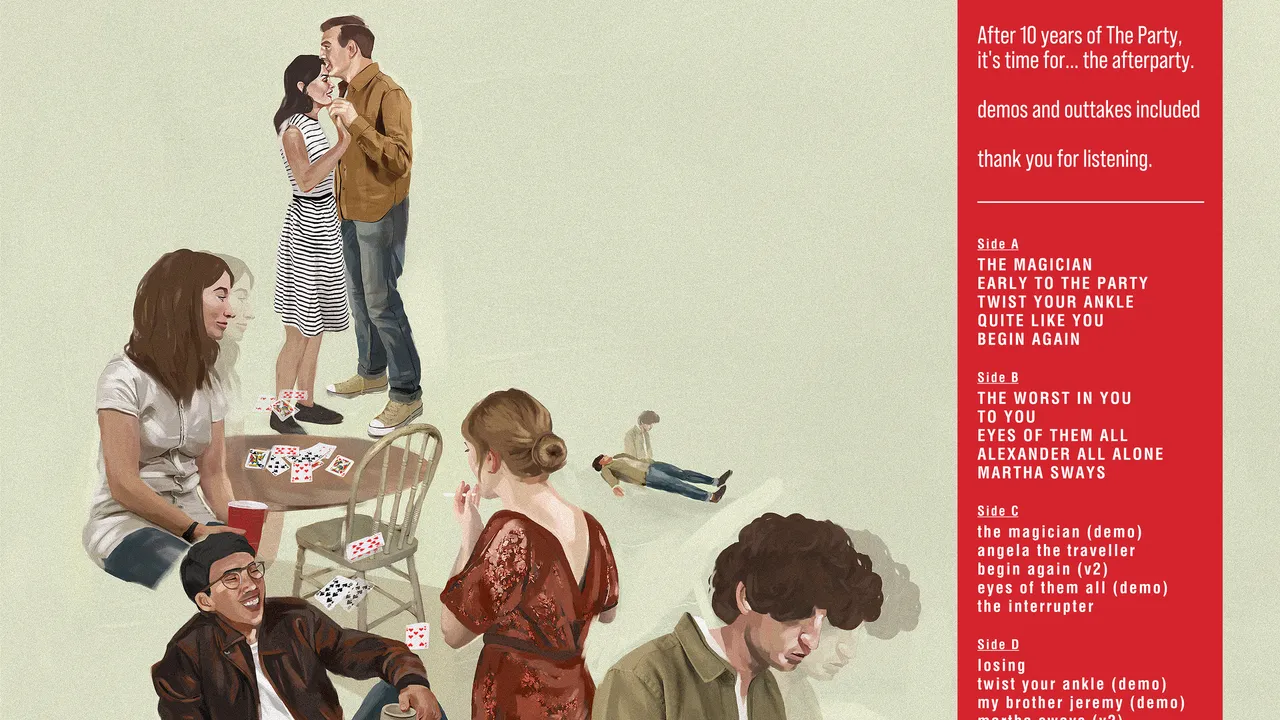
To show up at The Party is to feel a lurch of uncertainty in your stomach; stay a while, and you’ll feel a whole friend group’s trepidations as if they were your own. Ten years after Andy Shauf first introduced us to the wine-drunk and drama-prone partygoers sketched on his beloved concept album, Jeremy, Sherry, Alexander, and Martha still sprawl across the shag carpet of his songs, suspended in the purgatory of their mortifications. They show up too early, spill their guts after a bottle of wine, and think of past lovers while holding new ones, all to the tune of their creator’s whimsical arrangements. A new anniversary reissue, released with a bonus EP of demos and outtakes called the afterparty, preserves these youthful fumblings in amber. It affirms The Party’s status as a fastidiously wrought masterpiece, a portrait of wistful limbo created by an artist ready for a breakthrough.
A concept album that traces the events of a single soireé in dioramic detail, The Party introduced broader audiences to Shauf, a gentle-voiced Saskatchewanian songwriter whose wallflower empathy and growing interest in character studies culminated in a record as boozy and subtly devastating as a Raymond Carver story. Shauf described The Party in a letter accompanying the reissue as “a study of shame.” These are songs that iterate and elevate minor party fouls into dramas of symphonic proportion, arrangements that articulate the heightened emotions churning inside anxious minds.
No score yet, be the first to add.
If you consider that Shauf was raised religious (one of his earliest musical endeavors was a Christian pop-punk band), this shame takes on eschatological stakes. The Party has a subtler shade of spiritual remorse than 2023’s Norm, an album which tackles God head-on, yet these songs are clearly concerned with the transgressions that trigger divine wrath, the salvation that awaits—or doesn’t—those who die of embarrassment. “Hell is found inside of me,” states one character; “the devil takes control” of another, overcome with guilt as he dances with a woman who resembles his ex. Each hangover may feel like judgement day, but Shauf reminds us the big one is coming: Some day, perhaps soon, “a brilliant light will dissolve us all.” Until then, Shauf plays God with winking levity, orchestrating the emotions of mere mortals with humor and heart: Take the string interlude on “Early to the Party,” which see-saws on a half-step interval reminiscent of the Jaws theme as a character tries to escape a conversation, or the butterflies-in-your-stomach glissando that follows a drunk character’s misplaced confession of love in “Quite Like You.” Like a Foley artist for feelings, he scores sensation from a distance with precision and playfulness. (The impish clarinet helps.)