
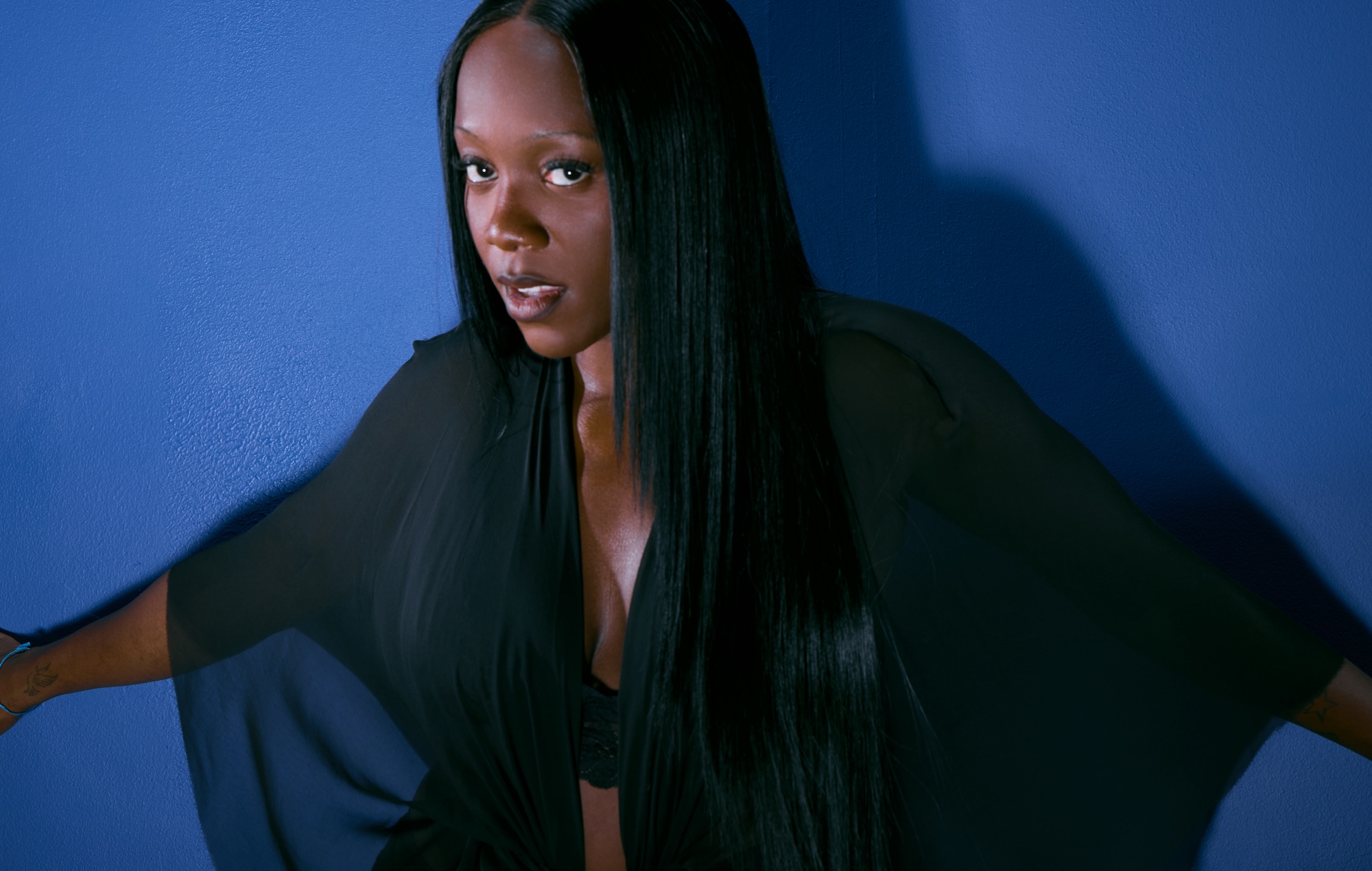
Rachel Chinouriri is a big party girl – or at least she thought she was. In times past, she loved going out and getting on the sauce, ignoring the cloud of anxiety that would loom over her the morning after. “I’d go on loops of drinking from a stressed-out or traumatic place, being like, ‘This is really fun’, and then the next day being like, ‘Oh, I shouldn’t have done that’,” she tells NME with a smile. Relaxed in her London flat, she leans into a teal blue couch, plants and books filling the frame behind her as she plays with her long, sleek black hair. “I couldn’t seem to get myself out of that loop.”
When she began to interrogate that pattern, she realised she needed to do some soul-searching and ask herself some big questions. Among them, what was she trying to avoid through drinking and partying – losing friends? Not being popular? “Am I scared of the person I am?” she remembers wondering.
It was that period of self-inspection that sparked the story of her second album, ‘I Think I Spoke Too Soon’, on which she untangles that party girl identity and realises what was behind it all, told through the lens of a lush night out. The first song she wrote for the record, ‘The Good Fight’, highlights that process. “I’m with the friends I hate, and it’s me questioning why I drink and enjoy this submersion into something which at the time I thought was cool,” Chinouriri explains. “I’m like, ‘Actually, pull me out from this thing that I’ve sunk myself into.’” It had an impact – by the time she turned in the album’s final song, she’d been sober for more than a year.
Where her debut ‘What a Devastating Turn of Events’ catalogued her outward relationships, be it with her family, romantic partners, or the world around her, her second goes inward. Its 12 tracks chronicle a shift in awareness and self-perception – a journey closer to who she is as an artist and as a person, the first steps of which were realising who she isn’t. And sure, hangovers and exhausted mornings that made touring harder fuelled her desire to sober up, but so did the success of her debut album.
“There were so many [times where I was like] ‘My career and my life is so full and abundant, and it’s very busy’,” she reflects. “I started perceiving it as hard work. But then when I look at it as someone who had a paper route and multiple jobs growing up, I was like, ‘No, this is the life I asked for. It’s busy, and it’s doable, but it’s gonna be hard work if I’m then drinking alcohol excessively on top. This is not adding to the already chaotic, stressful time. And for me to be able to keep good relationships with my fans and my family and my boyfriend and with myself, maybe the one thing I need to sacrifice is drinking.”
On the vibrating, synth-pop track ‘Broken Chair’, she delves into a night of excess with her signature delicate vocals, singing: “I love drinking till it’s over / You all love me till I’m sober / I’m walking home the morning after / Your friendly neighbourhood disaster”. She wrote the track in Los Angeles with fellow indie confessionalist and collaborator Lucy Dacus, who she has called “one of my favourite people I know” and has had an impact on Chinouriri beyond the song itself.
Feeling out of place in the City of Angels, Dacus reassured her that she was more than enough without the partying and drinking. Though the subject matter can feel heavy at times, in true Chinouriri fashion, she writes a catchy, buoyant chorus with a wink: “You look lonely, but not me / I’ve got plenty of friends until the last call”.
“This is the life I asked for. It’s busy, and it’s doable, but it’s gonna be hard work if I’m then drinking alcohol excessively on top”
Despite her decision to sober up and “do therapy and the inner work”, she doesn’t see that part of her life as a detour, more so just another part of the journey. “I wouldn’t even say that time was negative because my album had come out and I was doing well for the first time in my career,” she says of her party girl era. “I was earning money for the first time. There were just so many positives happening. I was like, ‘This feels really hard, but I’m actually experiencing all the things that I prayed and asked for.’ I’ve had to learn not to punish myself for that because I actually wasn’t having a bad time. I don’t have to demonise that experience.”
That experience included two BRIT nominations, a sold-out headline UK tour, and opening slots for Sabrina Carpenter, Florence + The Machine and Wolf Alice. It was a string of hard-won successes for an artist who had to create space for herself in the predominantly white indie scene, even as she was categorised as R&B, soul, and “urban” when her music was objectively not. It can also explain why she didn’t dig too deep into the sounds of Madonna, Kylie Minogue, Donna Summer, or Prince, all of which shared space on her playlist alongside the noughties indie acts that inspired her first album. That is until now – categorisation be damned.
Though ‘I Think I Spoke Too Soon’ is drenched in euphoric nostalgia (MGMT and LCD Soundsystem also inspired the record), it’s still diaristic, as if Chinouriri can’t avoid herself, even with a few drinks on a dancefloor. It opens with the glitchy disco track, ‘One Song Away From Crying’, narrating the feeling of pushing down tears in the club. “I’ve never looked better, and I’ve never felt worse”, she harmonises over the glossy, layered dance track, before teasing, “I’m one dance away from leaving here without saying goodbye”.

On ‘Pretty Girls,’ she writes an ode to womanhood backed by kinetic drum machines, and it plays out like a slow-motion dance-floor montage blessed by Two Door Cinema Club, as she evenly requests: “Can we kiss until the silver sparks turn to blue light?” It’s all relatable and danceable, a perfect encapsulation of contrasting feelings – a desire to escape by forced enjoyment, before reality hits and you realise you can’t, or don’t want to, avoid yourself anymore.
“I wanted more upbeat [songs],” she says of the sonic arc of the album. “I’m a bit tired of the sad, slow songs. I love them, but singing them live … When I go out on stage, I wanna run around and jump and dance and shout.” But changing things up didn’t come without its concerns. “Knowing I was making quite disco-pop music, and seeing how much the fans loved the indie music, made me a little anxious because I [didn’t] know if [they were] guys are gonna rock with it,” she shares. “But currently, they are rocking with it very heavily, and it’s been very positive.”
When NME asks how Chinouriri hopes her devoted fanbase of Darlings feel when they hear the album, she answers with a wide grin: “Freedom.” She points to Madonna’s ‘Hung Up’, one of her favourite songs of all time. “If I hear that, I’m standing up, and I don’t care who’s watching me. I want songs that when people hear [them], they’re like, ‘Woo, let’s go and dance and be silly and close their eyes,’” she adds, mimicking losing herself in music. “I want my fans to be able to feel that.” As for how she’s feeling the pressure of following up her critically acclaimed debut? “I’m fucking excited,” she laughs. “Can I say that? I’m ready for it.”
Rachel Chinouriri’s ‘I Think I Spoke Too Soon’ is out now via Parlophone Records