
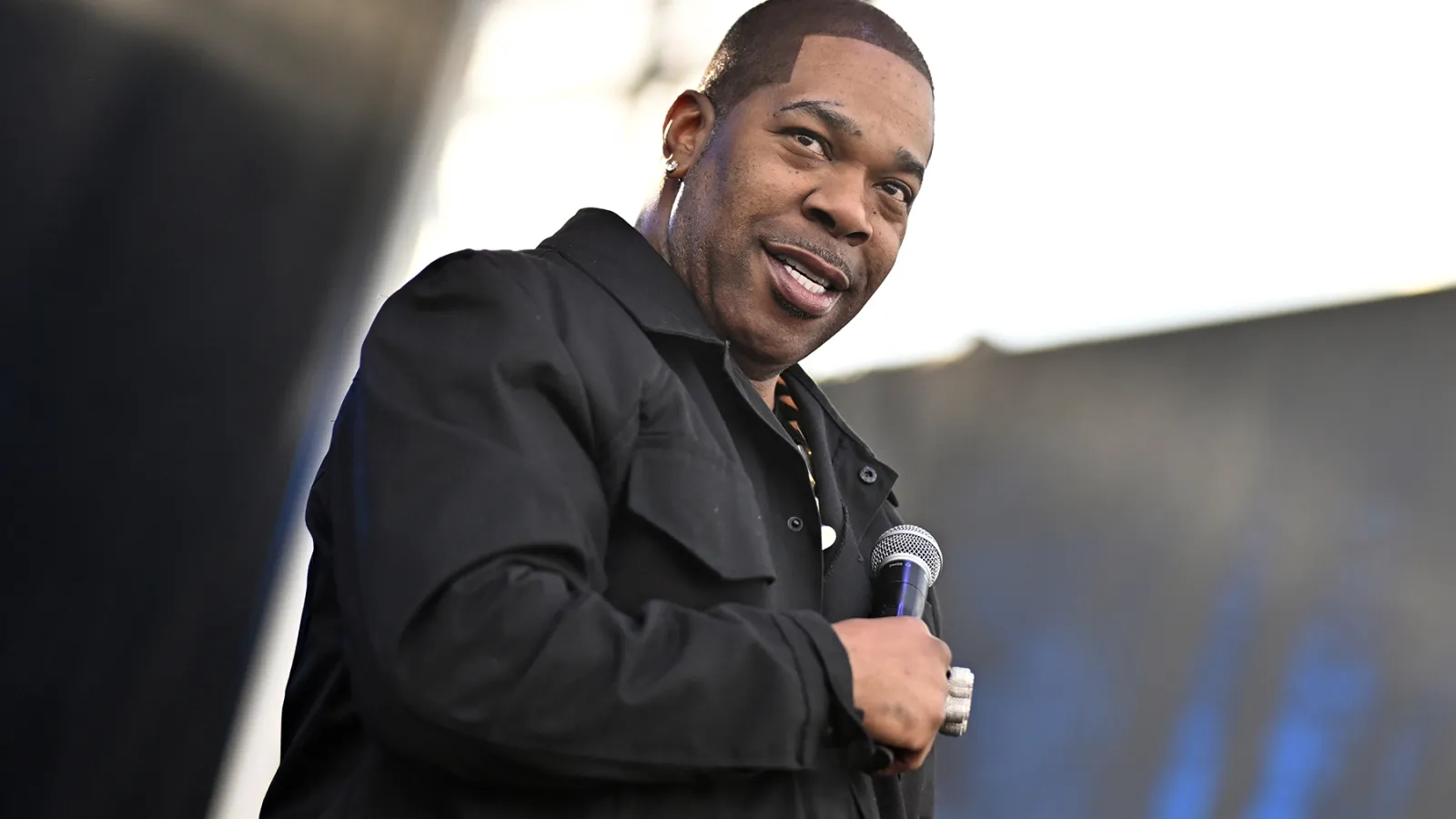
Busta Rhymes is in deep thought. It’s a Wednesday evening in mid-October, and the rapper, notorious for his gregarious presence, has momentarily shed that bombast for a pause of reflection. His words are measured, but filled with the clarity and perspective of an artist who has traversed multiple eras, with the gravitas to show for it.
The shift in the air could be attributed to the supernatural, as J Dilla, the iconic late producer, has become central in our conversation. Addressing the emotional weight of making music meant to bolster and further the legacy of his longtime friend and collaborator — who passed away in February 2006 due to complications stemming from a lengthy battle with lupus — Busta is nearly at a loss for words.
“I mean, I’m always…” he begins, his voice trailing off before regaining its tracking. “He hasn’t been here for 20 years, so whenever I work with his music, it’s always an emotionally incredible experience because I’m working on shit that I think only he could do. Nobody else alive can do it the way he did, even though he’s been gone for this long. It’s always that feeling when I’m working with Dilla’s music and the production that he left.”
With a professional relationship dating back to Busta’s 1996 solo debut, The Coming, there were high expectations whenever the Brooklyn native linked up with his Detroit counterpart. Dilla went on to produce tracks on several of Busta’s albums, including 1997’s When Disaster Strikes…, 2000’s Anarchy, and 2002’s It Ain’t Safe No More…, cultivating a chemistry both seamless and timeless.
That magic has lived on over the decades since Dilla’s passing, as Busta continues to pay tribute to his fallen comrade by doing what they did best. That tradition was most recently carried on with Dillagence II, Busta Rhymes and Dilla’s first full-length studio collaboration in an official capacity.
Released through Busta’s Conglomerate label, Dillagence II credits the late Dilla as its primary producer and includes new contributions from a myriad of collaborators, including Lauryn Hill, Common, Lil Wayne, Big Sean, Anderson .Paak, Ludacris, Jimmy Jam and Terry Lewis, Karriem Riggins, Honey Bxby, Talib Kweli, and C.S. Armstrong, as well as a posthumous appearance by D’Angelo.
Submitted for consideration in the Best Rap Album category at the 2027 Grammy Awards, Dillagence II stands as Busta Rhymes and J Dilla’s latest opportunity to add a gilded gramophone to their collection of trophies. Neither has won a Grammy despite receiving multiple nominations throughout their respective careers.
Busta Rhymes opens up about the legacy and influence of J Dilla, the creation of Dillagence II, his message to the Recording Academy, and why he and Dilla receiving their flowers on Grammy night would make for perfect timing.
You released Dillagence II earlier this year. How did it feel to showcase you and Dilla’s chemistry once again?
We actually released it a little over a month and a half ago, on Aug. 25. It’s relatively new, fresh, and I’m excited and super proud to represent our chemistry, restore the feeling, and introduce it to the people who have been a part of the journey with me and Dilla. We’ve got a 30-year working relationship and history of cooking together in the studio with this music from my first solo album in 1996, The Coming.
Aside from yourself and the family, who were some of the people who helped put the project together behind the scenes?
On the production side, the work was primarily produced by Dilla. I’ve also got to acknowledge Karriem Riggins — he produced two joints himself, and he also co-produced a song with Dilla that features me, Common, and Jon Batiste. He produced a song that was done with me and Jesse from Watch the Duck. The one with Jon Batiste has co-production from Karriem Riggins, “What We Got in Common.” Jesse from Watch the Duck [worked on] “Run Em Down,” and he also produced the record called “Drugs.” I’ve also got to big up Kev Brown and Black Milk because they co-produced the record “SPAZZ,” which was the first single for Dillagence II.
I also want to big up this producer by the name of Count. I mean, I had two other brothers with him co-produce the Dilla joint with my children called “Royalty,” which features my my two kids CIE and Trillian. Got to big up Big Sean and Anderson .Paak, Ludacris, Lauryn Hill, Lil Wayne.
It’s been a lot of a lot of support. Talib Kweli. C.S. Armstrong as well. All these individuals that came through. And last, but not least, I have to big up [Dilla’s mother] Ma Dukes because she’s hosting and she pretty much spoke what was on her heart throughout the album, from beginning to end.
When did the recording process for Dillagence II begin?
It started with a phone call from Ma Dukes in November of 2025 because this year is the 20th anniversary of Dilla’s transition. She was reaching out to me to ask me to help her figure out a way to celebrate this milestone for J Dilla. It started off with me just trying to make a song, and then it evolved into this project, Dillagence II, and I just feel super honored and tremendously blessed to even be in a position to be asked to do this by Ma Dukes because I always want to represent Dilla, and that’s a constant silver lining throughout all of my projects: his involvement.
To be able to do this and have this as an addition to my legacy and his is probably one of the most incredible experiences for me. Especially at this time because while I’m doing this for him, I’m also celebrating five album anniversaries this year, with Dilla having been a part of three of those five album anniversaries.
So the celebration of him goes even beyond just celebrating his 20th anniversary of his transition. It’s almost like an ode to our entire work history. His legacy individually, my legacy individually, and our legacy and work history collectively.
What’s the process for picking out the tracks from the vault that you’re going to rhyme on? Do you already have the tracks, or do you go through Ma Dukes?
Everything that I recorded, I had, with the exception of one or two joints that people gave me [once] they heard that this project was happening.
Big up to the D’Angelo family as well for blessing me with the opportunity to be able to have his first step out since his transition. I was gifted with that. I didn’t even know that existed. That’s one of those examples of what I was talking about, but pretty much everything else, I already had.
The Karriem Riggins beats were joints that he gave me to contribute to this project as well, and the Kev Brown and the Black Milk production was something I had ended up putting together to make it one song with the way the beats would switch up in stages.
All of the Dilla joints, they were the music and production that he left with me because he would always feed me beats from when we first met. They just accumulated over time. Outside of having what I had and getting what I get, you end up making the music based on what you feel most inspired by, and what moves and invokes the emotion, and gives you the excitement to want to create. That’s really what the process was.
Did y’all do the features on the album in person, or where were the vocals laid down?
It was a combination of both. Some was done in person and some wasn’t because everybody’s moving and shaking, and everybody’s doing what they’re doing concerning nurturing their careers as well…. If [we’re not] in the same place, then we work around each other’s schedules, and we send the music back and forth. But when the schedules did align, we could get together. We definitely made that happen. The record with my kids: I did that with them in person. The record with Anderson .Paak, we did that in person. Some of the joints with Karriem Riggins, I think we did two of those in person.
What’s it like to be able to have someone who didn’t meet Dilla in person appear over his music and beats?
It felt good to be the conduit for those who never met him to be a part of this work because they were fans of him, and they were able to add something that I felt was going to be a significant contribution to his work. I’m very selective with who I want to put on his music because I feel a great responsibility to make sure nobody misrepresents his work. It felt good because, again, Dilla left a footprint and fingerprint on this culture that impacted a lot of people. Even though they didn’t meet him, never worked with him, and might not have ever had access to his work. For me to be able to be the conduit to that, it was an honor, a pleasure, and a privilege.
You mentioned that he hasn’t been here physically for 20 years, but if he was, how do you think he would feel about the AI trend? Do you feel he would be utilizing that, or would he shun that?
I don’t know because it wasn’t around when he was here. I can’t speak to what I think he would do, that would be speculation. What I do know is Dilla was always one to utilize the tools as they advance. He worked with the SP-1200. That was around before the MPC. And then when the MPC came, he evolved into working with that. If we’re going to go on that pattern, I’m pretty sure he would have continued to evolve.
Dillagence II is up for Grammy consideration. What would it mean for the album to receive acknowledgement?
It would mean everything because neither one of us has received a Grammy. The Grammys are actually airing and being held on his birthday. That would be… I can’t even express what that might feel like because, again, I never won a Grammy, number one, and number two, what’s the chances of the Grammys actually airing on his birthday? That would be some whole other shit.
What would be a message to the voters on the Grammy committee as why Dillagence II is deserving of a nomination?
I forgot to mention that Jimmy Jam and Terry Lewis also added production to “This Woman” which is directed with D’Angelo. They added some beautiful keys and brought another sparkle to the record. I feel like when you have all of these incredible people pulling up to be a part of this magic, and you think about how the album came together and the people who volunteered to be a part of this body of work, it’s a testament to how much this music means to people, from the icons to the new generation, and how much Dilla and Busta Rhymes’ chemistry resonates.
You know, [guest artist] La Reezy was one year old when Dilla passed away. He’s 21 now. That’s not regular. That’s not something that people normally can say, as far as how the impact of their work and their creative contribution has shifted culture and music. He wasn’t even born yet when I put out my first record, you know what I’m saying? For him to understand what Busta Rhymes is, what I do, for me to be introduced to La Reezy before I even met him, which is part of the reason why I picked him to be on the record. Somebody sent me an Instagram post with him actually shooting a video of himself hanging from the side of one of those trolleys while spitting to a Dilla beat. It’s a testament to how we’ve effectively impacted culture through our work and through the gift that we’ve been able to share and continue to share. We got Jimmy Jam and Terry Lewis, who collaborated to be part of a song with me and D’Angelo on Dillagence II.
D’Angelo and Dilla had their own history of work and creating together. Even outside of Busta Rhymes, we’re all a part of this similar ecosystem. Jimmy Jam and Terry Lewis decided they wanted to be a part of it three days before the release date and gifted us with their contribution.
It’s a testament to just how incredibly the music resonates with every level of this music culture and the body of work Ma Dukes, Dilla’s mother, the Yancey family, the Yancey estate, the Archer family, and the Archer estate with the D’Angelo’s family.
All of the incredible people who decided to be a part of it speaks volumes. Regardless of when you listen to the music, and you feel what you feel from the music, you understand that this is a moment that really doesn’t exist anywhere else in music. Culturally or at the industry level. It’s just something that I think speaks for itself, and I think that’s what music should do. It should speak to you, and make you feel, think, learn, and understand something that you can only get from that body of work.
So as far as the Grammy voters are concerned, my message to them would be thank you in advance for voting for the music and celebrating with us a moment that is purely from the most genuine place possible, because the music was created to represent the beauty of the art of music. That was the sole agenda of what this body of work was about.
It wasn’t about trying to make a record for any specific reason. A lot of times, you see artists make records for radio, or we see artists make records for the club, or they make records for specific things. This music was made purely to represent the art of an incredible producer and an incredible artist and an incredible emcee and another incredible artist together all as a collective.
This is a moment unlike any other moment. It took a long time to get to this moment. I’ve always done songs with Dilla, but I never did an album with Dilla in this way. We do have Dillagence, that came out in 2007, but it was just a mixtape where we just wanted to tribute Dilla right away after his transition.
It’s just a beautiful experience, opportunity, and moment in time. I would love for them to hold it in the highest regard, as it’s being received by the people. And that’s pretty much it.
You’ve received various Grammy nods over the years, but have yet to win. What would you say was the toughest loss, or a song or album that you feel should have won?
I don’t really recall if I ever felt that way. … I can’t speak to the actual moment where I feel like I should have won this or I should have won that. The perspective I look at life from in general is in a divine way. When it’s supposed to happen, it will. It feels like it’s coming together in that way now, with the way everything is being divinely aligned: from the five album anniversaries and Dilla being a part of three of them, to it being the 20-year anniversary of his transition and us having a new album out while all of this is getting celebrated. The Grammys airing on his birthday is divine timing because none of this could be created by a human’s calendar. This is bigger than man. This is greater than man. This is godly to me.
You mentioned earlier that you have five album anniversaries this year, but I want to speak specifically about your debut, The Coming, which turns 30, and The Big Bang, which is 20 this year. What are your favorite memories from those two albums?
The Coming was my first album, and [2006’s] The Big Bang was the album I really enjoyed making with the people that was involved, especially Dr. Dre spearheading the whole production [as executive producer]. The process was new, and it was an experience I enjoyed, even though it was a little challenging at times.
Then I enjoyed even more so seeing the New York Knicks win their championship on the same day of the 20th anniversary of The Big Bang, which was June 13. That’s the day the album came out in 2006.
That’s about it. I really think those two albums were turning points for me. When I did the Big Bang album, I was dealing with a lot personally, custody battles with my kids’ [mother] that I had just won in 2005. I cut my dreads as a shedding and a rebirth, got in shape for the first time, like really on some training for two years type of shit. It was a good time. I felt good. I felt fresh. I felt revitalized, and obviously, the first album going solo was a big deal because that was a new chapter in my life.