
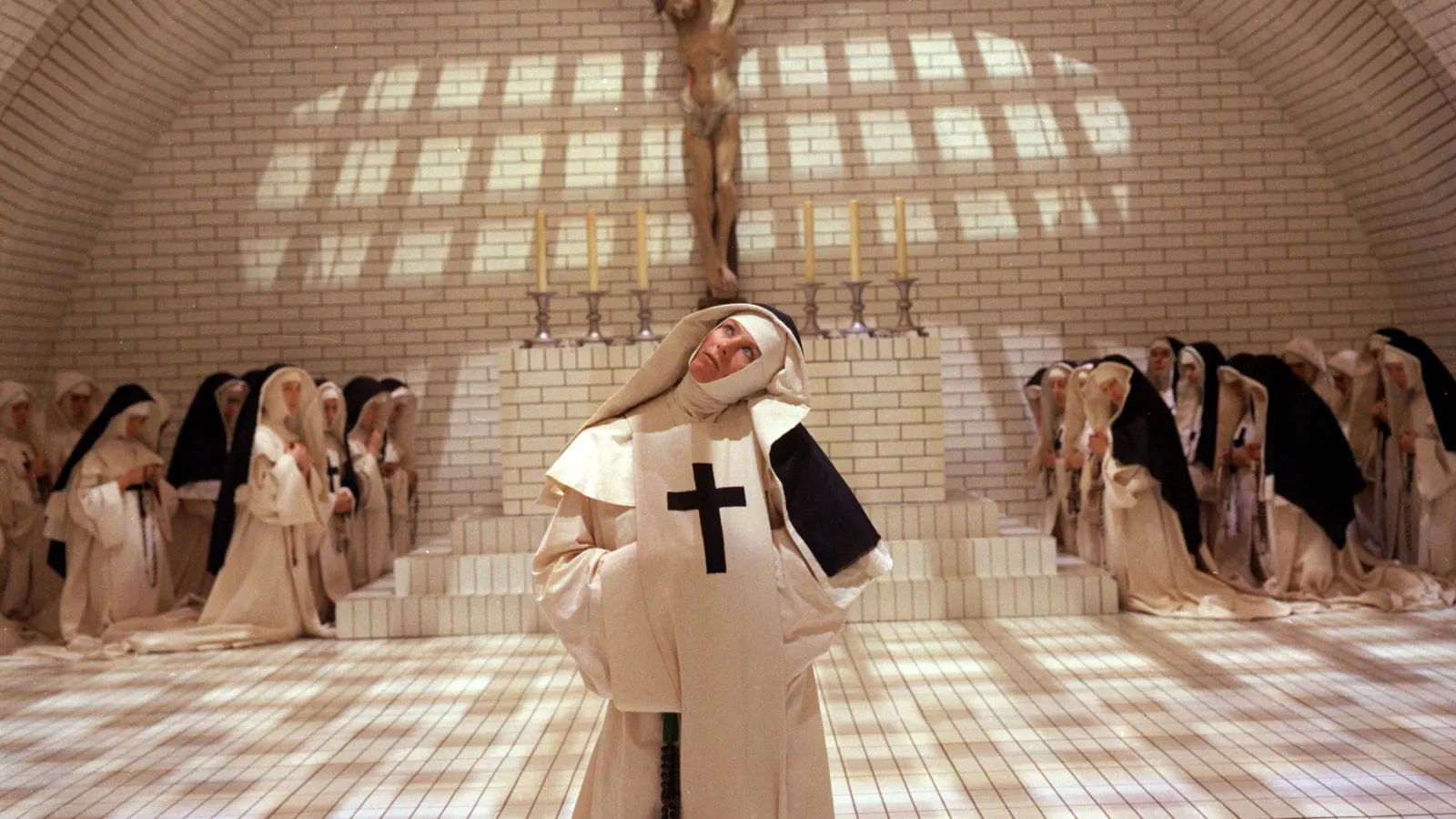
Mark Kermode believed in God, the devil, and the movies. He didn’t have faith in the concept of miracles, however. Until, like the saints, he experienced one himself.
Long before the 63-year-old writer, musician, and TV personality became one of the most recognizable film critics in the United Kingdom, Kermode was just another British kid infatuated with rockabilly and horror flicks. One Friday night in the early 1980s, the power of cinema compelled him to go to the Phoenix Theater in East Finchley, London, to check out a late-night double feature with a bandmate. The second half of the bill was a screening of The Exorcist, which had long cemented its reputation as one of the most intense, influential blockbusters of the previous decade. William Friedkin’s tale of demonic possession so freaked out his friend that he ended up crashing on the teenage Mark’s floor, too scared to drive home. “It was quite the evening,” Kermode says, his eyes widening behind his black-rimmed spectacles at the memory.
As for the first half of the bill, that featured a slightly less popular but equally controversial cult movie from the era, which also dealt with religion. Kermode knew the filmmaker’s name, because the director — Ken Russell — had made Tommy. He’d remembered seeing the poster for that mind-blowing 1975 screen adaptation of the Who’s concept album, with Roger Daltry’s head being nearly enclosed in an Iron Maiden with hypodermic needles and the tagline, “He’ll tear your soul apart.” This earlier Russell work did not include acid queens, pinball wizards, or teenage-wasteland messiahs. It was, however, equally mind-blowing. Partially (and loosely) based on Aldous Huxley’s novel The Devils of Loudun, the story concerned a priest named Urbain Grandier who upset the political powers that be in 17th century France. The holy man was eventually be burned at the stake as a heretic.
This was Kermode’s first encounter with The Devils, the 1971 film that would become somewhat of an obsession with him for the next four-plus decades. He would not be aware of the fact that what he’d seen that night was one of several versions of the movie that had been floating about, all of which were incomplete, for many more years. Nor could Kermode guess that, in a future he couldn’t possibly imagine as a teenager, that he’d end up befriending the man behind this butchered masterwork and spend endless days trying to track down several missing sequences, including a set piece unceremoniously dubbed “the Rape of Christ” that contained what the late, great Russell thought was his best work.
Nor could this awestruck kid begin to fathom the notion — and the older, wiser Kermode would be the first to tell you this — that he’d eventually find himself preparing to present Ken Russell’s The Devils before a crowd of gobsmacked cinephiles at the New York Film Festival. (It opened for a theatrical run on October 16.) The restored “director’s cut” of Russell’s long-censored, still remarkably shocking cult film not only features all of the previously missing material, including the orgiastic scene of mass hysteria that was thought to have been destroyed. It now reveals itself to be a stone-cold masterpiece and a highly charged parable about state-sanctioned violence, brainwashing, and the use of organized religion as tool of repression.
“Ken always said The Devils was his only political film,” Kermode says. “But he also referred to it as ‘damaged goods,’ because of what happened. And it’s no longer ‘damaged goods.’ Now it’s Ken’s movie again.”
Russell had been riding high off the success of Women in Love, his taboo-tweaking 1969 take on D.H. Lawrence’s romantic novel, a.k.a. the One Where Oliver Reed and Alan Bates Wrestle in the Nude. When he proposed that his next project would be an adaptation of Huxley’s novel, however, the studio behind his recent hit, United Artists, turned him down. Thankfully, Warner Brothers was interested in working with this hot new director, and Russell set up the project — with Reed playing Grandier and Vanessa Redgrave as Sister Jeanne des Anges, the convent’s abbess whose lust for Grandier will engineer their mutual doom — there.
Some of the more envelope-pushing moments, including an extended scene of nuns ripping off their habits and rubbing themselves on a life-sized crucifix, were in the script. Warners knew what they getting, or so Russell assumed, when they took on the project. He was merely shooting what was on the page. Yet the British Board of Film Censors went into an uproar when they saw the cut that Russell submitted. “Ken said that a lot of things were essentially whittled down to nothing,” Kermode notes. “But there were two sequences that the Board just said: Those are coming out. One was the bit near the end, with Sister Jeanne and the bone [in which Redgrave’s character pleasures herself with a femur bone]. The other was the Rape of Christ. [BBFC Secretary] John Trevelyan simply went, ‘That can not be in the movie at all.’”
Even worse for Russell, the studio objected to the film, and sicced their own in-house censors on it. In Britain, the film went out to theaters in an X-rated cut that excised a number of key moments; the American version was sliced up even further in order to appease the MPAA and receive an R rating in the states. Kermode is pretty sure he saw the X-rated version that night in East Finchley, but by the mid-1990s, all of the British cuts had been taken out of circulation. The highly butchered American version was the only version you could see.
Kermode had established himself as a film writer of note by that point, and was asked by Sight & Sound Magazine to interview Russell in 1995, for a spread they were doing on censorship. It turned out the two both lived in New Forest in Southern England at the time, and were practically neighbors. Tasked with showing Russell a series of stills that the publication was running, Kermode asked the filmmaker to comment on each of them in terms of what was taken out of the film. When they got to the Christ sequence, Russell proceeded to relate everything that he’d shot, in great detail.
“He described all of it so vividly,” Kermode recalls. “And I said, ‘Well, we must find it!’ And Ken said, ‘You won’t find it. The last time I saw the reel, it was sitting by a Moviola… and then it was simply gone.’ I asked him when that was, and he answered, ‘1971. It’s probably destroyed.’ I just said, ‘Ken, we will find this.’ And he simply looked at me and said, ‘Yeah — you won’t.’”

Vanessa Redgrave and Russell, on the set of ‘The Devils.’
Courtesy of Warner Bros. Clockwork
For years, Kermode doggedly chased down every possible lead he could find in regards to the missing footage, and talked to everyone who’d been associated with The Devils in the hope of finding clues to any possible whereabouts. In the meantime, he’d been working on a documentary on The Exorcist, the other film he caught on that fateful double feature, and had managed to locate and identify several missing scenes that William Friedkin added back in. When that “director’s cut” of The Exorcist was released in 2000, it became a massive hit all over again. Thanks to his involvement with that successful restoration, Kermode had momentarily bought himself some industry clout. If there was ever a time to cash in some chips regarding The Devils, it was now.
“Except you have to remember that The Exorcist made a lot of money, and The Devils did not,” Kermode notes. “Ted Ashley, the head of Warners, famously butted heads with Ken over it. And I can’t emphasize this enough, but I am not an archivist. I am simply living proof of the triumph of persistence over talent. I don’t physically find things. I literally just annoy people into finding things. But because of my peripheral association with the Exorcist reissue, people are now taking my phone calls. So I finally managed to get someone to go into Warner’s archives and see what’s there in depth.”
And this is the moment that the aforementioned miracle occurs.
“I end up in Warner’s office in London, on Wardour Street,” Kermode says. “There’s a really nice guy there named Tim, who is being incredibly tolerant to me. It’s like once a week, ‘Here comes Mark again, making a fuss, can we stop looking for this material and just put this whole thing to bed?’ I’m now working on Hell on Earth, a documentary about the making of The Devils. We start going through the pages and pages of shipping logs for prints, and I notice an entry for a reel of film labeled ‘C Cut 89.’ I know that the BBFC cuts to the film were listed as 89 seconds long; it’s actually much longer than that, but that’s the official number. I go, “Tim, do you think that means ‘censorship cuts 89?’ Tim goes, ‘No, that’s not what it is.’ I said, ‘Okay, look, would you call it in? And if it isn’t anything, I’ll leave you alone, and I will go back to Ken and say that’s it, you were right, we can’t find anything.’
“He agrees to check it out, because it’s an offer too good to refuse: Oh, this guy will finally leave me alone if I do this,” Kermode continues. “Fast forward a few days, and I am in a store getting nappies” — a British colloquialism for diapers — “because I have a young child. My phone rings. It’s Tim. ‘I called in that tin. It had a vinegar whiff about it, which probably means it hasn’t been opened for a long, long time. Also, I looked at the first few frames, and all I can tell you is there’s a bunch of nuns and a bloody big crucifix.’
“I immediately called Ken,” he adds, “and said, ‘Hi Ken, it’s Mark. I’m in the baby section, buying nappies, and we found the Rape of Christ.’”
To this day, no one is sure why the reel was marked “C Cut 89” — it contained not only the complete Christ sequence but had several other bits of previously missing scenes, all of which ran longer than 89 seconds. The whole thing was a mislabeling mistake. But Kermode’s obsessiveness paid off, and the holy grail had been found. He was able to insert the found footage into Hell on Earth, which showed once on the BBC’s Channel 4. The doc was edited by Michael Bradsell, who had also edited The Devils back in the day; Kermode convinced him to cut the missing scenes back into a print of the original film, then made a digi-beta copy. When the critic and his wife, the author and college professor Linda Ruth Williams, programmed a “History of Horror” series at the BFI in 2004, they decided to show the “director’s cut” digi-beta as an unannounced screening.
Russell showed up for the event. Afterwards, the filmmaker told his wife, Elize Russell, that seeing even a crude print of the restored version, after believing that all was forever lost, “gave him his rhythm back.” Kermode wept.
“And for close to 25 years, that was it,” he says. “We now had a complete version, and still, there just really wasn’t any enthusiasm to go out on a limb for a film which had never brought Ken anything but trouble and had never caused Warners anything but grief. The idea of putting back in material that some people still considered to be offensive. ‘Distasteful tonality’: that was the phrase that was always trotted out. That was the only thing we ever heard. It was literally just those two words for two decades.” Not even a reevaluation of Russell’s work, following his death in 2011, could move the needle.
Then, in January 2026, Kermode received an email out of the blue. It was from Christian Parkes, the former Chief Marketing Officer of Neon. He and his fellow coworker, Spencer Collantes, had left the independent studio behind Parasite and Longlegs and started up a boutique film division at Warners titled Clockwork. They wanted to speak to him about something, but it had to be in person. Could they meet at the Berlin Film Festival the following month? And please don’t tell anyone about this.
Kermode was curious, if not slightly annoyed about all this cryptic communication and the request for a secret rendezvous. Still, he told the duo they could find him at certain bar on a certain date. When Kermode sat down across from Parkes and Collantes, he immediately joked, “Right. This is either about The Exorcist or The Devils, and we’ve done The Exorcist already — so let me guess, you think Warners will finally let us put out all of The Devils.” The two men exchanged a nervous look.
“I was kidding, because of course no one was going to let that happen,” Kermode says. “Then there’s this long silence, and I suddenly realized: Wait, they actually are going to do it! Wow. They’re dead serious.” Parkes and Collantes did, in fact, want to make the director’s cut of The Devils the inaugural release for Clockwork. They were hoping to use the digi-beta copy from 2004 as the template for a new 4K restoration that they hoped to premiere at Cannes. Kermode assumed they meant the festival’s 2027 edition. Parkes and Collantes were thinking about the Cannes that was only four months away. Everything needed to happen quickly.
Oliver Reed and Vanessa Redgrave, in a scene from ‘Ken Russell’s The Devils.’
When Ken Russell’s The Devils, as this complete version would be called, was announced as part of the 2026 Cannes Classics lineup, it quickly became the hottest screening of the festival. (“A colleague said that people trying to get tickets for The Devils at Cannes looked like a scene out of The Devils,” Kermode says.) The critic introduced the single public showing, along with several members of Russell’s family. It was an extremely emotional moment for all involved.
“I’m in the film, you know,” says Ken’s daughter Vicki Russell, speaking over the phone in a separate interview. “I played a slave girl, pushing a cart filled with plague bodies. That was a long day. But when I saw myself onscreen at Cannes, all I could remember was how much fun it was to be there, and how happy my dad was while he was making it. I remembered learning how to ride horses during the production, and playing on those sets [courtesy of production designer and future filmmaking legend Derek Jarman] — it was like my dad’s version of Disneyland. He used to say, ‘One day, maybe they’ll understand me like they understood Van Gogh: long, long after I’m gone.’ And when I saw this new version, it felt like, ‘Now they’ll understand you, Dad.’ It feels like a redemption.”
“What’s amazing to me is,” Kermode says, “was not just how well it played at Cannes. It’s how amazing this 55-year-old movie is playing like it was made for right now. It’s a political movie about the abuses of power and the exploitation of the people. Ken was always ahead of his time. But it’s almost like the movie was waiting for its moment. And God help us, The Devils has truly found its moment.”