
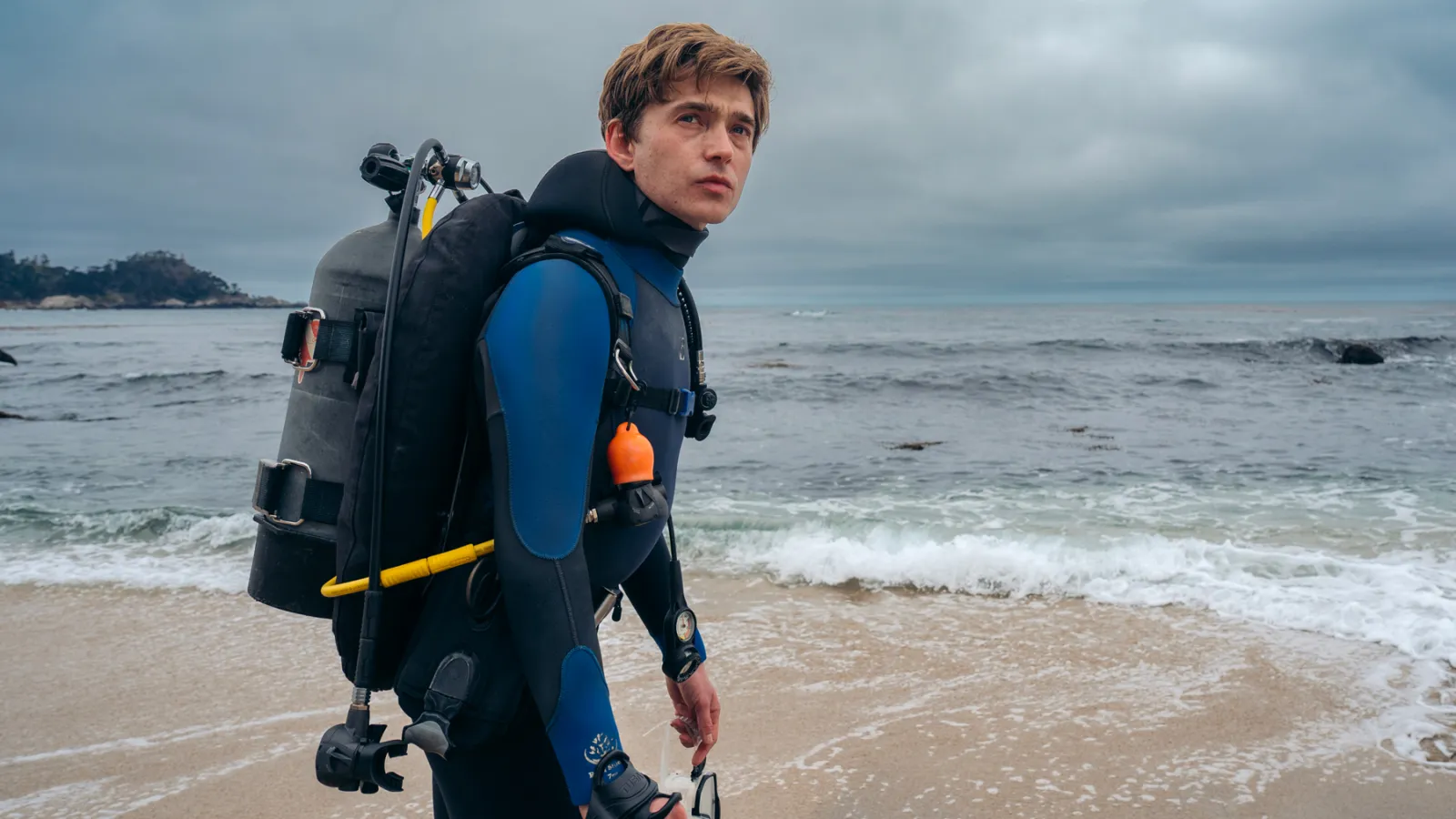
Before he was swallowed by one in Whalefall, Austin Abrams flew to Dominica to see a sperm whale up close. Posted up on a boat in the turquoise waters off Nature’s Isle, he watched as pods of the slick, gray beasts drifted by the bobbing boat.
“This probably sounds silly, but making a whole movie about these kinds of whales, it felt just strange not to have an interaction with one,” Abrams says. “It makes you realize they’re not animals. They have the same essence of a person, basically. It feels like you’re meeting individual beings that are on another level. They just have a really lovely energy to them. Something I kept hearing was, ‘Have good energy, because they can pick up on it.’” That’s the key, he explains, to drawing them close.
The gentle giants undoubtedly picked up on Abrams’ good vibes, and the same could be said for audiences in 2026. The 30-year-old Sarasota, Florida, native has been acting since he was a kid, and made his film debut back in 2011, but it wasn’t until this year that he broke through in a big way. Abrams has garnered legions of fans playing hapless everymen in last month’s horror blockbuster Resident Evil and in Whalefall (in theaters now), the new thriller based on Daniel Kraus’ 2023 novel about a grieving scuba diver who’s swallowed by a whale. And while Abrams has become an unlikely star, part of his success in these roles may be due to his being relatively unknown — or, if he has any say in the matter, unknowable.
Abrams embraces the everyday-guy persona so fully it sometimes seems like a bit. He bats away personal or specific questions with bashful incredulity — like, “Aw, shucks, why do you want to know about me?” Ask about an old article in which he claims he demanded an agent at age eight and he groans. What does he do in his spare time? He told The New York Times: “I’m staring at walls, mostly. I don’t know, man.” What music does he like? He says he was listening to jazz earlier, but it’s unclear whether that was by choice or Dave Brubeck’s “Take Five” just happened to be playing in the background. Inquire about an interview clip of Charlie Heaton claiming Abrams once went beast mode for 15 minutes in a backyard cold plunge and he barks a laugh: “What the hell? Why is he saying something like that? I don’t think 15 minutes is accurate, to be honest.”
The facts that he will allow, though, speak to a guy who has always been serious about acting. The son of doctors, Abrams got his start in community theater, and later hit screens in supporting roles: the bumbling best friend in 2015’s John Green coming-of-age film Paper Towns; an ill-fated bully in Guillermo del Toro’s 2019 adaptation of Scary Stories to Tell in the Dark. “Movies were always something I was really fascinated with from a super young age,” Abrams says. “People will tell me stories about them walking in and me watching some movie when I was way too young. It was like being transfixed.”
He acknowledges that he was a shy kid (“probably still am a bit”) and says doing theater gave him “some sort of release” that he needed. “I just remember feeling free” onstage, he adds. But once he discovered the work of Heath Ledger and Daniel Day-Lewis, he began to dream of acting as more than a casual creative outlet. That, says Abrams, was “when I started to wake up to the real possibility of it. What could be done.”
Ledger, especially, is a role model; his quietly strong performance in Brokeback Mountain was a touchstone for Whalefall — for both Abrams and director Brian Duffield, who included it on a Letterboxd list of inspirations for the film. “You go back and look at the rest of his work [before The Dark Knight], and it’s all so experimental and that is super exciting,” Abrams says. “He’s constantly taking swings and just trying things that you’re literally seeing on camera work and not work. Seeing him do all these different kinds of characters was really inspiring.”
Whalefall follows Jay Gardiner (Abrams) as he grapples with his rocky relationship with his father, Mitt (Josh Brolin). Mitt is an avid diver; Jay is less enthused by the sea. However, after Mitt drowns himself in the midst of a terminal illness, Jay goes diving in search of his father’s remains. In the process, he ends up in the belly of a sperm whale, fighting for survival while flashing back to his childhood and his complicated dynamic with Mitt.
The film, which features long stretches where Abrams is the only person onscreen, sees him effortlessly shift from playing surly teenage Jay in flashback scenes to bereft and exhausted adult Jay. “Jay so badly wants his father’s approval, but also it’s almost as if he seems incapable of doing what he needs to do to achieve that,” Abrams explains of the character, “which then creates a feeling of inadequacy in him.”
“Austin came in and auditioned and was just extraordinary out of the gate, really heartbreaking and emotional,” Duffield says. “He has an amazing ability to make everything feel specifically and uniquely tailored to him; he’s not just like a casting headshot. He takes it upon himself to kind of get to know the ins and outs of the characters that he’s playing.” Abrams became an expert scuba diver in the process of filming, Duffield notes, and formed a close bond with whale expert Patrick Dykstra, calling him up any time he had a question about the titular beast.
Naturally, much of the film’s action occurs inside the whale’s mouth and various stomachs, all of which were constructed in a practical set for the movie. Encased in sort of a sack, Abrams spent 40 days filming inside the “whale,” as Jay fights a giant squid that was also swallowed, struggles against gravity when the whale dives deeper into the sea, and battles to get free.
There’s very little dialogue in those scenes, with Abrams’ face doing much of the work to convey his character’s terror. In one sequence, Jay bonds with a wayward jellyfish — much like Tom Hanks with his volleyball, Wilson, in Castaway. “When you’re spending so much time alone, there is so much comfort in just finding a friend,” Abrams says, “whether that friend is a living thing or not. At that time, with everything that’s going on, it just feels it feels like Jay needed a friend.”
Asked what was going on in his head during those hours in the belly of the beast, though, Abrams demures. “You talk about those things, and, then, ultimately, it’s so much less interesting,” he says. “Also, it can be quite personal. There’s certain things that you don’t even tell anybody — even friends.”
Maybe that’s how he feels about being thrust into sudden stardom. Abrams blended seamlessly into several of his more recent roles: the shy loverboy in Euphoria, the sly, popular kid in 2022’s Netflix teen movie Do Revenge, a strung-out druggie with impeccable comedic timing in Zach Cregger’s Weapons. But Cregger’s follow-up, Resident Evil, cast him as the bumbling yet oddly capable hero Bryan Hodukavich — and catapulted him into the leading-man strata. Audiences delighted as his Bryan — a medical courier tasked with transporting a cure to the zombie plague infecting his city — fumbled with massive guns, mourned the loss of his beloved Jordans to toxic ooze, and was overly accommodating to bloodthirsty monsters. “It’s great to be in the theater and hear someone in the audience say something that my character says one second later,” he says. Often, that something is akin to, “Oh, shit!”

Abrams navigating a zombie apocalypse in Resident Evil.
Sony Pictures
In Whalefall, Abrams screams and thrashes with the same vulnerability, and a few more inner demons. It’s a one-two punch of regular Joes in highly irregular situations that’s helped fans form a deep bond with the man behind the scared-shitless characters.
When I inform Abrams that the sheep hat he wears in Resident Evil has become one of the most popular Halloween costumes of the season, he replies with typical understatement. “That’s cool. That’s sick,” he says. “What that means is that people hopefully connected with what you did, and that’s the most that you can ask for in doing this.”
Daniel D`Amico for SANREMO.FM