
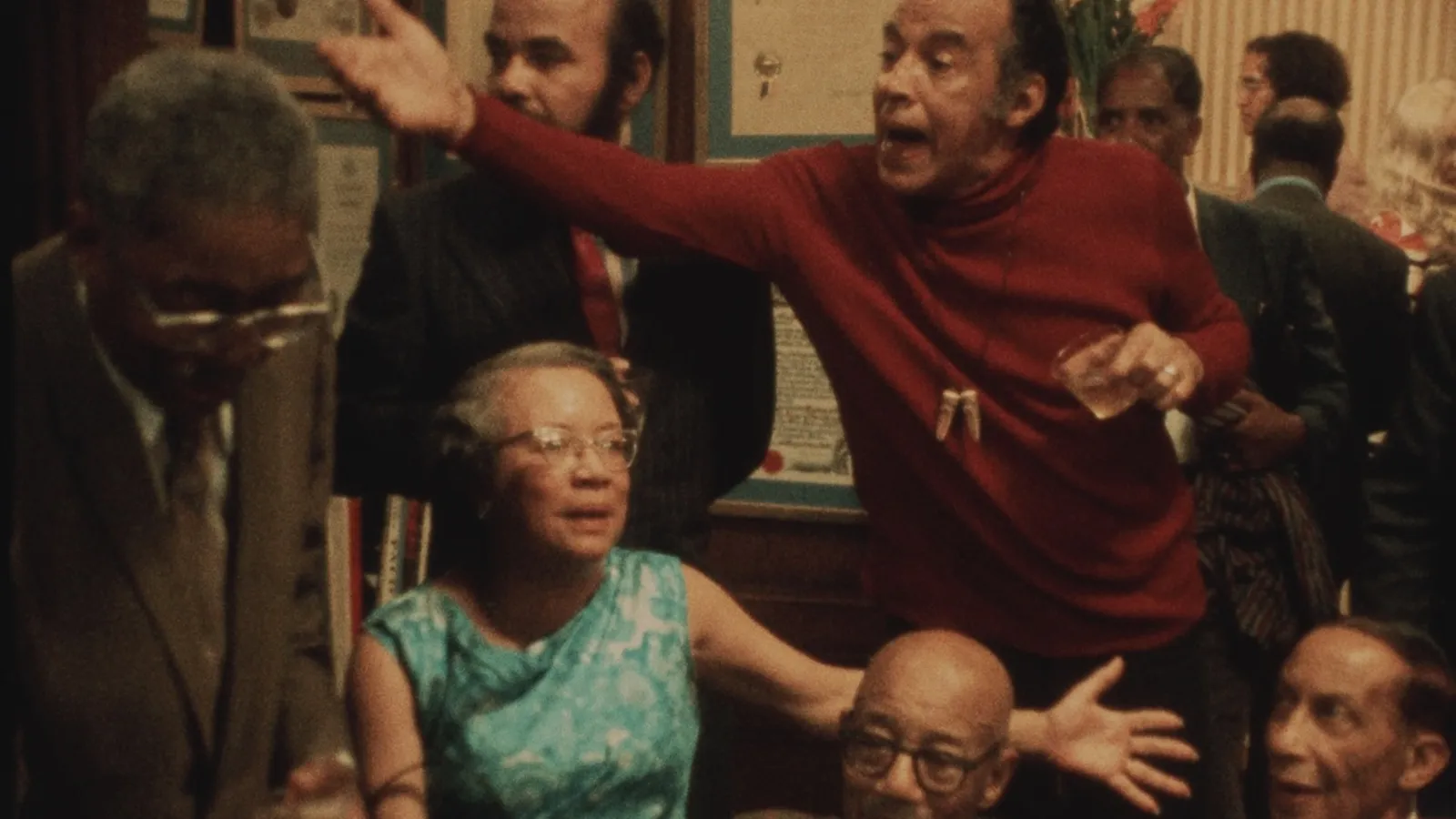
The names fly at you fast and furious: Eubie Blake, Richard Bruce Nugent, Gerri Major, Leigh Whipper, Regina Andrews, Romare Bearden, Aaron Douglas, James Van Der Zee. They are poets and pianists, painters and photographers, journalists and salon hosts, mover and shakers, all of them sipping cocktails and chatting about days past. It’s 1972. Having borrowed Duke Ellington’s uptown apartment, filmmaker William Greaves (Symbiopsychotaxiplasm: Take One) invited the remaining luminaries of the artistic movement known as the Harlem Renaissance for a reunion of sorts. Some are old friends. Some have not seen each other for decades. All of them made history north of 110th street that reverberated around the world.
Greaves kept his cameras rolling, catching legends affectionately reminiscing, airing grudges, grousing about the next generation and, occasionally, demanding credit where credit is due. Arna Bontemps declares that the movement officially began when his fellow poet, the late Countee Cullen, published his work “Heritage”; his widow, Ida Mae Cullen, repeatedly asks why no one else at the party treats him like the major figure he was. Backs are slapped and tempers flare. Things get spicy. Some say it peaked in 1921. Others claim it never ended. This fertile period of creative and intellectual life wasn’t even a renaissance, one partygoer declares. It was “an awakening.”
If Once Upon a Time In Harlem was simply a chronicle of that once-in-a-lifetime gathering — if it allowed you to be nothing but a voyeuristic fly on one hell of an exquisitely designed wall — this documentary would still fall under the category of “must see ASAP.” The backstory itself is nearly as fascinating as the repartee: Greaves shot the party for what he believed would be a much larger work on the Harlem Renaissance, complete with archival clips and talking-head testimonials, then ended up shelving the film. (The archival bits became the 1974 short From These Roots.) For decades, the filmmaker and his wife Louise Archambault Greaves tried to craft projects around the footage, yet could never find the right fit. Greaves died in 2014; his widow managed to secure a grant to restore the 16mm reels before her death in 2023. David Greaves, William’s son — and one of the cameramen shooting the party in 1972 — and his daughter, Liani Greaves, decided to finish what the paterfamilias had started.
What they’ve now blessed us with, however, is more than just a document. It’s a portrait of a cultural movement as a living, breathing organism, one comprised of people with a lot of conflicting opinions about what it accomplished, and who exactly accomplished what. The giants get their victory lap, naturally. But they also get into it with each other, arguing over details and challenging each other’s memories. Some of the music, the poetry, the photographs (the montage of Van Der Zee’s extraordinary prints of the period will leave your mouth watering), and the reportage from back in the day are edited in to remind folks of how thrilling and moving the work itself was, and is. Mostly, you’re in the room where it happened, listening in as the ambassadors of early 20th century Black America discuss how they changed America.
And the way that David Greaves and his collaborators — shout out to editors Lynn True and Anne De Mare — shape the material in a way that resembles the ebb and flow of an actual party, while giving you an oral history that doubles as a time capsule of a neighborhood in the early Seventies, feels like a grande fête unto itself. Once Upon a Time in Harlem more than earns the majestic, epic feel of its title. The legacy of what happened twice over, when art was made and attention was paid and a legacy was reflectively debated via real talk (especially when such histories are trying to be systematically erased by the bad-faith powers that be), is not only preserved for posterity. It’s reclaimed and represented as a mission statement. All of this happened once upon a time. It’s also urgent, and contemporary, and timeless.